While there is no shortage of leading indicators in the PV industry that can be used to predict future trends in manufacturing and across the various companies involved in this space, one of the most pertinent ones relates to capital expenditure (or capex).
There are many key metrics worth listing at the end of each year in the solar industry. In terms of the upstream/manufacturing side, two jump out as leading indicators for the year ahead.
The first is to rank the top-10 producers of the solar cells during the year.
Renewable energy company Welink has announced a joint venture with Your Housing Group – claimed to be valued at £2.5 billion – which could see the development of 25,000 solar-powered homes using BIPV in the UK each year by 2022.
The last minute decision to drop Brazil’s only solar and wind auction for 2016 has been “received with perplexity” by the Brazilian PV sector, according to the head of the country’s solar association.
This blog contains the concluding part of my Tales from Taiwan feature, with the first blog - Tales from Taiwan Part 1: more capacity comes online, but not in Taiwan - appearing on PV-Tech earlier this week.
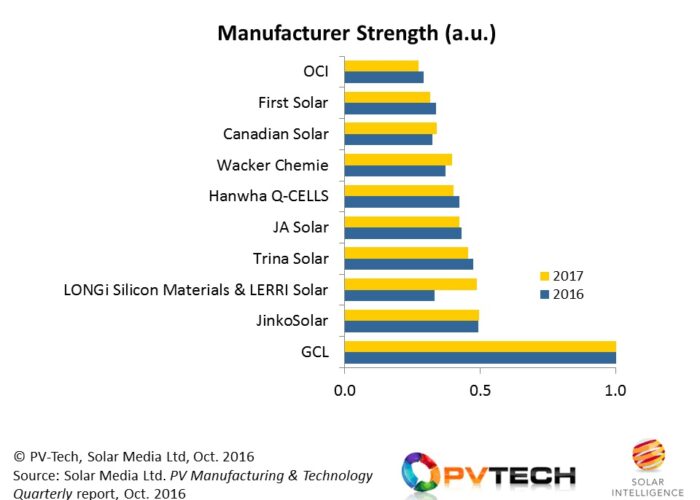
The entire solar PV upstream value-chain, including equipment and materials suppliers, is set for drastic changes during 2017, ushered in by a perfect storm of events that has impacted on the industry within a space of 2-3 months, according to the latest release of the PV Manufacturing & Technology Quarterly report from the research team of PV-Tech’s parent owner Solar Media, Ltd.
During the period 2006 to 2011, equipment spending for solar manufacturing was a really big deal for capital equipment suppliers. Companies such as GT Advanced Technologies (then GT Solar) and Applied Materials (serving thin-film and c-Si expansions alike) were clocking up billion-dollar plus backlogs.
Capital expenditure (capex) from solar PV manufacturers is set to decline during the first half of 2017, as the industry adjusts to the excess of new capacity having come online during 2015 and 2016, according to the latest findings in the PV Manufacturing & Technology Quarterly report, released July 2016.
Solar PV manufacturing in 2016 has seen the highest capex (capital expenditure) levels for years, and a return to capacity expansion plans. Furthermore, many of the companies announcing the capacity expansions are doing so for the first time, especially at the cell and module stage.