Recent analysis has underscored the world-beating economics of solar coupled with single-axis trackers. But for developers, choosing the optimal mounting is a highly project-specific calculation that may result in alternative configurations.
Market research firm Wood Mackenzie’s most recent comparative analysis of the global levelised cost of electricity (LCOE) of different power generation sources rated solar with single-axis trackers as the world’s most cost-competitive under the right conditions.
Try Premium for just $1
- Full premium access for the first month at only $1
- Converts to an annual rate after 30 days unless cancelled
- Cancel anytime during the trial period
Premium Benefits
- Expert industry analysis and interviews
- Digital access to PV Tech Power journal
- Exclusive event discounts
Or get the full Premium subscription right away
Or continue reading this article for free
In the Middle East and Africa, Wood Mackenzie said solar PV combined with single-axis trackers offered a world-beating LCOE of US$37 per megawatt hour.
This finding will reinforce what many in the industry have long observed: tracking systems deliver compelling economics in numerous markets worldwide. The data appears to support this conclusion—recent figures from Lawrence Berkeley National Laboratory reveal that 96% of US utility-scale capacity installed in 2023 utilised tracking systems, marking the highest share on record and underscoring trackers’ dominant position in large-scale solar deployment.
However, while the LCOE advantages of solar plus trackers are indeed substantial in many contexts, the reality facing project developers is more nuanced. The optimal system configuration depends heavily on local conditions that extend well beyond simple irradiance calculations.
Geography, climate patterns, land costs, topography, grid constraints and evolving project cost structures all play critical roles in determining whether trackers or fixed-tilt systems deliver superior project economics.
In the following perspectives, two industry experts examine this question from different angles. The first explores how regional characteristics—from the clear, bright skies of the southwestern United States and MENA region to the cloudy, high-latitude conditions of northern Europe—fundamentally shape the tracker-versus-fixed-tilt equation.
The second challenges conventional assumptions by arguing that recent shifts in component costs, particularly dramatically lower module prices relative to structural and installation expenses, warrant a fresh evaluation of high-density east-west fixed systems that may have been previously dismissed in favour of tracking alternatives.
Fixed-tilt vs. tracker: how LCOE varies across global markets
One question facing developers on every utility-scale solar project is deceptively simple: fixed-tilt or tracker?
The answer involves complex calculations around capital costs, energy yield, operational expenses, and site-specific conditions that vary dramatically by region. And this decision affects 30+ years of asset performance.
The LCOE equation
Levelised cost of electricity (LCOE) distils decades of project economics into a single
metric: total lifetime costs divided by total lifetime energy production. The calculation breaks into three components:
- Capital expenditure (equipment, installation labour, balance of systems)
- Operating expenditure (maintenance, monitoring, component replacement over 25-30 years)
- Energy production (total revenue generation across system lifetime)
- According to data from the National Laboratory of the Rockies in the US (formerly the National Renewable Energy Laboratory, NREL), trackers typically add US$0.15-0.35 per watt to upfront capital costs compared to fixed-tilt systems.
That premium buys motorised mechanisms, control systems and sun-following architecture to deliver 15-20% more annual energy output in high-irradiance regions.
In solar economics, more kilowatt-hours of production in the long term often outweigh higher capital expenditures – but not always. The mathematics varies dramatically by region.
Where trackers win: clear, bright skies
Direct Normal Irradiance (DNI) measures sunlight reaching Earth’s surface from the sun’s direct path. This determines how much trackers can capture, compared to what fixed-tilt systems already collect. DNI is maximised by clear skies, minimal cloud cover, and intense direct sunlight.
In these places, trackers spend most daylight hours at optimal angles and maximise the energy premium that justifies their cost.
Across the globe, some examples of ideal locations for trackers include:
- The southwestern United States
- The Middle East and North Africa (MENA), particularly desert regions
- Most of Australia
- Chile’s Atacama region
For instance, Saudi Arabia’s geography and climate make it ideal for trackers: intense direct sun, flat terrain suitable for large arrays and projects sized for maximum economies of scale.
Similarly, tracker-based PV systems in Arizona, Nevada and West Texas consistently deliver lower LCOE than fixed-tilt alternatives, even accounting for higher capital and O&M costs.
Recent Lawrence Berkeley National Laboratory data shows that 96% of US utility-scale capacity installed in 2023 used tracking systems, the highest share on record.
Moving beyond natural factors like weather, projects in regions with high curtailment rates also see improved LCOE from trackers. Trackers allow for more production during hours when electricity prices are higher.
In markets with high levels of curtailment and a pronounced duck curve, using trackers provides additional flexibility and improves the value of the generated energy.
Where fixed-tilt wins: high, cloudy, expensive latitudes, High-latitude regions typically don’t receive high DNI due to lower sun angles, especially in winter. Northern European countries like England, Ireland and Germany also experience frequent cloud cover, further lowering DNI.
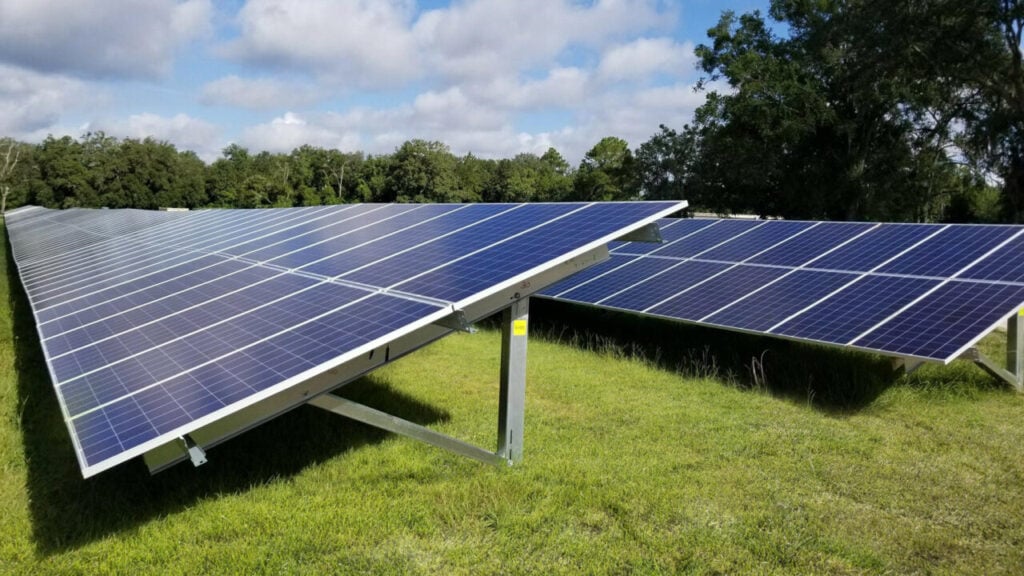
Land costs also factor into trackers’ cost-effectiveness. Tracker structures typically require wider row spacing, and thus more land. In expensive, low-DNI regions like Germany, fitting more modules into a given area with fixed-tilt racking can sometimes offset the energy-per-module boost provided by trackers.
On the other hand, southern European projects, especially in the Iberian peninsula, usually receive more DNI than their northern neighbours. Combined with a lower cost of land, trackers generally provide better LCOE in areas like Spain and Portugal.
Site-specific constraints
There’s a major caveat to the above characterisations of global regions: they’re all vast generalisations. Even within favourable fixed-tilt regions, individual site conditions can tip the economics toward trackers (or vice versa).
For instance, foundation requirements are impacted by multiple factors, including soil bearing capacity, rock depth, wind and hail exposure and groundwater levels.
Irregular topography, like steep slopes, can make fixed-tilt trackers more cost-effective, since they don’t have moving components and so can function with smaller, lighter foundations.
But again, this isn’t always the case. Terrain-following trackers now accommodate a wide range of topographies, and many trackers have robust wind-stow protocols for sites with sustained high winds (such as many coastal and high-elevation areas).
In fact, hail risk usually pushes developers towards trackers, since – unlike fixed-tilt systems – trackers can provide a hail-stow function that changes tilt angles to minimise damage.
For many owners, this ability to mitigate hail damage is a critical requirement, since a hailstorm can cause significant damage to the entire solar power plant – especially when modules are at the relatively flat angles common in most fixed tilt sites.
Finally, certain financial structures can make trackers the clear choice, regardless of topography or DNI levels. Grid interconnection constraints, or power purchase agreements with time-of-use pricing, can make tracker generation curves essential.
If a PPA rewards afternoon peak production, trackers’ extended generation into evening hours delivers added revenue that fixed-tilt systems just can’t match.
Estimated O&M costs
Fixed-tilt systems require minimal maintenance: structural inspections, occasional bolt retightening and panel cleaning in dusty environments. Barring extreme weather damage, these systems can operate for decades with negligible intervention.
Trackers introduce mechanical complexity with motors, actuators, gearboxes, controllers and sensors. Lubrication schedules, bearing replacement and electronic component failures add recurring costs.
Currently, tracker O&M can run 20-40% higher than fixed-tilt over project lifespans.
However, those costs must be weighed against the long-term energy premium trackers deliver. It’s often the case that a system producing 15% more energy, with 30% higher O&M costs, can still achieve lower LCOE than fixed-tilt, since the additional revenue exceeds the additional O&M expense.
Modern trackers also incorporate remote monitoring, predictive maintenance capabilities and self-diagnostic systems that flag component degradation before failures occur. These features make O&M costs more predictable, reducing risk premiums.
At GameChange, the vast majority of projects we deliver in the US include foundation design, engineering and supply.
That integration extends to how we think about our client’s long-term O&M, which influences whether we recommend a fixed or tracker system for a given project.
Bifacial gains
Trackers with bifacial modules create compounding benefits. As trackers follow the sun, they optimise both direct front-face irradiance and reflected rear-face irradiance from ground albedo.
The energy gained from combining these technologies exceeds that of either alone.
Fixed-tilt bifacial systems still capture rear-face irradiance, but the static angle limits how effectively panels harvest reflected light throughout the day. In high-albedo environments (snow, white gravel and desert sand), bifacial trackers can achieve 18-27% energy premiums over monofacial fixed-tilt.
As the bifacial module market share grows (now exceeding 50% of global shipments), this combined effect has accelerated tracker adoption globally.
Maximum energy isn’t always minimum LCOE
Maximum energy and minimum LCOE aren’t always the same outcome. For some sites, fixed-tilt optimises LCOE even though trackers would produce more total energy.
For marginal cases involving moderate irradiance, moderate land costs, or medium complexity terrain, deciding on fixed-tilt or trackers requires detailed financial modelling with site-specific inputs. A sensitivity analysis of key assumptions reveals which variables most affect the decision.
Developers increasingly use software tools that model both architectures with local irradiance data, real equipment pricing and site-specific installation costs.
These analyses reveal tipping points: the irradiance threshold above which trackers win, the land cost below which trackers outperform dense fixed-tilt arrays, or the PPA structure that makes afternoon generation curves essential.
What trends are changing the fixed tilt vs. tracker equation?
Several trends are reshaping the calculation between fixed-tilt and tracker systems.
Tracker costs continue declining as manufacturing scales and designs optimise. In many markets, the US$/watt premium that required 25% energy gain to break even five years ago, now breaks even at just 12-15% gain.
As this premium shrinks, trackers will deliver superior LCOE in more and more regions.
On the other hand, interconnection congestion and extended queue times increasingly reward projects that can energise quickly. Fixed-tilt systems’ simpler installation (often 20-30% faster than tracker deployment) can mean earlier revenue generation.
In certain cases where interconnection timing is critical, this speed-to-revenue can offset a lower long-term energy yield.
Energy storage integration also factors in. Battery systems paired with solar PV benefit from trackers’ extended generation curves, which spread charging across more daylight hours and reduce clipping losses during midday peaks.
As solar-plus-storage becomes standard, trackers’ value propositions strengthen, especially when combined with storage in regions with high curtailment rates.
We can make some broad generalisations for certain geographies – trackers usually win in bright, clear, relatively inexpensive regions like the southwestern US and MENA, while fixed-tilts are more suited for high, cloudy, expensive latitudes like northern Europe. But much of the time, there’s no cut-and-dried geography for fixed-tilt versus trackers.
The key is detailed site-specific analysis that balances upfront investment, long-term operational costs, speed to interconnection and realistic energy production projections. Every site deserves analysis that aligns with the system architecture and financial reality. That’s how projects achieve bankable LCOE projections that hold up over 30+ years.
Next week, we’ll continue the series with Henner Jahnke, chief sales officer at Jurchen Technology, exploring whether dramatically lower module prices relative to structural and installation costs warrant a fresh look at high-density east-west fixed systems over tracking alternatives.