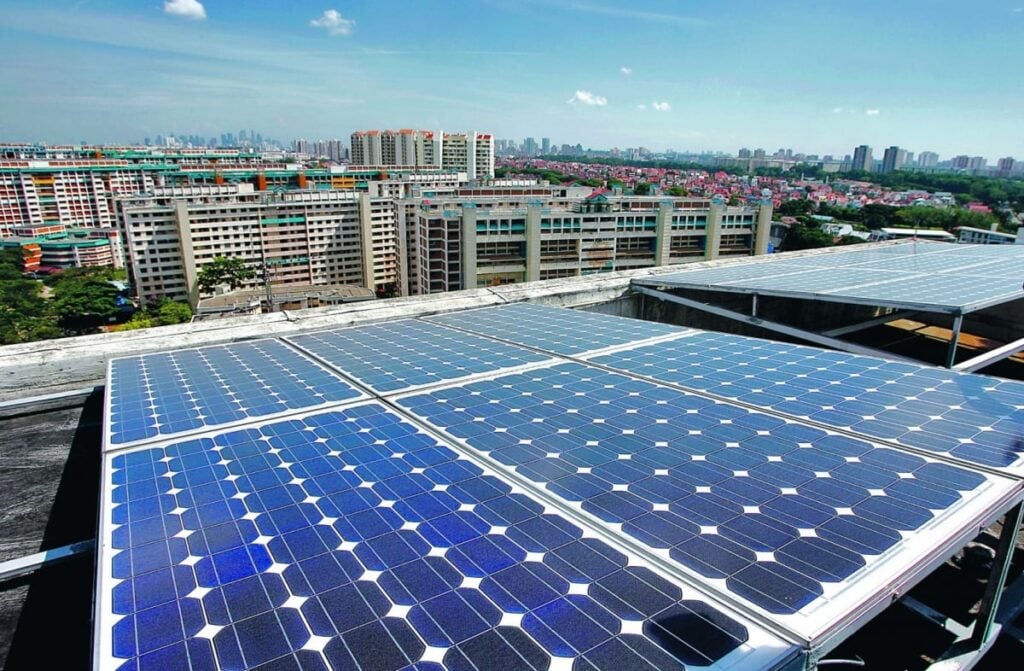
Singapore has raised its solar PV deployment target to 3GW by 2030 after reaching its previous 2GW target in 2025.
The Singapore Energy Markets Authority announced the 1GW increase yesterday, saying it “significantly advances Singapore’s transition towards cleaner energy sources”. The government said it would meet the target by looking to deploy solar on “all feasible rooftops, land and water spaces as well as exploring more innovative solar deployments such as overhang solar that could serve as shelters, canopies at open-air car parks, and other suitable areas.”
Try Premium for just $1
- Full premium access for the first month at only $1
- Converts to an annual rate after 30 days unless cancelled
- Cancel anytime during the trial period
Premium Benefits
- Expert industry analysis and interviews
- Digital access to PV Tech Power journal
- Exclusive event discounts
Or get the full Premium subscription right away
Or continue reading this article for free
The Energy Market Authority said it met the 2GW target by encouraging rooftop residential and commercial & industrial (C&I) solar adoption through its SolarNova, SolarRoof and SolarLand schemes, as well as the increasing cost-competitiveness of solar deployments. To date, rooftop solar accounts for around 80% of Singapore’s deployed capacity, the government said.
“Singapore is already one of the world’s most solar-dense cities, but we can do more,” said Puah Kok Keong, chief executive of the Energy Markets Authority. “Our new solar target reflects Singapore’s commitment to building a cleaner, more resilient energy system. This important initiative requires strong collaboration across government, industry and the community.”
Despite the raised target, the Energy Market Authority said that solar can “realistically contribute only up to around 10% of Singapore’s projected energy needs by 2050”. It said Singapore would pursue a “diversified energy mix … while ensuring energy security and the power system’s resilience.”
As a city state, Singapore is dominated by small scale solar—like residential and C&I installations—and innovative deployments that save on land use. In September, SembCorp, a Singapore-based engineering firm, unveiled plans to build an 86MWp floating solar installation on the country’s Pandan reservoir. It is also building a 150MW floating site on the Kranji reservoir in the north of the country.
Much of Singapore’s renewable energy supply is imported from other countries. A report from Rystad Energy said that Singapore could become the “core” of the Southeast Asian power system, as planned interconnection deals with neighbouring countries currently stand to bring 25GW of new renewable energy capacity online.