Data collection and analysis in solar PV installations is increasingly sophisticated and granular, particularly relating to grid interaction and weather forecasting.
One less commonly reported aspect of data collection is the Pyranometer, a small device resembling a large egg, which measures solar irradiation in real time at a PV project.
Try Premium for just $1
- Full premium access for the first month at only $1
- Converts to an annual rate after 30 days unless cancelled
- Cancel anytime during the trial period
Premium Benefits
- Expert industry analysis and interviews
- Digital access to PV Tech Power journal
- Exclusive event discounts
Or get the full Premium subscription right away
Or continue reading this article for free
Pyranometers allow you to understand “What’s actually happening in your PV park,” said Masaaki Hasegawa, general director at EKO Instruments, a Japanese producer of Pyranometers. Speaking at the Solar Quality Summit in Barcelona, he said that data collection from these instruments offers a different profile than satellite-based irradiation data, which he said can vary significantly.
Many PV project operators rely on some averaging of their irradiance data over time intervals, which Hasegawa said can make the variation in irradiance seem flatter or more uniform than it is in reality. He said that effectively deployed data from a Pyranometer can show the spikes and troughs in irradiance that are smoothed out by averaging the sun’s energy over time.
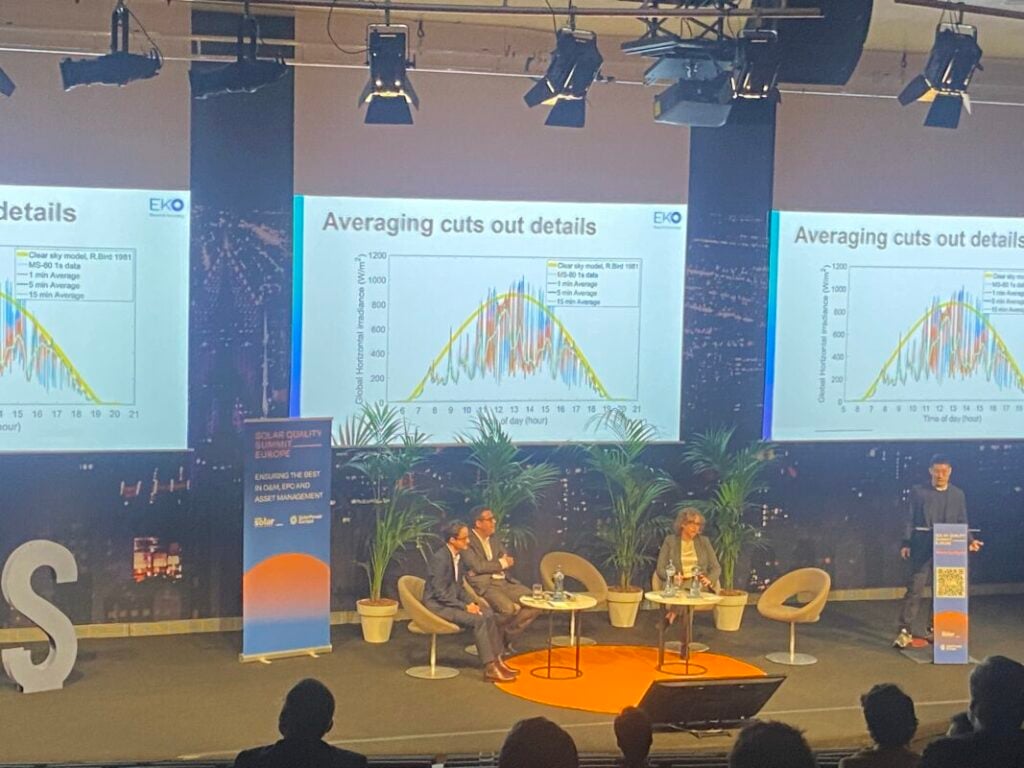
“‘These kinds of spikes can impact the operation of a PV park, because it can stress your panels and your inverters,” he said, adding that without knowledge of the details of irradiation, plant managers are unable to respond. If a PV system is paired with storage, “Instead of losing that electricity [resulting from an irradiance spike], you can charge your battery instead,” he added.
Installation and maintenance of Pyranometers and other such equipment is essential for accurate data and forecasts, Hasegawa said. The angle of a Pyranometer in particular, which is sensitive to tilt, is “crucial in order to improve the quality of your data and analysis and forecasting,” he added. “You cannot just assume that having a pyranometer means you can get really good quality data.”
‘Weather is chaotic’
But weather forecasts are still the biggest limitation in current PV forecasting, said Pierre-Jean Alet, group leader of digital energy solutions at CSEM.
“There will never be a perfect weather forecast,” he said. “The challenge is how to manage that uncertainty. We should incorporate uncertainty.”
Managing that uncertainty can come down to both data quality and the forecasting method, Alet explained.

“We need to have high-resolution data, otherwise everything gets smoothed out. Weather is chaotic, and there will remain uncertainties with the best possible forecast. With intra-day forecasting [as well as day-ahead forecasts] you can reduce your uncertainty gradually and take positions on the market [accordingly].”
AI models are used increasingly often for weather forecasting, and Alet said that they are often very useful. However, he said that AI is not yet a replacement for very localised and specific forecasts for a particular PV plant.
“Good weather forecasting for every square meter of the planet” is something that remains “decades” ahead, added Oriol Salto i Bauza, chief data scientist at AleaSoft.
Outside forces
Bauza said that AI has made “great advances in forecasting for weather and PV plant performance, but that there are still limitations; chiefly, grid curtailment.
“There are things that cannot be understood just with AI. Curtailments, for instance,” he said. An operator can know the details of their own plant intricately, even including the weather forecast for the area, “But then there are the outside components; how much of your PV production is the grid going to accept?
“This is something that’s not usually well-identified in the data,” said Bauza, citing instances where an AI system may mislabel or ignore the possibility of curtailment. “If you don’t correctly identify a grid curtailment of a fraction of your power output, it’s going to appear as an error in your forecast,” he said. “Things that are outside your reach are the things that are not correctly identified.”