The world is entering an ‘electricity-led era’, with solar PV set to become the globe’s largest electricity generation technology by 2032, according to Bloomberg New Energy Finance (BloombergNEF).
Electricity will account for two-thirds of new energy demand from now to 2050, driven by demand from electric vehicles, data centres and wider electrification across economies, BloombergNEF said in its New Energy Outlook 2026 report.
Try Premium for just $1
- Full premium access for the first month at only $1
- Converts to an annual rate after 30 days unless cancelled
- Cancel anytime during the trial period
Premium Benefits
- Expert industry analysis and interviews
- Digital access to PV Tech Power journal
- Exclusive event discounts
Or get the full Premium subscription right away
Or continue reading this article for free
The report highlighted the growth of data centres in particular, which hit 84GW of capacity in 2025, a 20% increase year-on-year consuming 500TWh of electricity, or 1.9% of global total demand. BloombergNEF expects data centre demand to more than double by 2050, ultimately consuming one tenth of global electricity demand.
In the next six years, solar PV will become the largest single electricity generation technology in the world, the report says. This is because of the huge reductions in the cost of solar equipment and generation in recent years, and what BloombergNEF called “massive overcapacity” in the solar sector.
Global grids are also set to become more flexible over the next decade – something essential to expanding renewable energy capacity and managing demand. “A larger, more dynamic power system requires increased flexibility from both supply and demand,” said BloombergNEF. “By 2035, some 11% of megawatt-hours generated are shifted, up from 3% today.”
The report points out that there is currently no new viable low-cost energy technology set to take over from solar PV and battery energy storage, despite “billions” in government support and US$0.5 trillion in corporate equity for startups and other firms. “Hopes are high for new nuclear, geothermal or storage technologies, but none has been proven sufficiently at scale – yet,” the report said.
“As EVs, data centres, population growth and industrial activity spur electricity demand, the world is in a race to meet rising energy demand with the most efficient, least-cost technologies,” said Matthias Kimmel, head of energy economics at BloombergNEF. “[the New Energy Outlook] shows that solar becomes the world’s largest generator overall by 2032, while storage jumps 17-fold to 3.8 terawatts by 2050, underscoring how clean technologies are increasingly critical to energy security, system flexibility and meeting the world’s growing power needs.”
Global fossil fuel crisis
In the short term, BloombergNEF said that continued rapid deployment of clean energy technologies could allow nations across the world to “cut their reliance on imported fossil fuels and ultimately strengthen their energy security.”
The three major shocks to the energy economy in the last decade – COVID-19, the full-scale invasion of Ukraine and the current Iran-US-Israel war – have made the case for reducing structural reliance on fossil fuels and imported energy. BloombergNEF said that the current situation, “Far more so than in previous energy crises, many countries that are dependent on fossil fuels are able to reduce their economic exposure to energy commodity imports by adopting low-carbon technologies.”
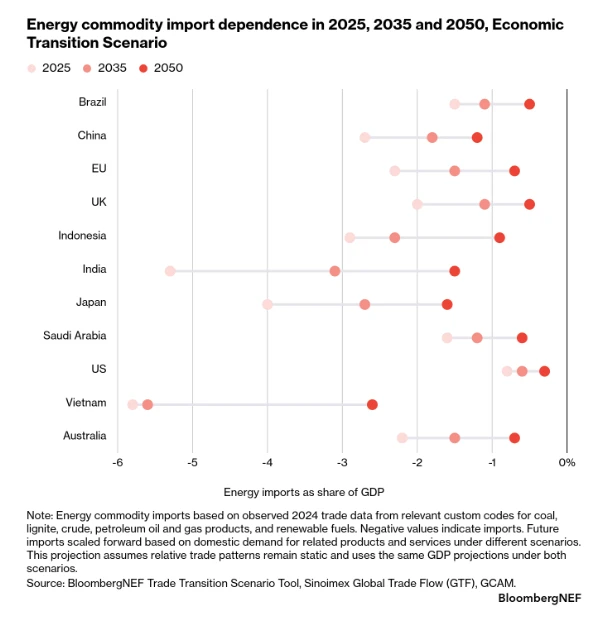
The biggest importers, like Vietnam, Japan, India and Indonesia, stand to gain the most in GDP terms from reducing energy imports as each spent between 3% and 6% on energy imports in 2025. Europe and China – 2.3% and 2.7% of GDP spent, respectively – also stand to gain considerably, while net exporters like the US and Saudi Arabia will also “modestly” reduce their import spends, the report said.
“We’re living in another moment of crisis, but unlike in past decades, today there are real options for countries to react,” said David Hostert, chief economist at BloombergNEF. Data from SolarPower Europe this week showed that the continent’s existing solar PV fleet has saved around €10 billion in avoided gas imports since the outbreak of the Iran war in March.
“We now have viable technologies that can be deployed at scale and fast, at an overall lower cost to the system than the fossil fuel technologies that used to be the primary choice. Through clean power and electrification we can strengthen energy security and reduce harmful emissions along the way,” Hostert said.