Developers of co-located solar-plus-storage projects need to identify the challenges faced by offtakers, and ensure their projects are designed to “solve” them.
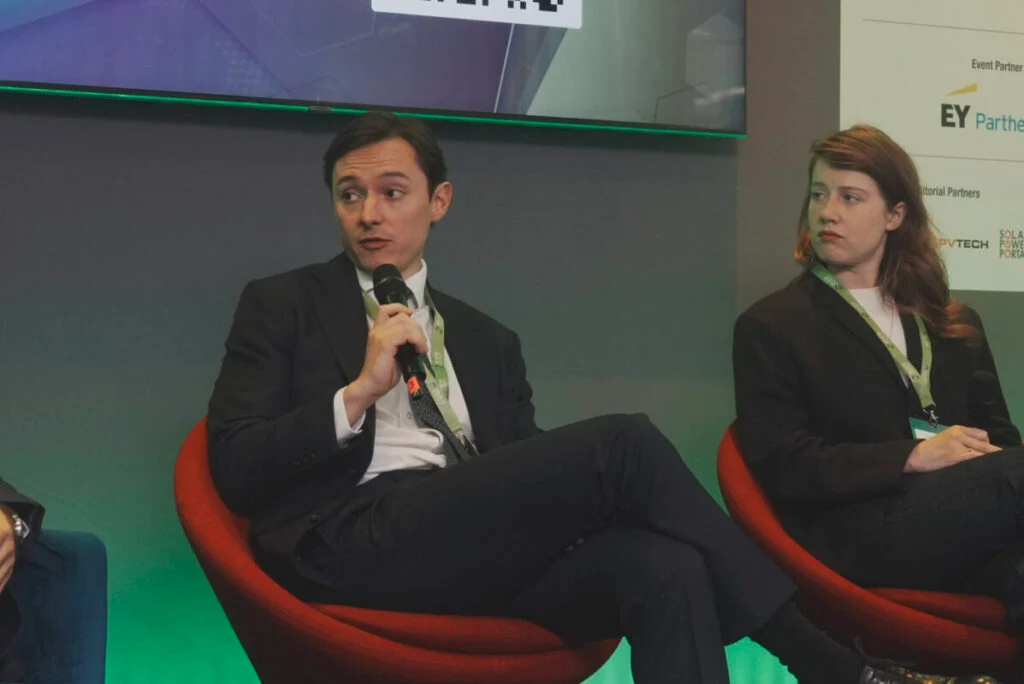
This was the opinion of James Phillips, vice president of energy at Brookfield, who spoke on a panel discussion this morning to kick off the second day of the Renewables Procurement & Revenue summit in London. When asked about the challenges faced by developers of projects that incorporate a range of renewable energy technologies, such as solar PV and battery energy storage systems (BESS), Phillips suggested that the primary focus should be on answering this fundamental question, before aiming to tackle the more specific technical challenges.
Try Premium for just $1
- Full premium access for the first month at only $1
- Converts to an annual rate after 30 days unless cancelled
- Cancel anytime during the trial period
Premium Benefits
- Expert industry analysis and interviews
- Digital access to PV Tech Power journal
- Exclusive event discounts
Or get the full Premium subscription right away
Or continue reading this article for free
“The really key question, though, is ‘what does the offtaker landscape look like?’ and what problem are you actually aiming to solve for them?” he said.
“Of course a hybrid power purchase agreement (PPA) is going to be more complicated to do than a solar only or a wind only [PPA] as we’ve now got an additional asset to manage,” he continued, echoing sentiments expressed on the first day of the event that PPA negotiations have become increasingly complex in Europe.
Pierre-Louis Raust, director of development at Power Capital Renewable Energy, described BESS projects, both standalone and co-located, as a “very highly technical product … because it has import and export and, depending on the use case, you will degrade it faster or slower”. BloombergNEF’s Sonia Grunenwald delivered a presentation at the summit yesterday covering the complexities associated with batteries, and particularly in terms of the sophisticated revenue stack required to turn a profit from a BESS project.
Sarah Montgomery, co-founder and CEO of Infyos, also said that developers with expertise in solar PV and BESS need to ensure they have a firm grasp of the intricacies of co-location: “There’s a lot of developers that have a very strong track record in PV moving into co-location. On a technology side there’s complexity that comes with BESS … does the developer understand the interplay of the different systems?”
“My observation is that there’s this duality between risk and risk mitigation in hybrid [projects]; in one part you’re trying to get closer to the profile that the customer wants and you get more flexibility, but on the other hand you introduce a whole new set of technical complexity and contractual complexity,” said Mark Augustenborg Ødum, co-founder and CFO at Better Energy, echoing this idea of co-located projects bringing additional complexity.
‘Absorb the risk of volatility’
The panellists also agreed that many of these complexities can create challenges in the long-term; as Augustenborg Ødum said, “you don’t know how the market is going to develop in the future [where there are] risks that you don’t know; it’s hard for bankability.”
“One thing I think is very important is that from a seller perspective, these deals are now much more complex to model on a long-term basis,” added Phillips. This uncertainty was picked up on by On Site Energy’s Martin Gaffney, who gave a presentation on the first day of the event that his company has become more involved in short-term PPAs, as short as four years, in part because of the challenges associated with modelling revenues in such a market over the long-term.
Raust said that there is a fundamental mismatch between the “static document” of PPA frameworks and the “dynamic environment” of the European energy mix amid the energy transition.
“A 15-year PPA shouldn’t be trying to predict the market viability,” he explained. “Instead, for me, it should try to be robust enough to absorb the risk volatility of the market evolution and not destroy the bankability.”
This week’s Renewables Procurement & Revenue Summit, held from 20-21 May in London, is hosted by PV Tech publisher Solar Media. The event covers PPA design, tackling high energy prices and more; for more information, including the full agenda and ticket options, visit the event website.