Europe has avoided €10 billion in gas imports since the start of the Iran war thanks to power generated from its solar PV fleet, according to research from SolarPower Europe.
The research said that in March, avoided imports reached €110 million (US$128 million) per day, with a cumulative saving of €3.76 billion over the course of March.
Try Premium for just $1
- Full premium access for the first month at only $1
- Converts to an annual rate after 30 days unless cancelled
- Cancel anytime during the trial period
Premium Benefits
- Expert industry analysis and interviews
- Digital access to PV Tech Power journal
- Exclusive event discounts
Or get the full Premium subscription right away
Or continue reading this article for free
Gas prices have skyrocketed since the outbreak of the US/Israeli war with Iran and the subsequent closure of the Strait of Hormuz shipping lane. European gas futures peaked at €60/MWh in March, double the average of the prior months.
SolarPower Europe said that with €10 billion, the EU could build another 8GW of solar PV capacity or more than 44GWh of utility-scale battery energy storage capacity, “more than three times” the capacity installed across the continent last year.
Walburga Hemetsberger, CEO of SolarPower Europe, said: “The full costs of the energy crisis are still to be measured, but it is a price Europe shouldn’t have to pay. Solar is showing the benefits of a renewable-first energy system. The savings since 1 March are equivalent to Belgium’s recent annual defence budgets.
“This is just a sample of what is possible. The energy crisis following the invasion of Ukraine is estimated to have cost 1.7 trillion EUR as bills spiked and governments looked to shield billpayers. Cutting the impact of gas on wholesale power prices must now be a priority.”
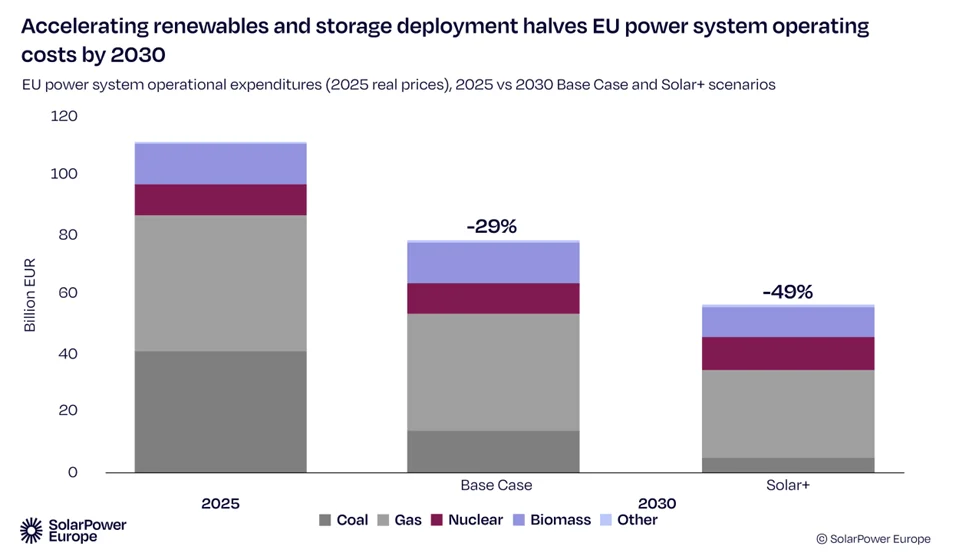
The group said that increasing grid system flexibility through measures like energy storage, thus allowing for greater renewable energy deployment and electrification, is a “strategic necessity” to reduce Europe’s vulnerability to international energy shocks. It said that over the course of 2026, power from Europe’s renewable energy fleet would avoid “tens of billions” in gas imports, depending on how prices evolve.
“By adding more non-fossil flexibility in our system we can reduce the impact gas has on setting electricity prices. [the grid flexibility package] AccelerateEU is the first step, but we need concrete measures that can rapidly encourage higher levels of deployment and deeper electrification of our society and economy,” added Hemetsberger.
While the case for renewables in light of increased volatility is clear on paper, there are growing structural challenges to the sector. A report from energy think tank Ember last month found that grid constraints could put up to 120GW of renewable energy projects at risk by 2030. We have also heard that the appetite for standalone solar projects has faded (subscription required) across the continent, pushing developers towards more complex and challenging hybrid and energy storage projects.