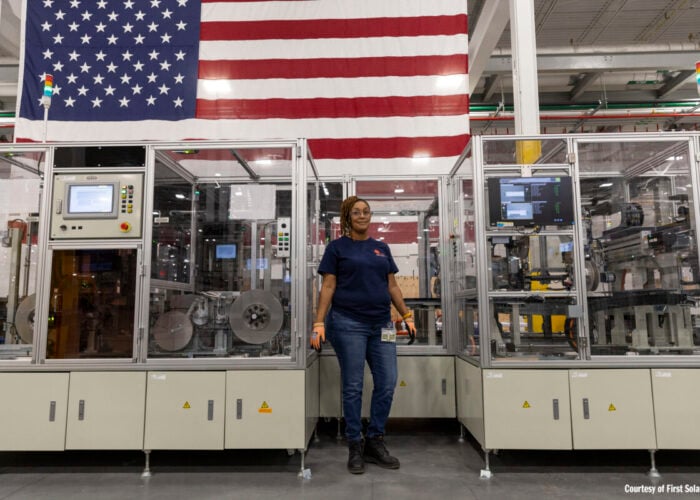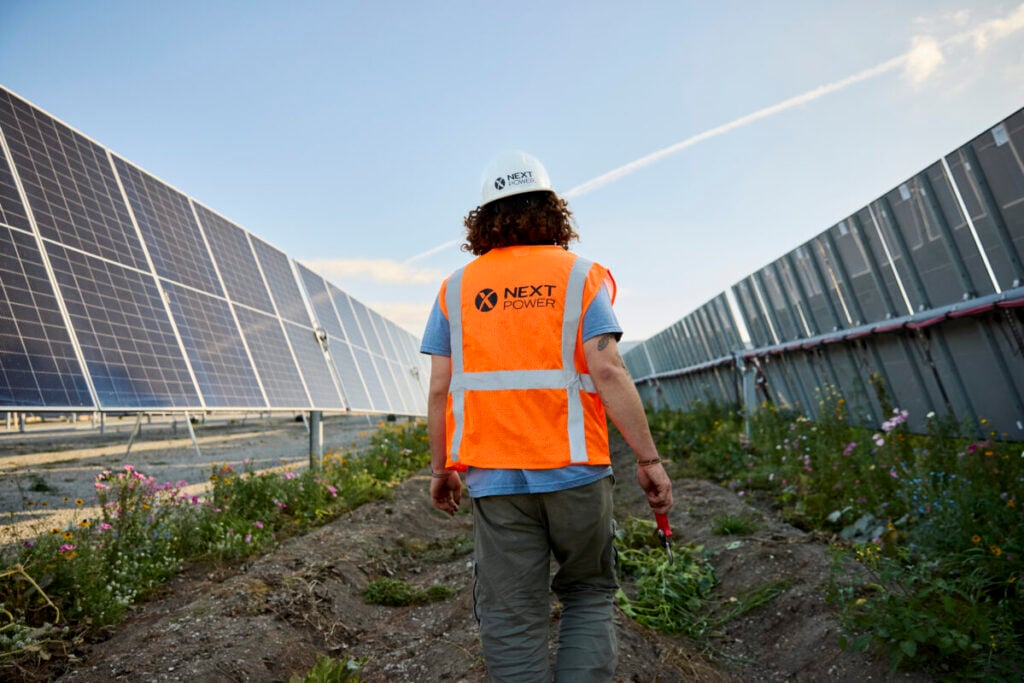
Tracker producer Nextracker has rebranded as Nextpower to reflect the wider portfolio of products and services it now offers. Tom Kenning examines the extent to which this move indicates a broader shift by tracker companies towards becoming integrated solutions providers.
For years, the solar tracker industry has enjoyed the comfort of everincreasing expansion and growth, but as the market matures and margins narrow, there are signs that tactics are changing. The largest companies have begun a series of acquisitions that extend beyond their traditional pureplay tracker offerings to encompass other parts of the value chain, from foundations to AI software.
Try Premium for just $1
- Full premium access for the first month at only $1
- Converts to an annual rate after 30 days unless cancelled
- Cancel anytime during the trial period
Premium Benefits
- Expert industry analysis and interviews
- Digital access to PV Tech Power journal
- Exclusive event discounts
Or get the full Premium subscription right away
Or continue reading this article for free
Competition is also heating up. To date, the tracker market has been dominated by two manufacturers, US-based Nextpower (formerly Nextracker) and Array Technologies, but Gamechange Solar swooped in this year to become the second largest provider in the US over Array, while Chinese company Arctech has established itself as a major player in the rest of the world.
While global solar tracker market fundamentals appear robust with an expectation to reach more than US$8.3 billion in 2025, according to S&P Global Energy forecasts, there are drivers to pivot strategies.
“Despite this large market, leading solar tracker suppliers are rapidly expanding their portfolios to serve a larger part of the total capex of utility-scale solar given the highly competitive environment in 2025,” says Cormac Gilligan, director, clean technologies and supply chains, at analyst firm S&P Global Energy.
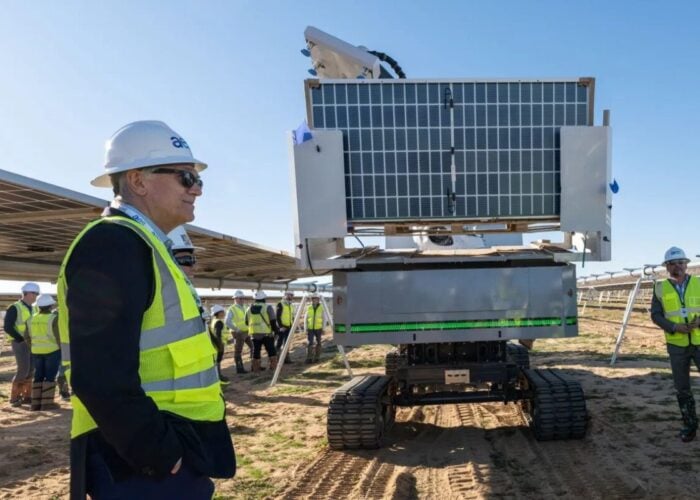
Solar tracker suppliers in particular have expanded into new product offerings such as robotics, transformers, module frames and electrical balance of system (eBOS), which encompasses cabling and combiner boxes. Furthermore, tracker firms have invested in sophisticated software and AI capabilities to tackle challenges such as shading or major weather events, including hail and extreme wind conditions.
S&P Global expects this trend of expanding product portfolios to accelerate in the coming years as leading players seek to grow their revenue streams beyond solar trackers only, says Gilligan.
Meanwhile, there are also domestic content drivers at play in the US, regulatory pressures and overall PV supply chain volatility, along with the possibility that market demand could be shifting towards integrated solutions.
Tracking Nextpower
The recent headline development encapsulating the portfolio expansion trend was the news in November 2025 that the world’s largest solar tracker company, Nextracker, had rebranded to Nextpower and is now touting its ability to deliver “an integrated portfolio of advanced technologies”. The news came after the company had made several acquisitions, including the foundation company Ojjo, the eBOS company Bentek and the steel module frame firm Origami Solar, among others, and after spending more than US$40 million on three AI and robotics technologies.
The question of what is driving this behaviour is multifaceted. The overt attraction of offering a one-stop shop solution for customers could be seen as a response to market demand. However, it could also be viewed as a strategic diversification to bring in new revenue and protect against the maturing of the tracker market, or even an offensive move to disrupt traditional models of sourcing components and services individually.
Array has even followed Nextpower’s lead and bought Ohio-based racking and foundations company APA Solar, also touting it as a chance to offer integrated solutions.
EPCs traditionally had to source multiple individual components from modules and inverters to frames, foundations, trackers and software. But Nextpower’s transformation could spearhead a shift to EPCs now only having to secure modules in isolation, with the rest of the system delivered in one package. Nextpower even plans to include power conversion in its integrated offering next summer.
Howard Wenger, president of Nextpower, emphasises that the company’s products are still very much available “à la carte”, so purchasing a fully integrated system solution is not mandatory. He also stresses that the company is still “maniacally investing” in trackers to continuously improve them, while pouring a substantial US$100 million a year into R&D for many of the same products that it has been acquiring.
Must all tracker firms follow suit?
Asked whether the move to a fully integrated technology platform provider would force the hand of other tracker companies to do the same, Wenger declines to forecast how other firms will react, but says the move makes sense to Nextpower’s customers, many of whom he says have been asking the company to deliver even more offerings for some time.
Since the global tracker market will not continue growing at double-digit annual rates as it has been, more revenue pressure will be put on vendors across all regions, says Joe Shangraw, solar supply chain analyst at market research firm Wood Mackenzie. Especially as tracker prices get driven lower and lower by this competition, it would be logical for companies to look outwards towards neighbouring industries. Moreover, since many components such as foundations, eBOS and frames can interface with one another, bundling component sourcing together can bring about benefits in procurement, design and warranty.
Shangraw claims that Nextpower is uniquely positioned to pull this off as the world’s number one vendor with its growing margin not only in the US, but also in Europe, Australia and several other key markets. Other companies do not have the ability to introduce more products into so many more new markets and to new EPCs, he says.
As a case in point, Wenger has evidence demonstrating the power of combining the tracker platform with other technologies. Despite being early days for the bundled solution, last quarter, Nextpower had record sales for eBOS, even when including the 40-year history of Bentek whom it had only just purchased. It also had records for foundations, new customers and robotic inspection services.
For other firms, however, Shangraw says “a diversifying investment just doesn’t make as much sense if you’re currently worried about losing tracker market share in 2026, which almost everybody besides Nextpower is”.
“A few more acquisitions are likely, but I don’t expect it to snowball into an industry-redefining trend,” Shangraw concludes. “With global demand no longer growing everywhere, but rather ebbing and flowing across markets year-to-year, the name of the game is ‘flexibility’. Whether you try to reach that through more BOS offerings, or by diversifying your manufacturing, tracker functionalities and sales footprint.”
‘Flight to quality’
The switch to integrated solutions can both simplify interactions with an EPC and offer comfort in terms of warranty to a PV project owner as one company is responsible. Wenger explains that, whereas Nextpower used to only transact with EPCs, the wants and needs of owners are taking increasing precedence. Plant owners now want intelligent control capabilities, such as Nexptpower’s proprietary TrueCapture software, to optimise plant yield or hail prevention technology to protect the plant for years to come.
Solar energy was also the number one source of new power generation in the US for the last two years, which means that billions of dollars are at stake.
“That’s amazing, really, if you’ve been in our industry for a while, but that reflects a lot of money flowing in and a lot on the line for the owners to deliver the power,” says Wenger. “So, there’s been this flight to quality.”
One-stop-shop pros and cons
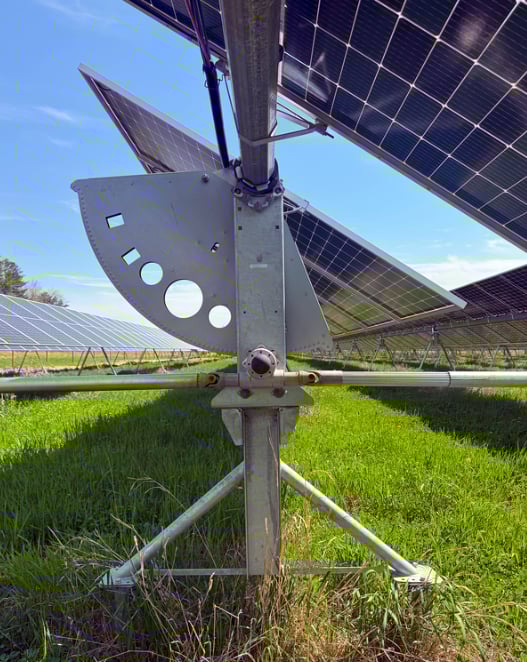
While individual components are still available to buy in isolation, the messaging is moving away from pure-play offerings towards integrated solutions. However, not everyone wants their technology choices made for them.
Donny Gallagher VP of engineering at US-based EPC Solv Energy, says it’s reasonable to suggest that Nextpower and Array are trying to increase market share and boost attractiveness to contractors with integrated solutions, but this move has “pros and cons”.
Smaller EPCs with less experience can now engage Nextpower for a “one stop shop” with racking, foundations, eBOS all in one. But, for larger, more experienced EPCs this might be seen as a limitation of options. A company like Solv, which is familiar with most solutions available, may prefer to find the “sweet spot“ of technology combinations on its own terms. So, integration may look attractive from a cost
perspective, but by limiting options, it may prevent finding the best engineering solution, as far as an EPC is concerned.
“It also puts all of our eggs in one basket, which personally makes me almost a little concerned,” Gallagher adds. “There’s more risk there.”
Nonetheless, Wenger says the diversification and pivot towards integrated solutions is “not a defensive move” but an “offensive move”, mainly in response to its existing customers asking the company to offer more technologies.
Reducing one million components from 500MW plant
A powerful example can be seen in the firm’s acquisitions of two foundation companies, Ojjo and Solar Pile International (SPI). By integrating the foundation into the tracker, Wenger says Nextpower was able to remove a million components—fasteners in this case—per 500MW system, leading to lower capex and a 20% faster installation.
Projects are now so huge that delivering correct design, engineering, installation and operation all in one will become increasingly attractive, Wenger says.
Nor is Nextpower’s strategy a response to supply chain and regulatory pressures, since it already has a “robust” supply chain with “super on time delivery”, Wenger claims.
Giving an EPC more confidence that components will arrive on time and in the correct location could “arguably” allow them to manage their workforce on site more cost effectively, says Mark Gibbens, GameChange Solar’s CFO and head of strategy. Keeping the labour force fully deployed through this clarity is “value additive”.
GameChange itself stands out from Nextpower and Array because it started out as a fixed-tilt company in 2013, so nowadays more than 85% of its tracker deliveries include the foundations—demonstrating an already well-established integration. It has also just built a medium voltage transformer factory in India, benefitting from the cheaper costs of self-build versus acquiring a company outright.
Domestic content bonus
With the Foreign Entities of Concern (FEOC) rules coming in in the United States and the carrot of domestic content tax credits, ‘Made in America’ is a big deal in the PV industry. In this light, a supply deal with US module manufacturer T1 Energy can now be leveraged to combine panels with Nextpower steel frames.
“It’s steel, it’s lower carbon and it’s made in the US,” says Wenger—adding that this delivers an extra 6 percentage points for domestic-content credits. However, he also states that these credits were not the driving force in these specific deals.
Elsewhere, the main rationale for Array’s “consolidation” through buying APA Solar is to provide value to the customer through integration of both design and multiple product offerings, as well as increased efficiency in installation, says Aaron Gabelnick, chief strategy and technology officer.
APA Solar was particularly attractive as a proposition due to its “market leading” ability to work in difficult subsoil conditions, both with fixed tilt and tracker applications. As an added bonus, with its American-made products, APA Solar is eligible for 45X domestic manufacturing tax credits, says Gabelnick. Array aims to launch a commercial integrated solution by mid-2026, combining APA’s A-frame systems with Array’s trackers.
Gabelnick believes that being able to offer integrated products to customers at a reasonable price and with ease of installation puts such players in a “differentiating, winning position”.
It’s not just EPCs that could benefit, but also the suppliers of niche services, design or solar equipment. Shangraw says that such companies would have an interest in working with a firm like Nextpower, as it could mean immediately being placed on “approved lists”, getting more contacts and breaking further into a difficult marketplace.
“It’s starting to create this circular trend where it appears to be paying off to some extent,” he adds.
While domestic content is not the main driver, it can create added revenue opportunities and make life easier for an EPC. Shangraw says only a small percentage of overall projects are going to have a 100% domestic supply chain, with many electronic components and motors still imported, and many even from China.
From hardware to solutions
The cleantech industry is rapidly requiring a ‘one stop shop’ or supplier partners that provide multiple components to facilitate easier procurement, faster supply and installation time, as well as simpler servicing procedures, says Gilligan. The PV industry is moving swiftly towards being solution providers rather than just hardware providers to help navigate challenging manufacturing localisation requirements, tariffs and meet more stringent grid and cybersecurity protocols.
“Companies that can provide a wider portfolio not only increase stickiness with the customer but can also generate margin in new products that they expand into offerings,” Gilligan adds. “As developers and EPC firms now have to consider no longer just offering solar but also battery energy storage, wind and green hydrogen, the need for simplifying the vendor offering will accelerate through the coming years.”
Ultimately, Nextpower has the advantage of working with a much larger budget than other tracker firms and has been targeting the “disruptor” side of the market with its acquisitions, says Shangraw. Origami and Ojjo for example, offer relatively unique products and “there is not an infinite supply of disruptors worth a potentially risky investment”, he adds.
Therefore, although there are movements towards integration, Shangraw does not foresee Nextpower or any other players taking an exclusive one-stop-shop direction anytime soon.
“There is so much project-to-project variety in equipment requirements depending on your site layout, country, labour costs, weather risks, etc, that you would need to offer dozens of solutions to actually be attractive with your in-house offerings,” he explains—while also noting that Nextpower is unlikely to be anywhere near the tens of gigawatts of capacity of these new products it would need to match its tracker manufacturing capacity.
However, industry needs are changing. Wenger says: “It’s a very fragmented solution set out there now, and we think customers are going to want a whole car, not the pieces of the car, and then put it together. But we’re not displacing EPCs—we’re trying to enable them to be better [and] we’re going to work with them the same.”
Trackers worldwide
“I’m hearing from a lot of players that pricing pressure globally is at an all-time high; some markets, more than others,” says Shangraw. “So, I think introducing new non-tracker products is one of the best ways to go.”
“Nextpower has the best of both worlds right now, because they are still seeing global growth a lot, because they are stealing market share.”
For now, the global stage remains competitive, with Chinese firm Arctech and US firm PV Hardware contesting with Nextpower, Array and Gamechange Solar. Arctech had a particularly strong start to 2025 and has established itself in the Middle East and India.
“Ultimately, over time, there’s always going to be good competition,” says Gibbens. “Even in the United States, where three companies have over 90% market share, there’s intense competition.”