SolarWorld using two OEM subcontractors as capacity constraints hit

Facebook
Twitter
LinkedIn
Reddit
Email
SolarWorld has started using two module assembly subcontractors to boost capacity to meet demand in the US and Europe, according to the company’s first half 2016 financial report.

Integrated PV manufacturer SolarWorld has started using two module assembly subcontractors to boost capacity to meet demand in the US and Europe, according to the company’s first half 2016 financial report.

In the financial filing, SolarWorld noted that its existing module assembly facilities in the US and Germany were operating at 100% utilisation rates, while its dedicated 72-cell module line at its facility in Hilsboro, Oregon was still in the production ramp phase.

This article requires Premium SubscriptionBasic (FREE) Subscription

Try Premium for just $1

  • Full premium access for the first month at only $1
  • Converts to an annual rate after 30 days unless cancelled
  • Cancel anytime during the trial period

Premium Benefits

  • Expert industry analysis and interviews
  • Digital access to PV Tech Power journal
  • Exclusive event discounts

Or get the full Premium subscription right away

Or continue reading this article for free
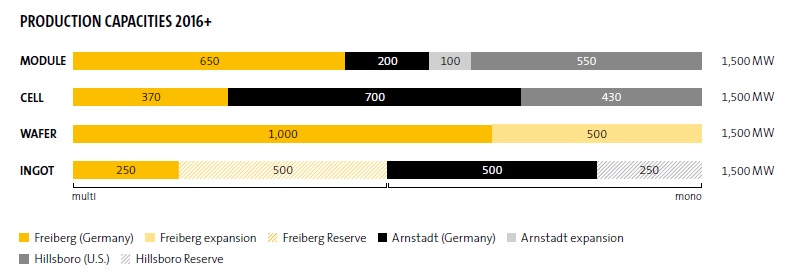
 SolarWorld has a balanced capacity of wafers, cells and modules of 1.5GW at the end of the June, 2016. Image: SolarWorld

As a result of capacity constraints, recently highlighted by PV Tech, SolarWorld has been using a major Canadian headquartered EMS (Electronics Manufacturing Services) firm with a module assembly facility in Thailand to supply PV modules to the US, while employing a US headquartered EMS firm with a facility in Europe to supply modules across the region. 

SolarWorld also noted in the financial filing that the modules were multicrystalline and supported higher in-house utilisation of its wafer production facilities, lowering production costs. The company noted that it had started using subcontractors since June, 2016. 

Checks by PV Tech indicated that SolarWorld could be using Canadian EMS firm, Celestica in Thailand and US EMS firm, Jabil Circuit in Poland. 

Export data indicates SolarWorld was shipping modules from Celestica in Thailand to the US since March, 2016.

Read Next

July 16, 2026
LONGi’s has unveiled a suite of new technologies intended to demonstrate how the PV industry can innovate its way out of its current malaise.
July 16, 2026
In the second of a two-part post, Moustafa Ramadan, head of PV Tech Research, explores the increasingly complex risks associated with solar cell procurement in the US.
Premium
July 15, 2026
US module and soon-to-be cell manufacturer T1 Energy is looking beyond wafers and cells to catalyse domestic production of ancillary components such as glass, frames and even pallets—while tapping semiconductor industry talent to staff its expanding operations.
July 13, 2026
JinkoSolar has announced a senior management change as the company continues to struggle with losses.
Sponsored
July 13, 2026
Dylan Middleton and Ruiqi Hua of JA discuss the importance of traceability, decarbonisation and circularity in PV module manufacturing.
July 9, 2026
The latest Silicon Industry Branch figures indicate continued weakness in the Chinese polysilicon market this week, though the decline slowed markedly.

Upcoming Events

Solar Media Events
October 13, 2026
San Francisco Bay Area, USA
Solar Media Events
November 3, 2026
Málaga, Spain
Solar Media Events
November 24, 2026
Warsaw, Poland
Solar Media Events
April 20, 2027
Istanbul, Türkiye