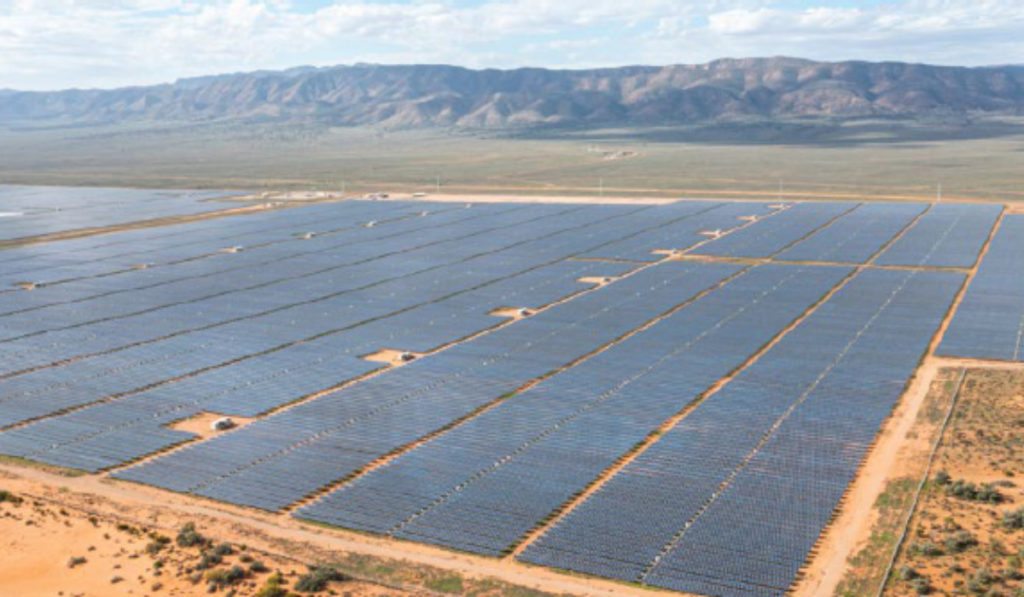
South Australia has opened applications for renewable energy feasibility licences across more than 11,000 square kilometres of land with some of the state’s highest coincident wind and solar resources.
The South Australian government is inviting investors to bid for land in two release areas, Gawler Ranges East and Whyalla West, with the combined territory spanning an area twice the size of Kangaroo Island.
Try Premium for just $1
- Full premium access for the first month at only $1
- Converts to an annual rate after 30 days unless cancelled
- Cancel anytime during the trial period
Premium Benefits
- Expert industry analysis and interviews
- Digital access to PV Tech Power journal
- Exclusive event discounts
Or get the full Premium subscription right away
Or continue reading this article for free
Applications are open until 28 June, providing a 13-week tender period for prospective developers to prepare bids and engage with native title holders on agreements.
The Gawler Ranges East release area comprises approximately 5,200 square kilometres on the Upper Eyre Peninsula, while the Whyalla West release area spans around 6,500 square kilometres in the Upper Spencer Gulf region.
Estimates suggest the areas could host renewable energy projects, though the government has not disclosed specific capacity targets in megawatts or gigawatts.
The tender represents a technology-agnostic approach to renewable energy development, allowing applicants to propose any technology type.
Investors are invited to propose how they would optimise the use of land and the renewable energy resources in the release areas, potentially incorporating solar, wind, energy storage or hydrogen production facilities.
This flexibility aligns with South Australia’s broader energy transition strategy, as the state’s electricity demand is projected to surge toward 50TWh by 2040, driven by green steel production, data centres and hydrogen manufacturing.
The tender operates under South Australia’s Hydrogen and Renewable Energy Act 2023, an Australian-first legislative framework that provides a pathway for the sustainable and strategic development of land for renewable energy purposes.
Under the Act, areas of pastoral land, certain Crown land, and state waters can be declared suitable for renewable energy development, creating a structured process for large-scale project deployment while ensuring proposed developments support local and regional needs, optimise land use, and co-exist with existing land uses.
The Gawler Ranges East and Whyalla West release areas were determined after extensive consultation with pastoralists, native title groups, other landholders and regional communities.
The Department for Energy and Mining worked closely with subject matter experts across government to ensure that appropriate safeguards are in place for key locations within the release areas, including areas subject to Heritage Agreements and native vegetation protections.
Tenders must address the prescribed criteria in their applications, including how they plan to deliver the proposed content within a specified timeframe, their experience in renewable energy development, their environmental management credentials, and how the project will benefit the state and the traditional custodians of the land.
The 13-week tender period explicitly allows applicants time to engage with native title holders on agreements, embedding Indigenous consultation into the procurement process from the outset.
South Australia has established itself as a renewable energy leader within Australia’s National Electricity Market, with renewables supplying 100% of the state’s electricity demand for almost a third of 2024.
The state’s renewable energy infrastructure has expanded rapidly in recent years, supported by both utility-scale projects and distributed energy resources, including Tesla’s South Australia virtual power plant, which was acquired by AGL Energy.