Federal permitting delays have held up 11GW of new renewable energy deployment in the US in the last year alone, and the presence of permitting rules could increase project development costs by up to 10%.
These are some of the takeaways from the latest report published by clean energy platform Crux, which surveyed 50 renewable energy developers across the US to assess the impacts of federal permitting regulations on project development.
Try Premium for just $1
- Full premium access for the first month at only $1
- Converts to an annual rate after 30 days unless cancelled
- Cancel anytime during the trial period
Premium Benefits
- Expert industry analysis and interviews
- Digital access to PV Tech Power journal
- Exclusive event discounts
Or get the full Premium subscription right away
Or continue reading this article for free
Published today, ‘The Impact of Federal Permitting on Clean Energy Development’ finds that the deployment of new solar and wind capacity has been significantly delayed, and made more expensive, by the current policy landscape in the US.
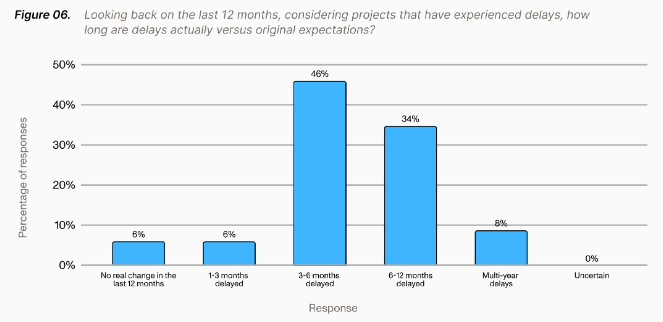
For instance, 94% of survey respondents said that permitting regulations had resulted in a delay of at least one month in the last year, with almost half—46%—reporting a delay of three to six months due to these rules. A total of 8% of respondents said they had experienced “multi-year delays”, more than the 6% that reported “no real change” in project timelines in the last year; these trends are shown in the graph below.
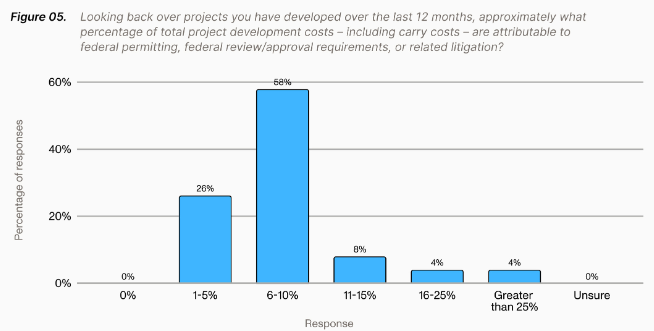
There is a similar trend for project costs, with the majority of respondents reporting a sizable increase in project costs over the last year, and a significant majority reporting an increase in project costs of more than 25%, the largest figure in the Crux survey. Of the 50 respondents, 4% said that they had experienced project cost increases of more than 25%, alongside 4% of respondents who said they had experienced increases of 16-25%.
More strikingly, not a single respondent reported no cost increase. The 6-10% cost increase answer was the most popular, with 58% of respondents reporting this scale of price increase; these trends are shown in the graph below.
This is particularly notable for the solar PV sector, as Crux notes that for a 100MW solar project, these increased costs translate to US$10-18 million in additional development costs, which in turn translate to 5% higher energy bills for customers. Just this week, independent power producer (IPP) Geronimo Power started commercial operations at an Ohio PV project of this scale, and with several developers seeing slimmer margins than they anticipated as tax credit deadlines loom, more expensive permitting costs would not be welcomed by project developers.
The majority of the report’s respondents also said that they sited projects differently from their original plans, explicitly to avoid having to secure permits from the federal government. In total, 82% of respondents said they had done this, suggesting that the federal permitting process is so flawed that it is actively impacting project design and siting.
This echoes the situation that was seen in the UK under the previous Conservative government; central government approval is required for renewable energy projects of 50MW and above, but the Conservative party’s opposition to renewable energy meant that this was a de facto ban on renewable energy projects of this size. As a result, the UK saw a raft of projects developed, of a capacity of exactly 49.9MW, in the years leading up to the Conservatives’ loss in the 2024 general election, following which 1.3GW of larger-scale solar projects were immediately awarded permits.
The need for a ‘predictable timeline’
What is perhaps most striking, however, is not that the need for greater federal approval is delaying project development or making the deployment of new renewable energy capacity more expensive, but that these obstacles are often a surprise to developers. Of the developers surveyed in the report, the majority—72%—said that they would want “more predictable outcomes” from the federal approval process.
This compares with 12% of respondents who called for shorter permitting timelines, suggesting that delays and expenses may be unwelcome, but are disruptions that can ultimately be planned for and overcome; unexpected permitting obstacles, however, have proven much harder to prepare for.
“Investors are ready to act, but capital markets need confidence that these projects will reach commercial operation on a predictable timeline,” explained Hasan Nazar, Crux head of policy. “Developers have made it clear that responsible reform of the permitting system is a powerful lever to deploy new energy to keep pace with demand.”
The Crux report points to several types of federal regulations that, once triggered, could significantly increase the time and cost required to secure federal approval. These include regulations pertaining to local animal habitats, protection of local water and wetlands and the fact that renewable energy projects—even those sited on private land—can require approval from the National Environmental Policy Act (NEPA) if it receives federal funding or encroaches on federal land.