“Home market strength plus Middle Eastern demand” has driven a surge in solar PV capacity in operation by Indian engineering, procurement and construction (EPC) and operations and maintenance (O&M) companies, according to Philip de Koning, founder of RenewAtlas.
He speaks to PV Tech Premium alongside the launch of RenewAtlas’ latest figures, published today. The RenewAtlas platform was built on the foundations of the Wiki-Solar database, whose league tables it continues and expands. This data covers solar PV project EPC, O&M, development and ownership companies, and ranks them by operational utility-scale solar PV capacity, alongside the size of their project pipelines under development, in the first half of 2026.
Try Premium for just $1
- Full premium access for the first month at only $1
- Converts to an annual rate after 30 days unless cancelled
- Cancel anytime during the trial period
Premium Benefits
- Expert industry analysis and interviews
- Digital access to PV Tech Power journal
- Exclusive event discounts
Or get the full Premium subscription right away
Or continue reading this article for free
While the top of the EPC and O&M rankings continue to be dominated by US companies in general—and SOLV Energy in particular, which boasts 17.4GW of operational capacity as an EPC and 19.7GW of operational capacity as an O&M, both of which lead the respective leaderboards—the reports point to growing contributions from Indian companies across both areas.
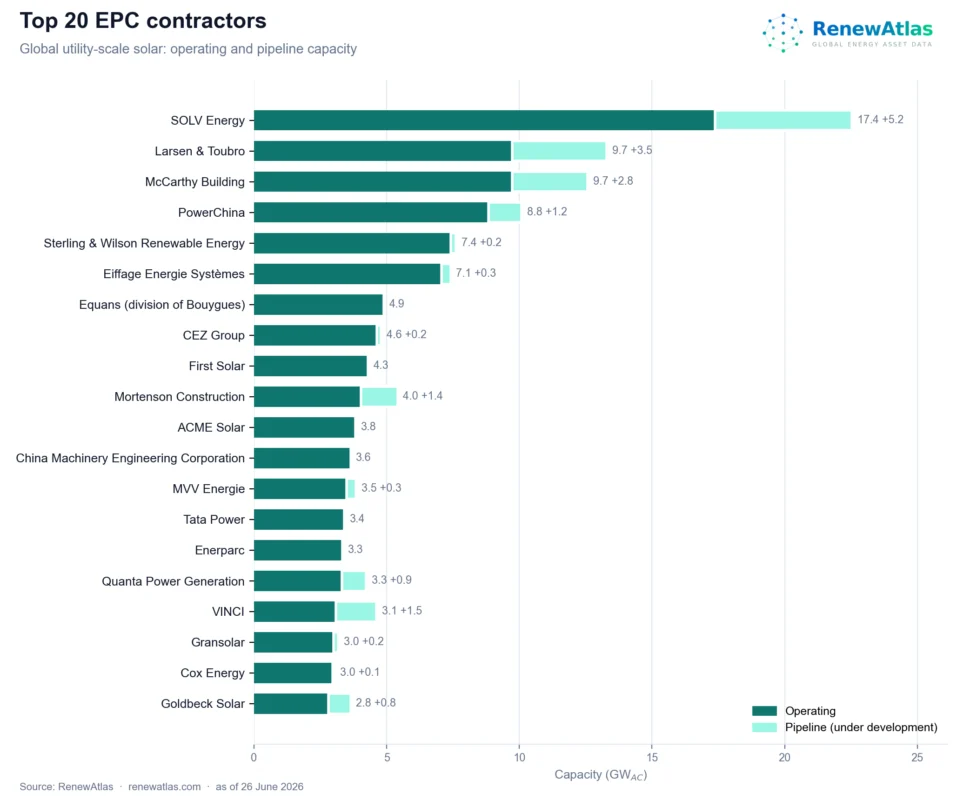
The RenewAtlas-Wiki-Solar figures show that capacity under development by EPC firms increased by 18% between last year and this, and Indian firms are the fastest-growing builders outside of China. As shown in the graph above, Indian companies Larsen & Toubro and Sterling & Wilson have the second- and fifth-most capacity in operation among EPC contractors.
Larsen & Toubro, in particular, is a leader in the EPC space, boasting the second-largest pipeline of EPC capacity globally. The company has a total of 13.2GW of capacity across operating and under-development assets, and an operational portfolio of 70 projects.
Indian solar PV growth almost matches that of the US
The sheer scale of solar PV capacity in operation in India is nothing new—figures from Wiki-Solar published earlier this year show how it has become the world’s third-largest country for cumulative operational capacity—but de Koning tells PV Tech Premium that the scale of growth has almost matched that of the US.
“India is now the world’s third-largest solar market, and by our count it added around 33GW in 2025—nearly matching the second-placed US at 35,” explains de Koning, who goes on to say that a high demand for new EPC work from asset owners in the Middle East has created an opportunity for Indian companies like Larsen & Toubro.
“But the leading Indian contractors have also become major exporters: Larsen & Toubro, our biggest capacity adder, has built more in Saudi Arabia (around 4GW) than at home, and Sterling & Wilson works across the Gulf, Australia and Africa,” he says. “So it’s home-market strength plus Middle Eastern demand, rather than any single company’s playbook.”
All of the EPC capacity tracked by RenewAtlas and Wiki-Solar in India is shown in the graph above. The companies’ reporting also draws a distinction between EPCs and O&Ms that “build big” and those that “build often”, suggesting that most companies build up a large portfolio through either a small number of investments in larger-scale projects, or through a plethora of investments made into smaller projects.
According to Philip Wolfe, founder of Wiki-Solar, Indian companies engage in both types of project, but the recent growth is “firmly at the large end”.
“Projects above 100MW now account for around 70% of India’s operating capacity, and 300-600MW plants have become common,” Wolfe tells PV Tech Premium. “This growth is driven by frequent national and state tenders, increasingly for Inter-State Transmission System (ISTS)-connected, round-the-clock hybrids paired with wind or batteries.”
June saw demand for exactly these kinds of projects, when the Solar Energy Corporation of India (SECI) launched a tender seeking 1.2GW of solar PV alongside 600MW/3.6GWh of battery energy storage systems (BESS). According to de Koning, batteries have become a “central” part of the tender landscape in India, as the government looks to secure a supply of power that is both renewable and reliable, and he tells PV Tech Premium that RenewAtlas’ future coverage will include storage to track this trend.
Domestic focus for Indian project developers and IPPs
There is a different trend among project developers and independent power producers (IPP) in India, beginning with the fact that no company based in India enjoys the same global footprint as Larsen & Toubro does in the EPC space.
Adani and NTPC, ranked seventh and eighth, respectively, are the only Indian companies in the top ten for project development capacity, and seventh-placed Adani is the sole Indian firm in the top ten of the IPP rankings.
Both league tables are led by companies based in countries with more mature solar industries. US-based NextEra Energy leads the project developer rankings, with 21.7GW in operation—more than 7GW more than second-placed Brookfield—while China’s State Power Investment leads the IPP rankings with 17.2GW in operation. In addition to the sheer size of portfolios, de Koning says that India’s leading IPPs and developers work on projects almost exclusively in India, rather than investing in a global portfolio.
“India’s large owners and developers—Adani, NTPC, ReNew, Greenko, Tata Power—are almost entirely domestic: between 90% and 100% of their capacity sits in India,” he explains. “Their growth tracks the home market directly. India is unquestionably an attractive destination for new projects, but for these companies it is the destination.”
While the dominance of India-based IPPs and developers in their home market has meant that there are ample opportunities for new solar deployments, this has created an environment where it is more challenging for overseas developers to get involved.
“Of the capacity we can attribute in India, around 85% is built by domestic firms, and not a single Chinese contractor appears, consistent with how closed that procurement market has been to Chinese participation,” explains Wolfe. “The overseas players that have broken in are almost entirely European: Czech, German and French firms.”
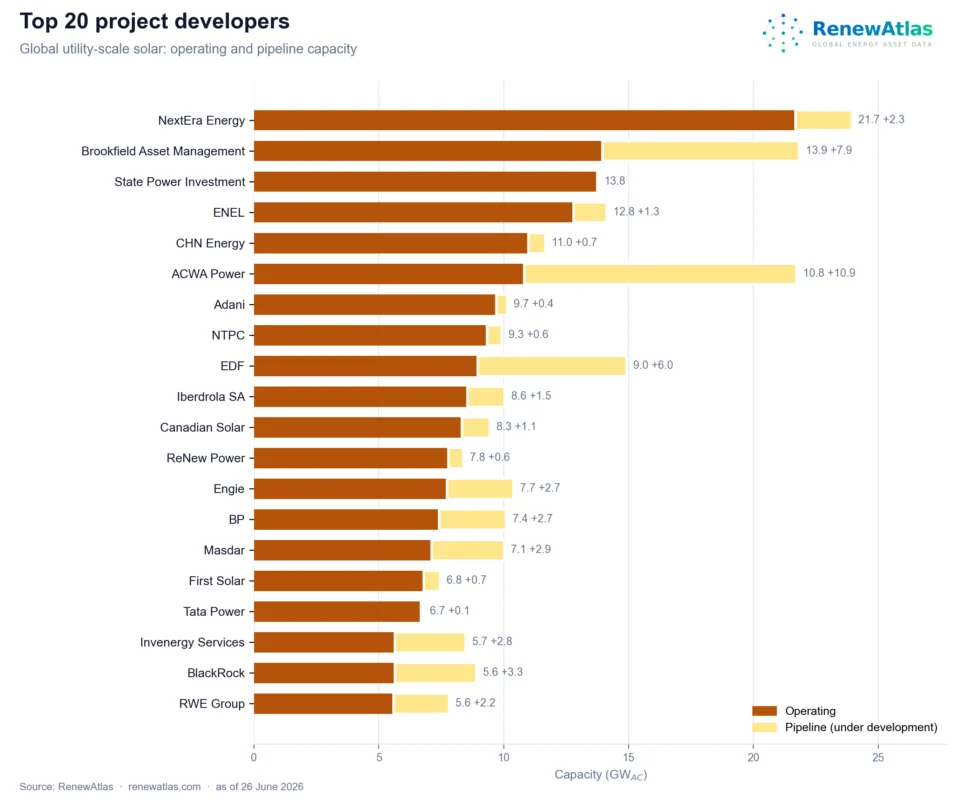
This disparity between Indian and overseas companies means that some of the largest project development pipelines in the world, as shown in the graph above, are not being built in India. Saudi Arabian firm ACWA Power has the largest project development pipeline in the world, at 10.9GW—the only company in the top 20 to have a larger pipeline than operational portfolio—but no presence in India.
Canada-headquartered Brookfield Asset Management, which has the second-largest pipeline of 7.9GW, even announced plans to sell a 550MW operational solar PV project in the Indian state of Rajasthan earlier this year.
“India is a distinctive market to operate in, with its own regulatory demands,” explains Wolfe. “This is why the big US builders have largely stayed in North America, with exceptions being those with prior international experience.”
“I’d be wary of predicting how any particular company responds, but structurally this has been, and remains, a largely domestic contracting market.”
Indeed, regulatory frameworks such as the Approved List of Modules and Manufacturers (ALMM) have encouraged the use of domestically-manufactured components, further incentivising the investment of Indian solar companies into the Indian solar sector. Ultimately, responsibility for maintaining the strong growth rate in project development and deployment will likely fall on those specialists already operating in the Indian solar sector.
Read RenewAtlas and Wiki-Solar’s full rankings of EPCs and O&Ms here, and their rankings of project developers and IPPS here.