Last week, the Federal Communications Commission’s (FCC) Public Safety and Homeland Security Bureau (PSHSB) categorised foreign-produced power inverters as a national security threat.
This immediately raised many questions, such as the ban’s scope, how long new models will have to wait to receive “Conditional Approval”, whether it will impact the construction of solar PV and BESS projects in the coming years, or whether we can expect an onshoring of inverter manufacturing in the coming months.
Try Premium for just $1
- Full premium access for the first month at only $1
- Converts to an annual rate after 30 days unless cancelled
- Cancel anytime during the trial period
Premium Benefits
- Expert industry analysis and interviews
- Digital access to PV Tech Power journal
- Exclusive event discounts
Or get the full Premium subscription right away
Or continue reading this article for free
PV Tech Premium spoke with several industry analysts to cover some of these questions, although one thing is certain at the moment: this new ban adds an extra layer of uncertainty for solar developers, independent power producers and engineering, procurement, and construction (EPC) contractors to deal with when developing a solar PV or a battery energy storage system (BESS) project, as covered by our colleagues at Energy-storage.news.
What is and isn’t banned?
One important aspect of the definition of power inverters in the FCC’s FAQ is the second point, which reads: “Contains components that enable remote communication, control, sensing, data-collection, or monitoring through Wi-Fi, cellular, Bluetooth, or other similar connections.”
An industry analyst who spoke with PV Tech and wishes to remain anonymous says that this helps narrow down the definition of a power inverter.
“If you’re shipping an inverter that does not have this [remote communication], it is not a power inverter and not covered under the covered list,” explains the analyst, adding that they expect to see inverters being shipped to the US without the wireless communication devices. Companies would later install approved communication devices.
Another source told PV Tech Premium that Sungrow, for example, does not have remote access to its PV and BESS products and restricts all connection activity to wired connections.
“To my knowledge, the FCC was never authorising entire inverters, and this is something that’s extremely confusing about this whole ban,” adds the industry analyst.
Before the implementation of the ban, the FCC was authorising the wireless components for the power inverter models on a voluntary basis. According to the analyst, this means that now the FCC is making the requirement for the entire inverter, only if they contain the wireless communication components. “I don’t really think we have any prior authorisations for entire inverters.”
Models that had previously secured authorisation won’t be affected by that new ban, and only new models will.
What are the short- and long-term impacts of the ban?
“Because the FCC ban applies exclusively to future inverter models while existing approved models remain compliant, the immediate market disruption is expected to be minimal,” says Mollie McCorkindale, senior analyst at PV Tech Research. This sentiment was shared by Lauren Gomez Cullen, European solar analyst at BloombergNEF (BNEF).
Hall Welborn, solar analyst at BNEF, adds that some companies had already begun their due diligence at the start of the year, due to the Foreign Entity of Concern (FEOC) rules.
“We ran a bankability survey for modules and inverters at the beginning of this year, and already some teams were talking about how they were increasing their due diligence on the inverter side due to FEOC,” says Welborn.
Gomez Cullen adds that the US solar industry is accustomed to adapting to new policies and can adjust quickly.
“Even before this, I’d heard of developers kind of adjusting their procurement strategies and avoiding certain Chinese manufacturers already because they were worried about something like this coming in. Obviously, this is stricter than just Chinese inverters; it is all non-American ones,” says Gomez Cullen.
Indeed, the FCC ban is not based on a specific country or set of countries but applies to any manufacturing outside of the US. And even inverters produced in the US could be affected by it if they don’t meet the FCC’s Buy American Act threshold. For inverters to qualify as a “domestic end product,” 65% of the value must consist of US components. From 2029, this threshold will increase to 75%.
“The percentage of components that are manufactured in the US as a threshold for what is considered a domestically manufactured inverter is an important distinction,” explains Welborn.
Regarding the impact on the pipeline of solar PV projects that will be built in the coming months and years, opinions differ. The same unnamed industry analyst told PV Tech that they expect delays and cancellations for solar PV and BESS projects, adding that:
“One of the problems is that projects apply for a position in the interconnection queue based on the inverter, and if they have to switch inverters, then they may have to restart their interconnection queue application. I think this will generally screw up project development in the US for years,” explains the analyst.
Whereas Welborn says: “We don’t think that this will impact our installation forecasts”.
How long will new models take to get Conditional Approval?
One of the possible longer-term impacts for future projects is the timeline for new models to get approved by the FCC. And a possible indication of how long it would take for new models to be approved is the router ban, given its similarities to the power inverter ban.
“This policy is a carbon copy of another policy that was applied to consumer-grade internet routers. Except the difference is the FCC did have authority over internet routers, whereas it doesn’t under inverters,” explains the industry analyst, adding that conditional approvals for large router makers were given in a matter of weeks.
“However, of all the companies that got conditional approvals, none of them were Chinese companies, which suggests that conditional approvals may be a way to simply weed out all of the Chinese companies,” emphasises the industry analyst.
Time will tell if the outcome will be the same for power inverters, and if companies will be able to get conditional approvals for their new models fairly quickly.
Moreover, some clarity regarding that process still needs to be released, concerning the need for new models to somehow be onshored to the US.
“It’s not clear that every model that gets approved would need to be made in the US, but to get approval they’d have to show a serious effort to try. It’s possible that changing economic conditions could undermine attempts to onshore US production after a new model gets approval. However, the approval may then be reversed by the Departments of War or Homeland Security, who help make the determination for a conditional approval,” explains Derrick Flakoll, senior policy associate at BloombergNEF.
How much capacity is there in the US?
Another important aspect to look at is the domestic supply of power inverters for both solar PV and energy storage projects.
Data from PV Tech Research’s InverterTech Bankability Ratings Report, see chart below, highlights that the US is forecast to reach 40GW of annual nameplate capacity by the end of 2026 and 60GW by the end of 2027.
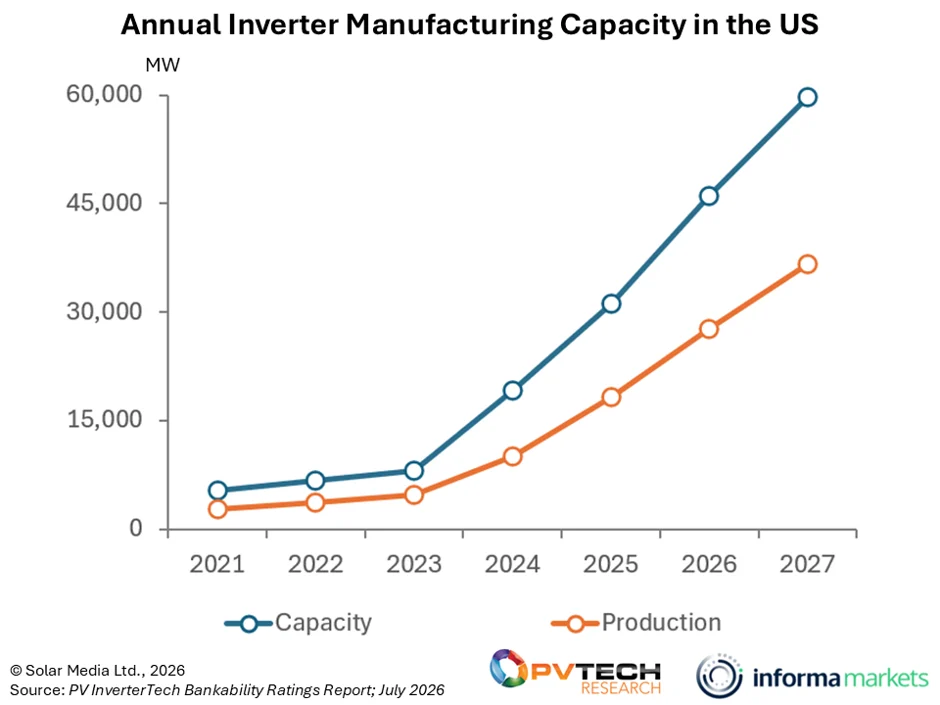
However, it is worth noting that not all of that capacity or production necessarily ends up being shipped to US projects. This is the same in Europe, which recently surpassed 100GW of manufacturing capacity, with a “substantial portion” of it ending up exported to the US.
“The US is experiencing a substantial ramp-up in PV inverter and PCS manufacturing capacity,” says McCorkindale.
Some of the European inverter manufacturers are in the process of increasing their US inverter manufacturing footprint. McCorkindale highlights the cases of Germany-based SMA Solar Technology and Spain-based Power Electronics.
The German solar inverter producer has commenced production at a 3.5GW+ facility in Portland, Oregon, in H1 2026, operating in partnership with Create Energy. Meanwhile, Power Electronics is scaling production throughout this year at its Texas facility with a target to reach 20GW+ of annual production capacity by 2027 and focusing on string and central inverter technologies.
“Despite impressive nameplate capacity figures that appear to align with annual US solar installation volumes, several critical challenges remain. Shortages in inverters with advanced networked communication features and grid-interactive capabilities. Limited availability of specialised products for energy storage integration and hybrid systems. Gaps in residential versus utility-scale product portfolios among domestic manufacturers.
“Also, newly established US facilities lack the operational history of established Asian manufacturers. Early production quality issues could undermine market confidence and slow adoption,” explains McCorkindale.
She adds that if the current manufacturing expansion trajectory continues, the US would achieve “substantial supply chain independence in the inverter sector within the coming years.”
“This would represent a fundamental shift from historical reliance on imports, particularly from Chinese manufacturers who have dominated global inverter supply. However, no other companies are known to be planning any more large-scale inverter manufacturing facilities, so production in the US could remain more flat than this current trajectory,” says McCorkindale.
Even though inverter assembly may be domestic, critical components such as semiconductors, capacitors or control boards still often originate from Asia, she says. “True supply chain independence requires addressing these upstream dependencies.”
Welborn adds that compared to other parts of the solar supply chain, such as module manufacturing, inverters can be scaled up quickly.
He also mentions that companies with an existing US manufacturing footprint can scale more quickly than those without. “Even though this ban does present opportunities for all companies to onshore domestic manufacturing inverters.”
Will Chinese companies be impacted differently?
Weeks before the implementation of the power inverter ban by the FCC, news agency Reuters reported that a draft banning Chinese solar inverters was in the works, however the FCC ended up adopting a wider ban. This obviously does not mean that Chinese companies might not be treated differently compared to other companies.
Regarding the possible onshoring of manufacturing by Chinese companies, Gomez Cullen points out that a difference between the EU and US regulations is that in Europe, the focus has been more on the headquartered location, whereas in the US, it’s the manufacturing location.
“Going off that, you’d assume that Chinese companies could onshore, but we do think in general it’s going to be more difficult for Chinese companies.”
Welborn adds that one of the criteria that will be looked for in a new model to receive Conditional Approval is the corporate structure, which could indicate that Chinese-owned companies would still face greater difficulty than non-Chinese ones.
“If you already have manufacturing capacity, you just need to hire more contractors and stuff to ramp up within the limits of the physical building you have,” adds Gomez Cullen.
Who imports to the US?
This brings us to who currently exports inverters to the US, with a focus on the company’s headquarters rather than the manufacturing location. McCorkindale says that solar PV inverter imports are dominated by Chinese-headquartered companies, with Sungrow as the largest single importer.
“While Sungrow operates manufacturing facilities across China, Europe, and the broader APAC region, a portion of its US imports originates from European production sites rather than exclusively from China,” adds McCorkindale.
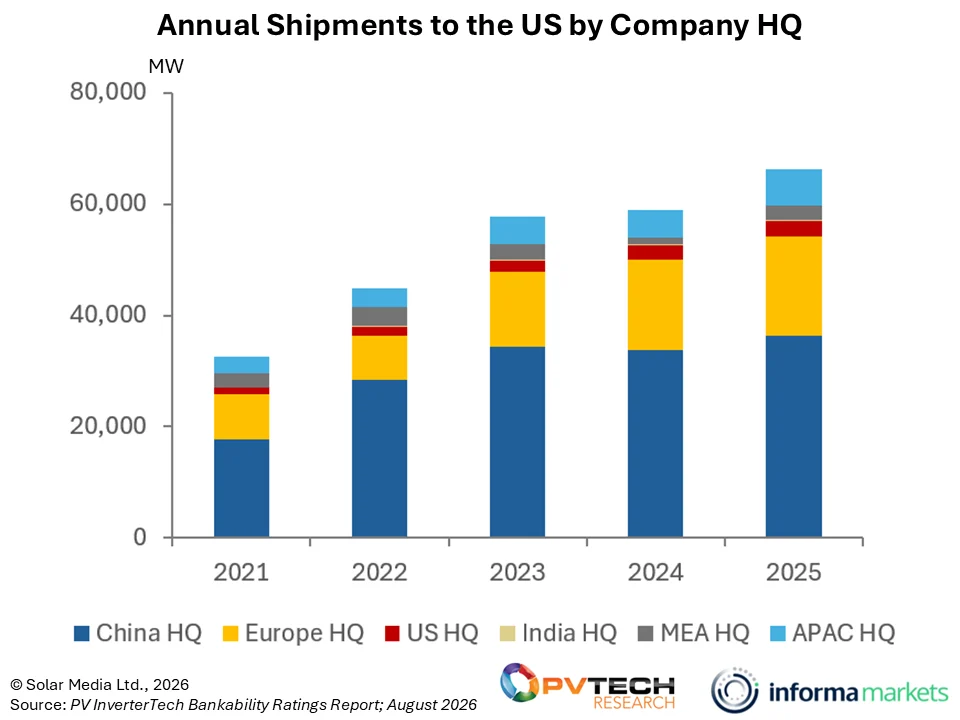
As the chart above shows, European-headquartered manufacturers are the second-largest import category and play a “crucial role in transitioning to domestic supply,” explains McCorkindale, adding: “Companies like SMA Solar Technology and Power Electronics have historically supplied the US from Europe, but are now establishing production in the US. While most shipments still come from Europe, as US facilities scale and become cost-competitive, a shift from imports to domestic supply is likely.
“US-headquartered manufacturers currently account for only a small fraction of inverter imports, reflecting the historical dominance of Asian and European ones.”
How will inverter innovation be affected?
Finally, another concern the FCC inverter ban has created is that new models could extend their product development cycles by 6-12 months, explains McCorkindale. She adds that this could potentially delay innovation and market introduction of advanced features.
Gomez Cullen adds that there is a difference between the model lifecycles of solar PV and BESS, with solar PV lasting longer than BESS. “Solar is longer than that in BESS, just because there’s a lot of innovation happening for BESS inverters at the moment,” says Gomez Cullen, adding that “Our main kind of point seems to be that it may prevent American developers from using the most state-of-the-art technology in BESS more so than solar.”
McCorkindale adds: “Existing solar installations using banned future models may face challenges with warranty replacements, system expansions, or component failures. This could create a secondary market for compliant legacy equipment or force costly system redesigns.
“Also, developers with projects in advanced stages may face decisions about whether to accelerate procurement of grandfathered models or wait for new compliant products, creating demand volatility.”
Returning to the issue of how long it will take new models to get “Conditional Approval”, this could determine whether there will be a technological gap in the US, explains Walborn.
“Getting that approval by the Department of War or Homeland Security, that’ll really kind of determine that technology lag, in addition to how fast these manufacturers can scale up in the US,” he adds.
“The FCC ban represents more than a regulatory compliance issue, it’s a catalyst for fundamental restructuring of the US solar supply chain with implications for deployment costs, technology development, and energy security strategy,” concludes McCorkindale.