Solar PV has met two-thirds (61%) of the US electricity demand growth in 2025, according to a report from think tank Ember.
Generation of solar PV increased by 83TWh in 2025, which represented a year-on-year growth of 27%, while electricity demand rose by 3.1%.
Try Premium for just $1
- Full premium access for the first month at only $1
- Converts to an annual rate after 30 days unless cancelled
- Cancel anytime during the trial period
Premium Benefits
- Expert industry analysis and interviews
- Digital access to PV Tech Power journal
- Exclusive event discounts
Or get the full Premium subscription right away
Or continue reading this article for free
The growth of solar generation was the highest in regions where electricity demand grew the most, such as Texas, the Midwest and the Mid-Atlantic. Solar growth met 81%, 81% and 33% of electricity demand growth, respectively, in these three regions.
Other states or regions also saw a growth in solar PV, such as is the case of Florida, where solar growth exceeded demand growth “by a large margin” and contributed to a fall in fossil fuel generation. This is in contrast with the rest of the US, where the majority of new solar generation met increased electricity demand rather than displacing existing generation.
However, the continued growth of solar PV in the US remains limited to a few states, with 37 states having less than 10% of their electricity from solar PV in the last 12 months.
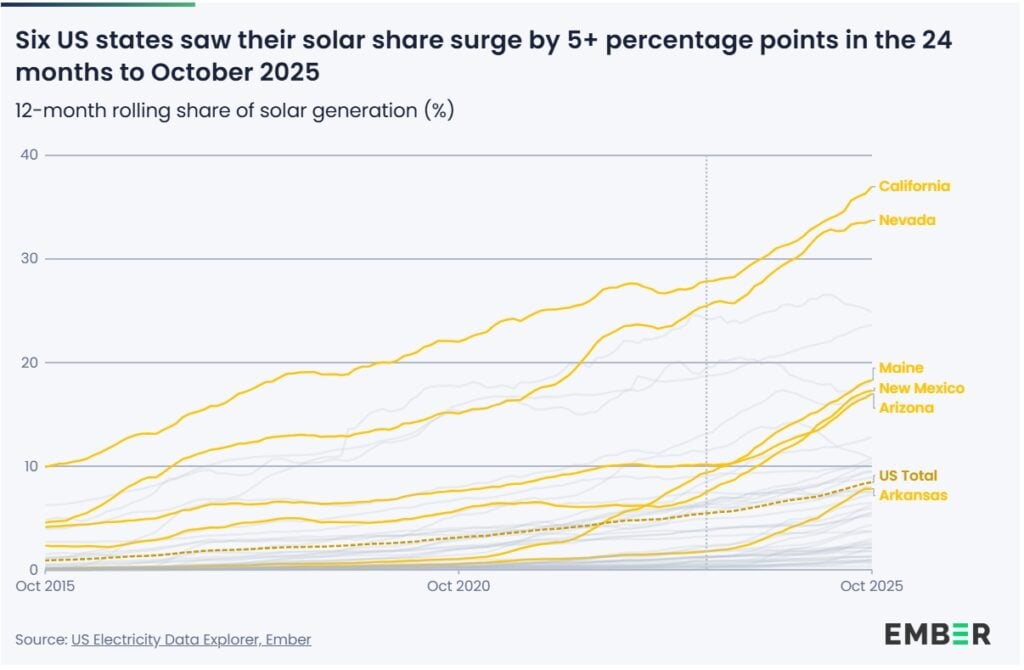
California remains the leading state in terms of the highest solar share with 37%, followed by Nevada with 34%. Both states, along with Arkansas, Arizona, Maine and New Mexico, have seen their solar share rise by more than five percentage points in the 24 months to October 2025. New Mexico has had the fastest increase, rising ten percentage points from 7% to 17% during that period.
Moreover, during daytime hours, solar PV has matched the rise in US electricity demand, while the technology also met some of the electricity demand growth during the evening hours, helped by energy storage.
According to Ember, the rise of batteries in the US is changing solar PV from cheap daytime electricity to dispatchable all-day electricity. A clear example of this is California, where in the last six years, the state’s utility-scale solar PV and battery generation grew by 58%, despite electricity generation only rising by 8% during the sunniest hour of the day.
Dave Jones, chief analyst at Ember, said: “Solar growth was essential in helping to meet fast-rising electricity demand in 2025. It generated where it was needed and – with the surge in batteries – increasingly when it was needed. Solar has the potential to meet all the rise in electricity demand and much more. With electricity demand surging, the case to build solar has never been stronger.”
Furthermore, utility-scale solar PV remains the fastest-growing source of electricity generation in the US, according to data from the US Energy Information Administration (EIA). It forecasts up to 70GW of new solar additions between 2026 and 2027, which represents a 49% increase in US solar operational capacity compared with the end of 2025.
Most of that utility-scale capacity addition in the coming two years will come online in Texas. Battery storage will also see a fast increase in operational capacity in the coming years with the Electric Reliability Council of Texas (ERCOT) market rising from 15GW in 2025 to 37GW by the end of 2027.