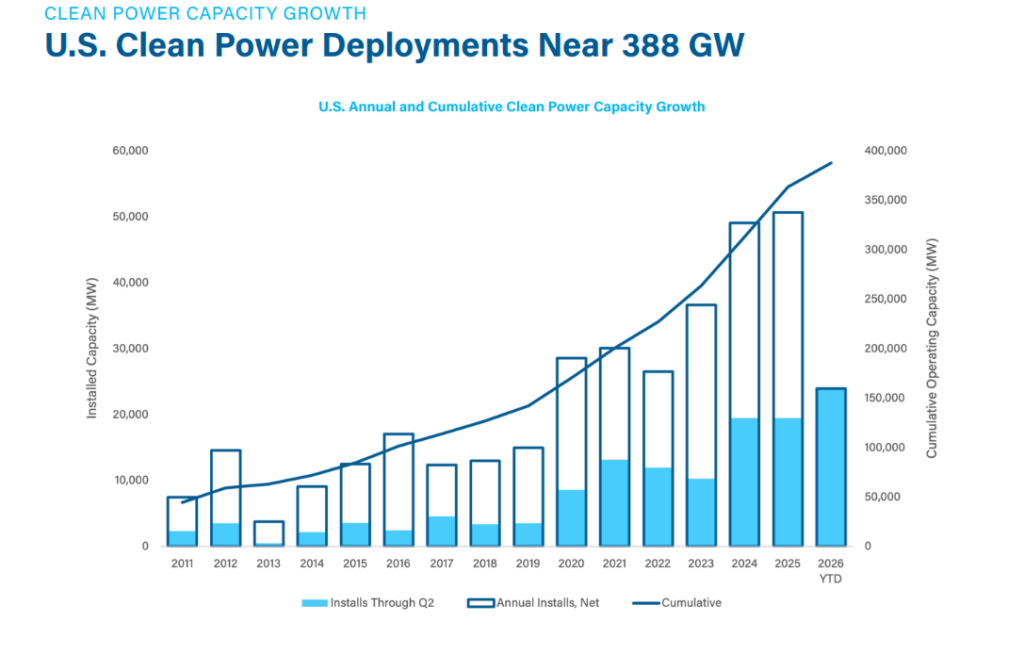
The US clean power industry added 17.1GW of utility-scale solar, battery storage and land-based wind capacity in Q2 2026, while the project pipeline reached a record 204.6GW, according to the American Clean Power Association (ACP).
The industry brought online 17,058MW of new utility-scale solar, battery storage and land-based wind capacity in the second quarter of 2026, up 45% from the same quarter in 2025, according to ACP’s 2026 Q2 Clean Power Quarterly Market Report.
Try Premium for just $1
- Full premium access for the first month at only $1
- Converts to an annual rate after 30 days unless cancelled
- Cancel anytime during the trial period
Premium Benefits
- Expert industry analysis and interviews
- Digital access to PV Tech Power journal
- Exclusive event discounts
Or get the full Premium subscription right away
Or continue reading this article for free
The quarter marked the strongest second quarter and first half of a year on record for clean energy deployments, with cumulative clean power capacity reaching 387,606MW, enough to power 83.2 million American homes.
Utility-scale solar accounted for the largest share of Q2 additions, with 7,405MW commissioned, representing 43% of new capacity additions. Land-based wind installations reached nearly 5GW, while 4,685MW/17,177MWh of battery storage was added.
Solar leads quarterly additions
US utility-scale solar additions more than doubled quarter-over-quarter, rising 102%, and increased 27% year-over-year.
The largest utility-scale solar project phase energised in Q2 was Repsol’s 650MW Pinnington Solar (Longhorn) project in Jack County, Texas. Pinnington is the largest solar project in operation in Texas and the second-largest in operation in the nation.
At the end of Q2 2026, cumulative operational solar capacity in the US reached 168.5GW.
New Mexico led the nation in quarterly clean power capacity additions, with just over 4GW of new projects starting commercial operations. The state accounted for 24% of all capacity added in Q2.
The additions included Pattern Energy’s 3.65GW SunZia Wind project, which made up 73% of all land-based wind capacity added to the grid during the quarter.
New Mexico’s additions outpaced Texas by nearly 900MW, ending Texas’ two-and-a-half-year streak as the state with the highest quarterly installations.
Clean power pipeline reaches record 205GW
The clean power pipeline reached almost 205GW at the end of Q2, up nearly 10GW, or 5%, from Q1 and 20GW higher than the same quarter in 2025.
Utility-scale solar recorded the strongest quarterly pipeline growth of any technology, increasing 7.7GW, or 7%, from Q1 to a record 111GW. Solar accounted for 54% of the clean power pipeline, with projects in development across all 50 states and Puerto Rico.
The battery storage pipeline grew 5% quarter-over-quarter to 56GW, 21% higher than the same quarter in 2025 and a record high for the technology. By contrast, the land-based wind pipeline fell 4% to 27,381MW in Q2.
Construction and offtake activity
A total of 130 clean power projects started construction in Q2 2026, representing nearly 14GW of capacity across 26 states. Utility-scale solar projects accounted for just over half of new construction, followed by battery storage at 35% and land-based wind at 13%.
Texas recorded the most new construction in the quarter at 4.8GW, followed by Georgia at 3.1GW, California at 1.2GW, Virginia at 1.0GW and Michigan at 0.6GW.
Clean power procurement announcements totalled 14.5GW in Q2, up 23% from the same quarter in 2025. Power purchase agreement (PPA) announcements for the first half of 2026 reached an all-time high of 21.6GW, while direct utility ownership reached a four-year high of 4,637MW.
PPAs accounted for 75% of all Q2 offtake announcements, with contracted capacity reaching 10.9GW, a 34% year-over-year increase and a record high for Q2 PPA announcements.
ACP said federal permitting and review delays and other policy barriers continued to threaten future development, despite the record deployment levels and growth in the clean power pipeline.
“Clean energy continues to prove itself in the marketplace — it’s the fastest to build, the fastest to scale, and is delivering the energy our country needs,” said ACP chief policy officer, JC Sandberg. “When clean energy is allowed to compete fairly with other technologies, we know that it can deliver reliable, affordable energy to power American homes and businesses.”
In a recent piece, Moustafa Ramadan, head of PV Tech Research explored how policy has shaped the US solar market, noting that trade protection and manufacturing incentives have supported domestic manufacturers while policy volatility has created challenges for developers and end buyers.
However, despite policy uncertainty, US clean energy tax credit transfers reached US$21 billion in the first half of 2026, highlighting continued investment activity across the sector.
Further discussions of the US PV industry and its fast-growing domestic supply chain will feature in our PV CellTech USA conference in California on 13-14 October. For further details and booking, visit the event website.