India added 50.6GW of solar module manufacturing capacity and 9.7GW of solar cell manufacturing capacity in the first half of 2026, according to Mercom India’s State of Solar PV Manufacturing in India H1 2026 report.
India installed a record 27GW of solar generation capacity in 1H 2026, up 49% year on year from 18GW in H1 2025, according to the research firm.
Try Premium for just $1
- Full premium access for the first month at only $1
- Converts to an annual rate after 30 days unless cancelled
- Cancel anytime during the trial period
Premium Benefits
- Expert industry analysis and interviews
- Digital access to PV Tech Power journal
- Exclusive event discounts
Or get the full Premium subscription right away
Or continue reading this article for free
The growth followed a record first quarter, with India installing 15.3GW of solar generation capacity in Q1 2026, up 143% year on year from 6.3GW in Q1 2025 and 49% from 10.3GW in Q4 2025, according to data released by Mercom in May 2026.
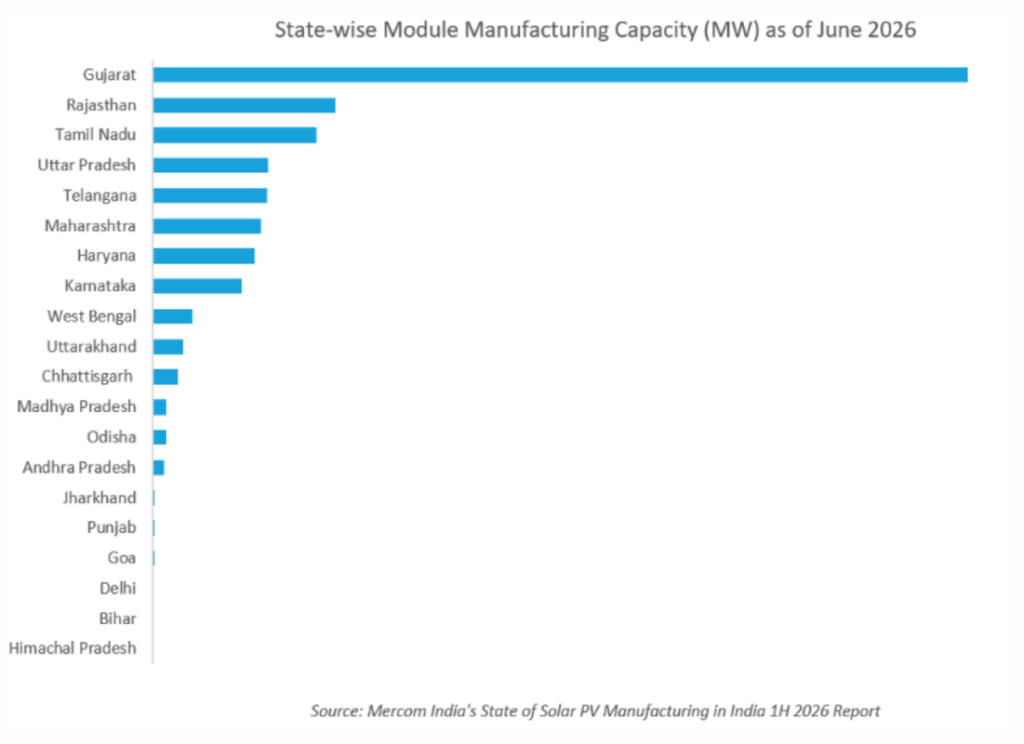
Cumulative annual module manufacturing capacity reached 261.7GW as of June 2026, while annual solar cell manufacturing capacity stood at 36.6GW.
Of the cumulative capacity, 225.5GW of module manufacturing capacity was listed under the Approved List of Models and Manufacturers (ALMM) List-I, while ALMM List-II covered nearly 35.5GW of cell manufacturing capacity.
Tunnel oxide passivated contact (TOPCon) accounted for 80% of ALMM-listed module manufacturing capacity as of June 2026, making it the dominant technology.
Monocrystalline passivated emitter and rear cell (PERC)/TOPCon accounted for 11%, followed by Mono PERC at 4%, heterojunction technology (HJT) at 3%, and thin-film technology at 2%.
Gujarat remained the largest manufacturing hub, accounting for nearly 45% of India’s module manufacturing capacity and more than 36% of cell manufacturing capacity. Rajasthan and Tamil Nadu ranked second and third for module manufacturing, with 26.1GW and 23.4GW of capacity, respectively.
For solar cells, Gujarat led with 37% of annual production capacity, followed by Tamil Nadu with 4.3GW and Telangana with 4.2GW.
India’s solar cell and module imports increased 18% in 1H 2026 compared with the first half of 2025. Solar cells accounted for 81% of total imports, while modules represented the remaining 19%.
The US remained India’s largest export market for solar cells and modules in 1H 2026, accounting for 92% of total exports.
However, this could be adversely affected by the US Department of Commerce’s (DoC) final anti-dumping and countervailing duties on crystalline silicon PV cells from India, announced earlier this month, with a combined rate of 249.13% for Indian manufacturers. The rate comprised a 123.04% final dumping margin and a 126.09% countervailing duty.
The country’s manufacturing capacity also remained concentrated among major producers. The top 10 manufacturers accounted for 60% of India’s total module manufacturing capacity.
According to an IEEFA and JMK Research & Analytics report released in September 2026, India’s solar module production capacity had reached approximately 233GW, with factories operating at an estimated 35–40% utilisation. The report estimated that a further 135GW of module capacity backed by firm investment commitments and near-certain commissioning schedules was in the pipeline.
Meanwhile, Mercom reported that Indian Mono PERC module average selling prices declined 1.8% quarter over quarter.
India’s installed renewable power generation capacity reached 288GW as of June 30, 2026, accounting for about 54% of total installed energy capacity, according to JMK Research & Analytics’ Q2 2026 India RE Update, released in August 2026.
Solar accounted for 162GW, or 56%, of installed renewable generation capacity, followed by wind at 57GW and large hydro at 52GW.
Around 149GW of renewable power generation projects, including solar, wind, hybrid and storage, were in the pipeline as of June 30, with commissioning expected over the following four to five years. A further 48GW was in the bidding phase, with tenders issued but auctions yet to conclude.
India’s renewable energy transition, from solar PV and energy storage to grid integration, will be a key topic of discussion at the Renewable Energy India (REI) Expo, co-located with the Energy Storage Summit India (ESS India), in Greater Noida on 22-24 October 2026. For the full agenda and booking details, click here.