Mollie McCorkindale, senior analyst at PV Tech Research, writes about PV inverter manufacturing trends across different markets.
The solar inverter industry is undergoing a significant technological transition, with string inverter technology rapidly gaining ground over traditional central inverters. This shift reflects evolving market demands, technological advancements, and strategic positioning by manufacturers worldwide, all increasingly shaped by government policy and regulatory frameworks.
Leveraging insights from our in-house market research team and the PV InverterTech Bankability Ratings Report, this article uses analysis of the leading 30 companies in the utility-scale PV inverter market.
Try Premium for just $1
- Full premium access for the first month at only $1
- Converts to an annual rate after 30 days unless cancelled
- Cancel anytime during the trial period
Premium Benefits
- Expert industry analysis and interviews
- Digital access to PV Tech Power journal
- Exclusive event discounts
Or get the full Premium subscription right away
Or continue reading this article for free
Global manufacturing capacity trends
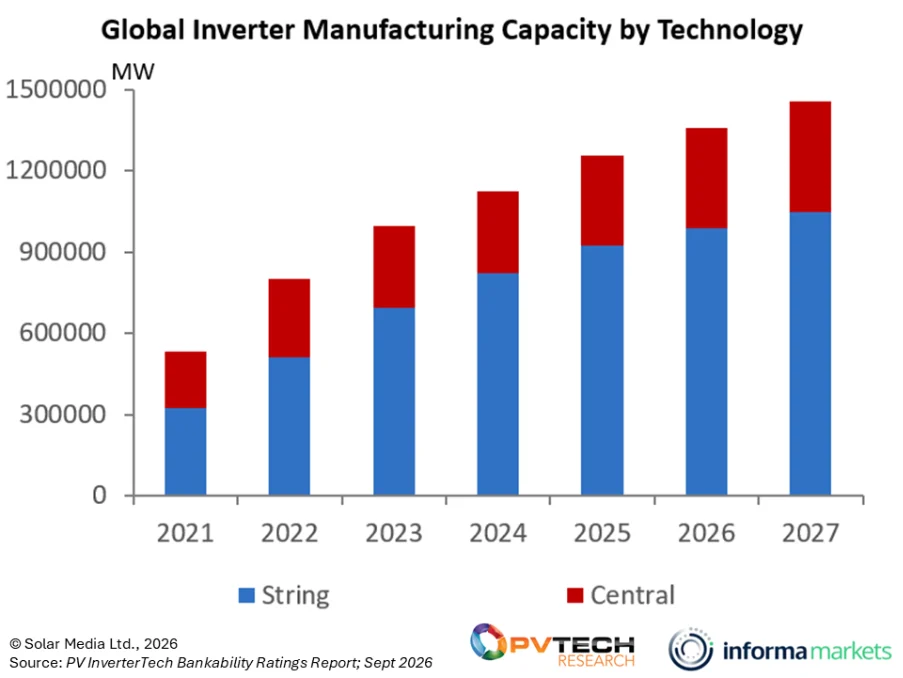
Recent data from the PV InverterTech Bankability Ratings Report on annual PV inverter manufacturing capacity reveals a clear global trend: string technology is capturing an increasingly dominant share of the market. In 2021, string inverters accounted for approximately 60% of total global manufacturing capacity. By 2024, this figure exceeded 70%.
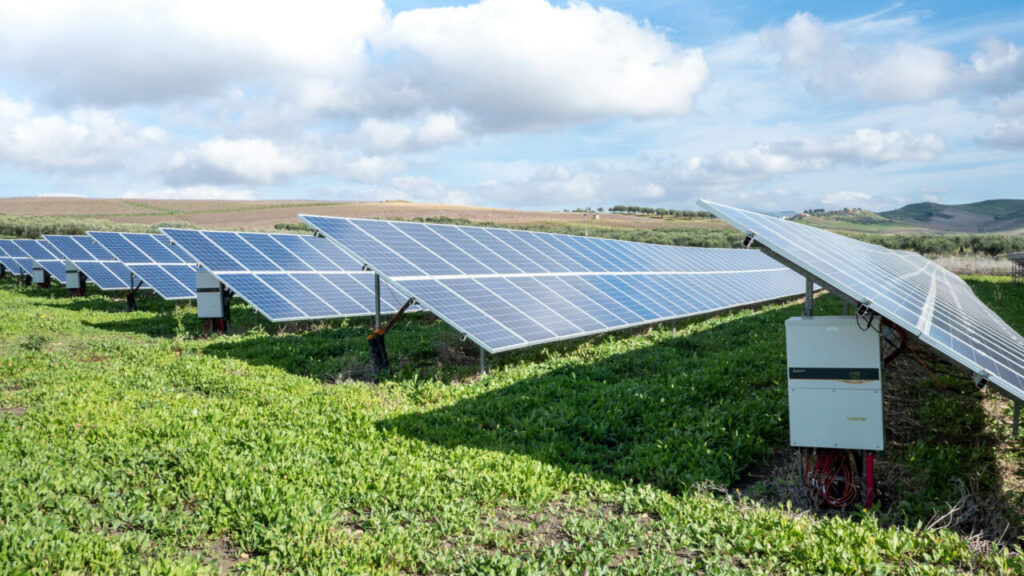
This transition is driven by compelling operational and economic advantages. Modern high-power string inverters deliver superior energy yields, modular reliability, and significantly lower lifetime operating costs. When a central inverter fails, megawatt-scale blocks of a solar farm go offline simultaneously. In contrast, a single string inverter failure affects only a tiny fraction of total capacity, minimising downtime and financial impact.
Maintenance considerations further favour string technology. On-site staff can quickly swap a failed string inverter with a spare unit within hours using standard tools. Central inverters require heavy machinery, concrete pads, and specialised engineers, translating to extended downtime and higher labour costs.
The rise of modular inverter technology
An important nuance in this landscape is the emergence of modular inverters, which blur the traditional distinction between string and central systems. While technically classified as central inverters in industry data, modular inverters represent a hybrid approach that captures advantages from both technologies.
Modular inverters employ multiple smaller, swappable inverter blocks housed together in a single large skid or station at multi-megawatt scale. Rather than relying on one massive monolithic core, they distribute power conversion across independent modular sub-units. This architecture delivers the redundancy and multi-MPPT (Maximum Power Point Tracking) benefits characteristic of string arrays while maintaining centralised infrastructure and scale advantages. When one internal module fails, the remaining modules continue operating, a significant improvement over traditional central inverter vulnerability.
Both European and Chinese manufacturers have invested in modular inverter technology, recognising its potential to bridge the gap between traditional central and string approaches for utility-scale applications.
The European exception: A different strategic path
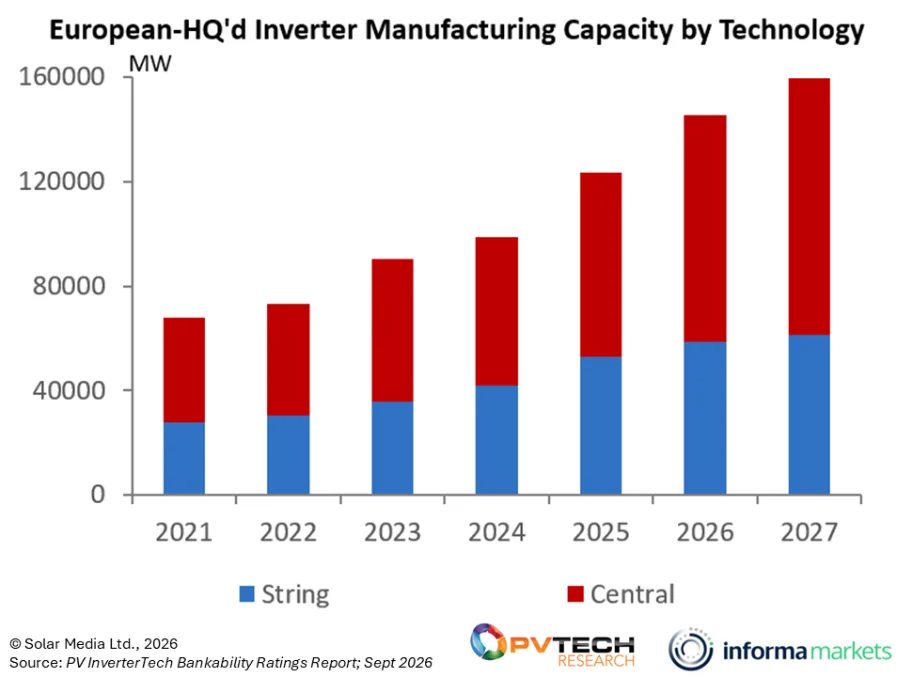
While the global market trends decisively toward string technology, European manufacturers present a notable exception. Annual manufacturing capacity data for European-headquartered companies shows string production has remained relatively stable at approximately 40% each year, with central inverters continuing to dominate their portfolios. This represents a genuine strategic difference from the global trend, where string inverters have exceeded 70% of capacity by 2024.
Strategic factors behind European positioning
European manufacturers such as SMA and ABB built their reputations around utility-scale and commercial projects where central inverters dominated for decades. Their more conservative approach to the string transition stems from several interconnected factors. Significant capital invested in central inverter production lines creates financial inertia that discourages rapid technology shifts, while their European utility-scale customer base was slower to adopt string inverters, maintaining demand for proven central and modular solutions. Additionally, a preference for robust, proven central solutions, particularly for mission-critical applications, has historically characterised European engineering approaches to utility-scale solar. Many European manufacturers position themselves as premium suppliers offering high-reliability central and modular inverters with advanced grid support functions, longer warranties, and superior service for harsh environments.
This strategic positioning represents either a differentiated market approach targeting high-value segments or a potential competitive disadvantage if utility-scale preferences continue shifting toward string technology. However, not all European manufacturers have maintained the same focus. Companies such as Fronius and KACO have primarily concentrated on string technology and are well-positioned if the trend toward string continues, while manufacturers including SMA and Ingeteam have begun diversifying their portfolios, shifting some focus toward large-scale string inverters in recent years.
China’s dominance in string technology
The global shift toward string inverters is overwhelmingly driven by Chinese manufacturers, who account for approximately 90% of annual global inverter manufacturing capacity. These companies have concentrated heavily on residential and small commercial markets where string technology offers clear advantages in installation flexibility, scalability, and cost-effectiveness.

Chinese manufacturers recognised early that string inverters aligned well with distributed generation trends and rooftop solar expansion. Their aggressive investment in string technology production capacity, combined with competitive pricing and rapid innovation cycles, has reshaped global market dynamics. While Chinese manufacturers also produce central and modular inverters for utility-scale projects, they have shifted their portfolios more decisively toward string technology compared to their European counterparts.
The US market: A strategic alignment
The US presents a unique market dynamic that currently favours European manufacturers’ strategic positioning. Unlike the global trend toward string technology, the US utility-scale solar market still fundamentally favours central inverters, though string inverters are gaining traction in smaller or more complex utility projects.
This preference creates a strategic alignment between European manufacturers’ production focus and US market demand. As European companies establish substantial manufacturing capacity in the US, driven by policy incentives including the Inflation Reduction Act’s domestic content bonuses, FEOC restrictions, and the FCC’s foreign inverter ban, their emphasis on central and modular inverters matches what most large US utility-scale developers currently seek.
However, this alignment may not be permanent. String inverters are gaining ground in several US market segments, including smaller utility projects (10-50MW), projects with complex terrain or shading issues where multiple MPPT channels provide advantages, distributed generation and community solar installations, and projects prioritising rapid deployment timelines. Additionally, the residential and commercial segments, where string technology dominates globally, continue growing in the US market.
This uncertainty is amplified by US policy frameworks that are reshaping the supply chain. The FCC’s conditional approval process for new inverter models could inadvertently influence technology adoption by favouring manufacturers with established US facilities (primarily European companies producing central/modular inverters) while creating barriers for Chinese string inverter manufacturers. Whether this policy-driven reinforcement of current preferences will accelerate or delay any potential shift toward string technology remains unclear.
For now, European manufacturers expanding US production capacity benefit from strong alignment with existing market preferences. Their success in the long term, however, will depend on whether US utility-scale customers maintain their preference for central and modular solutions, or whether the operational and economic advantages driving global string adoption eventually reshape American market dynamics as well.
The critical question becomes: Will utility-scale customers prefer central/modular systems (favoured by European manufacturers) or large-scale string arrays (favoured by Chinese manufacturers)? The answer likely depends on project scale, grid requirements, total cost of ownership, policy frameworks, and risk tolerance.
As the solar industry continues its rapid expansion, the inverter technology landscape will likely become more diverse, with string, central, and modular solutions each finding optimal applications based on specific project needs. Manufacturers who can navigate this complexity while adapting to both technological trends and policy environments will be best positioned for long-term success. European manufacturers’ bet on premium central and modular solutions represents a strategic differentiation rather than simply lagging behind, but success will depend on whether high-value market segments remain large enough to sustain their business models in an increasingly string-dominated global market.
Mollie McCorkindale, senior analyst at PV Tech Research, will be presenting more insights from the PV InverterTech Bankability Report at PV ModuleTech Europe on 3-4 November in Málaga, Spain. For more information, click here.
All data and analysis shown in this article come from our in-house market research. Full details on how to subscribe to our PV InverterTech Bankability Ratings Report can be found here.