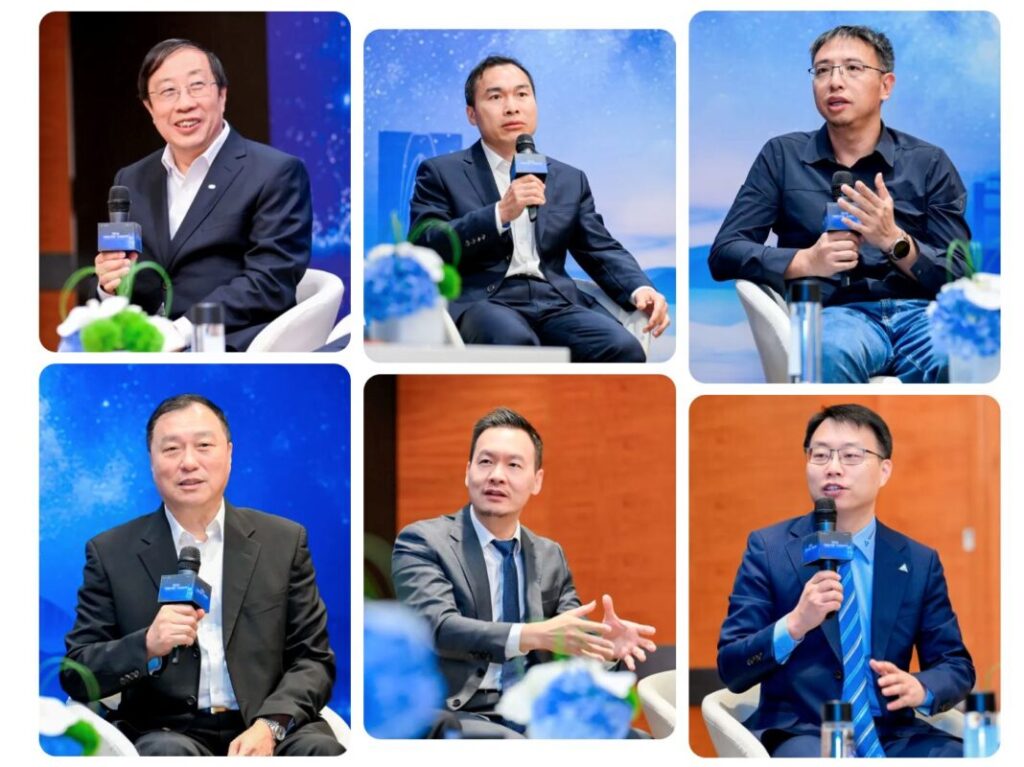
Zhang Guangchun, Canadian Solar, Fan Bin, Kunshan GCL-Perovskite, Allen Zhou, TÜV Rheinland Greater China. Image: TÜV Rheinland.
While the energy storage sector continues to grow, the PV industry is grappling with severe overcapacity. As the era of clearly delineated market boundaries and unchecked expansion ends, PV-storage integration has become essential for survival.
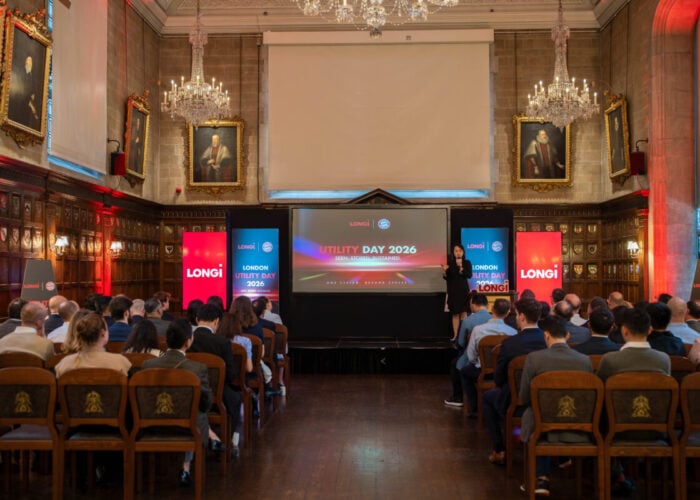
Against this backdrop, the 12th TÜV Rheinland Solar & Energy Storage System Summit hosted a panel discussion titled “PV-Storage Integration: Building a New Industrial Ecosystem”. Executives from TCL Zhonghuan, Chint Power, Canadian Solar, Hoymiles, GCL-Perovskite, and TÜV Rheinland discussed three key themes: overcoming cutthroat competition, deploying AI, and expanding globally in a compliant manner.
Try Premium for just $1
- Full premium access for the first month at only $1
- Converts to an annual rate after 30 days unless cancelled
- Cancel anytime during the trial period
Premium Benefits
- Expert industry analysis and interviews
- Digital access to PV Tech Power journal
- Exclusive event discounts
Or get the full Premium subscription right away
Or continue reading this article for free
The panel concluded that the solar PV and energy storage sectors have moved beyond the outdated growth model of competing on scale and selling at low prices for volume growth. With a comprehensive industry shakeout underway, only companies with core technological innovations, AI-driven productivity and strong global expansion capabilities will survive this cycle.
Breaking out of cutthroat competition: from price wars to multi-dimensional differentiation in technology, applications and patents
The solar PV and energy storage sector previously relied on scale-driven expansion and price wars to outpace rivals, but this business model has run its course.
Song Dengyuan, CTO of TCL Zhonghuan, put it plainly: “The industry’s old competitive logic—competing on price and scale—is no longer viable. Future competition will hinge on technological strength, patent portfolios, global operational capabilities, and tailored solutions for specific scenarios.”
He pointed to this year’s SNEC exhibition in Shanghai as evidence of the shift. In the past, companies competed primarily on module power output and conversion efficiency. Today, exhibition booths predominantly showcase end-to-end solutions tailored to specific scenarios.
In response to this changing landscape, TCL Zhonghuan has adopted a strategy of moderate integration. After acquiring Das-Solar, the company expanded its advanced BC solar cell and module manufacturing capacity. Building on the early differentiation achieved with its G12 large-format wafers, it is now fully focused on upgrading BC solar cells based on advancing screen-printing lithography patterning technology.
Through the acquisition of Maxeon Solar, it secured more than 1,600 foundational BC cell patents, establishing formidable technical barriers. Meanwhile, the company has developed specialised wafer products, including the Zhufeng series. Compatible with multiple technology routes, including TOPCon, HJT, and BC, these products enable deployment across a wide range of scenarios and help the company avoid undifferentiated, low-price competition.
Zhou Chengjun, General Manager of Chint Power, argued that innovation priorities must evolve alongside the industry. Drawing on his experience in both manufacturing and the broader power plant value chain, he noted that during the subsidy era, the primary goal was minimising the levelized cost of energy (LCOE). Today, with electricity pricing fully market-based, the rise of negative electricity prices highlights the critical value of PV-storage integration.
“Storage can shift energy from low-price time windows for discharge during high-price periods. The industry has moved from optimising single-point efficiency to maximising overall value,” Zhou said. Meanwhile, the rapid growth of AI computing and data centres requires power supplies that combine low-cost green energy, flexible dispatch, and high reliability. Chint Power’s R&D is responding by focusing on higher power density, flexible regulation, long-duration energy storage and system-level intelligence. Ultimately, these efforts aim to enhance the efficiency, flexibility, and lifecycle value of PV-storage systems.
Zhu Xuancai, general manager of PV-Storage at Hoymiles, stressed that “products must be defined by their scenarios”. Drawing on its electronics heritage from a Zhejiang University lab, Hoymiles initially tried to bring domestic storage products directly to overseas markets, only to face severe local adaptability challenges. While domestic C&I storage systems typically feature two-hour durations, overseas demand ranges from one to four hours, with regional preferences for module formats varying widely.
“You cannot use existing products to define customer scenarios. You must develop products based on real demand, pursue differentiation at the application level, and reduce costs across the entire value chain,” Zhu argued. He noted that overseas markets are highly fragmented—a stark contrast to China’s relatively unified market—requiring companies to deepen their local operations.
Zhang Guangchun, vice-president of Storage at Canadian Solar, stated that the industry must maximise full-lifecycle utilisation of PV-storage products and counter short-term price wars with long-term value. He warned that low-price competition is eroding the reputation of Chinese manufacturing. To succeed, the industry must shift its focus from “competing on price” to “competing on quality, service, and integrity.”
In his view, PV‑storage integration is the inevitable path to resolving PV curtailment challenges. Yet as the industry moves forward, companies cannot focus solely on scaling up hardware mass production; they must also pay attention to the risks associated with industrialising new technologies and prioritise long-term user value.
Drawing on its overseas PV power plant development experience, Canadian Solar entered the storage space early and has positioned itself around high‑end, high‑performance offerings. It was the first in the industry to adopt liquid‑cooling technology and actively balanced BMS hardware, and has rolled out these solutions at scale.
“Actively balanced BMS addresses the weak-link effect stemming from uneven cell ageing. It is a technological solution that solves real‑world pain points,” Zhang Guangchun emphasised. He warned that new technology, R&D, and industrialisation should be treated as separate considerations. Industrial‑scale deployment calls for prudent assessment, striking a balance between corporate returns and broader industrial and societal benefits. Furthermore, the industry needs to strengthen oversight of certification bodies. Third‑party institutions should deliver robust testing and certification services and fulfil their oversight role.
Fan Bin, chairman of Kunshan GCL-Perovskite — a leading perovskite company — went straight to the root of cutthroat competition in c‑Si. He stated plainly: “c-Si technology is nearing its efficiency ceiling, which is driving the severe market homogenization we see today. The theoretical efficiency limit for c-Si cells stands at 29.4%, and top‑tier laboratory results are already approaching this threshold. Widening technological gaps have become exceedingly difficult. A leading market position can be erased by competitors within six months.”
In Fan Bin’s assessment, the ultimate way to break out of this cutthroat competition is to overcome existing efficiency bottlenecks. Designed for collaboration across the PV industry, GCL-Perovskite has developed a c‑Si‑perovskite four‑terminal tandem technology platform that is compatible with diverse c-Si cells. Tandem cells built on this pathway boast a theoretical efficiency of 45%. Pilot‑line modules have already surpassed 30% efficiency and obtained IEC reliability certification.
“The fundamental solution to escaping the industry’s cutthroat competition is to lift the efficiency ceiling and build genuine differentiation. Perovskite tandem technology delivers foundational differentiation and can sustain a first‑mover advantage over a longer period,” Fan Bin noted.
Allen Zhou, vice general manager of PV & commercial products at TÜV Rheinland Greater China, offered the perspective of a third‑party body. He pointed out that high‑quality industry growth relies on authoritative third‑party standards. Given the rapid upgrading of emerging technologies, testing and certification frameworks must evolve in lockstep. For innovations such as perovskite, certification bodies are shifting from purely test‑oriented work to comprehensive technical services, rapidly developing new test methodologies and partnering with manufacturers to validate and commercialise new products.
AI implementation: from conceptual buzzword to real-world productivity
As artificial intelligence and large AI models rapidly penetrate industrial sectors, the PV and storage industries face a common challenge: AI remains largely conceptual, with few tangible real-world applications.
During the panel, several companies shared quantifiable AI outcomes that drive revenue growth and efficiency gains, demonstrating that AI is no longer just a marketing talking point but is emerging as a new source of competitive productivity.
Song Dengyuan of TCL Zhonghuan outlined TCL Group’s AI investment on the order of RMB10 billion (US$1.5 billion). He noted that TCL made an early push into industry-specific large AI models, with cumulative AI investments reaching the multi-billion-yuan level. Notably, the ‘X-Intelligence’ vertical domain large AI model has generated over RMB1 billion in economic benefits for display panel manufacturing.
According to Song, powered by the group’s “X-Intelligence” and ”Shenlan (Deepblue)” industry-specific models, AI has been deeply integrated into core PV manufacturing workflows. During the crystal-pulling stage, AI optimises thermal-field control and key process parameters, pushing the resistivity uniformity of silicon ingots above 90%. This has significantly improved process consistency and the number of furnaces each operator can manage. Production efficiency has increased by 5%, delivering nearly RMB100 million in annual benefits for the AI application.
Song revealed that “AI is now extending to complex processes, including BC-cell processing and passivation-layer optimisation. Algorithm iterations are replacing manual trial-and-error testing to continuously boost yield and process precision. Because both display panels and PV rely on semiconductor thin-film processes, technical know-how can be transferred across sectors. AI will be a critical foundation for the next industrial revolution.”
Zhou Chengjun of Chint Power stated that AI has been deployed across the entire business. For instance, it powers intelligent customer service and talent training in back- and middle-office functions; AI-driven visual quality inspection and intelligent material screening on the manufacturing floor; patent research and document drafting in R&D; and AI-enabled O&M systems on the operation side. These applications cut costs and boost efficiency across the board, serving as a foundational tool for lean corporate operations.
Zhu Xuancai of Hoymiles offered a different perspective on AI development. He remarked that because Hoymiles starts as a hardware-centric company, which is extremely sensitive to quality design, this is also slowing down the AI adoption. To date, the company has rolled out AI-powered customer service and made inroads into power-generation forecasting and battery warranty risk calculation. The goal is to quantify future warranty risks via AI while developing intelligent interaction features to lower the learning curve for users. The company prioritises use cases that deliver tangible business benefits while closely monitoring overseas data security risks.
Zhang Guangchun of Canadian Solar categorised AI applications into three tiers of value. First, at the corporate-office level, by building private databases and strengthening cybersecurity. Second, at the manufacturing level, by integrating physical and digital models to optimise production control. Third, at the business level, by empowering the new growth track of the AI data centre (AIDC), power support.
He emphasised that in the US market in particular, where policy restrictions limit power consumption for computing-intensive workloads and AIDC deployments cause steep load fluctuations, Canadian Solar leverages an AI-driven load forecasting and storage peak-shaving solution. This solution charges batteries during periods of low computing load and discharges at peak hours, precisely matching the highly volatile load profiles of data centres and unlocking new opportunities in overseas markets.
Fan Bin of GCL-Perovskite noted that the company focuses on AI-empowered materials R&D. “AI has completely reshaped the R&D paradigm for new PV materials,” he said. “With virtually limitless perovskite material combinations, manual trial-and-error is extremely inefficient. Using high-throughput automated experimental equipment, GCL-Perovskite has accumulated massive amounts of experimental data over two years and applies AI to identify optimal material formulations. As datasets grow richer and model accuracy improves, the R&D gap between innovative players and conventional manufacturers continues to widen, forming a core competitive barrier in this emerging technology segment.”
AI is also being widely adopted by third-party institutions. Allen Zhou of TÜV Rheinland explained that its laboratories deploy AI for test-data collection, analysis, and report generation. This substantially boosts the efficiency of testing, evaluating, and certifying emerging technologies. Working alongside PV and storage enterprises, TÜV Rheinland helps accelerate industry innovation.
Beyond simple product export: entering a new era of regional customisation and value-driven global expansion
In 2026, overseas markets are poised to become the primary source of profit for solar PV and energy storage companies. However, as global policy barriers, regional demand disparities, and compliance thresholds continue to rise, the era of broad, indiscriminate overseas expansion has definitively ended. Panellists unanimously agreed that the next phase of global expansion hinges on three core pillars: region-specific customisation, localised compliance, and the export of brand value.
Leveraging TCL Group’s extensive globalisation experience, TCL Zhonghuan achieved remarkable growth in the first half of the year 2026. Song Dengyuan reported that overseas sales of cells and modules increased fourfold year-on-year, while wafer sales surged nearly 3.7 times, with overseas revenue now accounting for 25% of the company’s total.
Song explained that TCL Zhonghuan’s strategy relies on launching differentiated products tailored to specific markets. In Europe, where decentralised PV dominates and demands high power density, low carbon footprints, and clear IP, the company focuses on small-format, all-black BC modules. In the Middle East, utility-scale projects prioritise high bifaciality, low temperature coefficients and weather resistance, driving demand for large-format, high-power BC and 1/3-cut TOPCon modules. In South America, complex certifications and diverse scenarios have led the company to offer integrated PV-storage solutions.
To support this, Song emphasised that technical analysis is conducted at the R&D and production stages, ensuring seamless coordination across the entire value chain from wafers to modules.
Zhou Chengjun categorised the global market into three tiers: high-value, high-barrier markets such as Europe and the US; key markets with tariff and localisation requirements, including Saudi Arabia and Turkey; and emerging markets with rapidly growing demand and diverse applications, including South America, Southeast Asia, and Africa.
He noted that the logic of going global has evolved from simply “selling products and capacity” to “selling solutions, services, and brands”. Accordingly, Chint Power’s overseas strategy aligns with this shift, building long-term competitiveness through localised teams and full-lifecycle services.
According to Zhu Xuancai, Hoymiles is pursuing a strategy of scaling up from pilot projects, advancing in a steady and prudent manner. Europe remains its core market, with operations rooted in Germany and the Netherlands before expanding into Eastern Europe. In the Asia-Pacific region, the company employs a refined, sub-regional strategy, entering with a single product and following up with comprehensive solutions. For the policy-uncertain US market, Hoymiles maintains a prudent, wait-and-see stance, relying instead on its Brazilian team to serve South America.
“We prioritise markets with viable deployment prospects, avoid the blind pursuit of short-term explosive growth, and are gradually expanding our product portfolio,” Zhu added.
As a benchmark for PV and storage globalisation, Canadian Solar’s internationalisation strategy was highlighted by Zhang Guangchun, who summarised it in one sentence: “Canadian Solar insists on focusing on high-value markets, knowing what to do and what not to do.”
Through years of strategic planning, the company has proactively established localised manufacturing capacity in Thailand, the US and Canada. Zhang stressed, “Companies going global must uphold their core principles and resolutely avoid replicating domestic low-price competition overseas. We must comply with local laws and industry standards, continue to export high-quality products, technology and reliable services, and safeguard the international reputation of China’s PV and storage industry.”
From the perspective of exporting new technologies, Fan Bin pointed out that high-value markets place a greater premium on efficiency. For instance, markets like Japan and Europe provide substantial premium margins for high-efficiency modules. For GCL-Perovskite, its high-efficiency perovskite tandem modules can command a significant per-watt premium in these markets.
Given their current limited scale, perovskite companies are not going global independently. Instead, they are partnering with leading module manufacturers to jointly develop high-efficiency tandem modules, leveraging their partners’ mature channels to bring new technologies to market.
Finally, Allen Zhou observed that future competition will no longer be about single products, but rather the synergistic capabilities of PV-storage systems. To support this, TÜV Rheinland is engaging earlier in corporate R&D to conduct reliability testing, identify risks in advance, and reduce development costs. Once products mature, the company provides comprehensive certification and full-chain technical services. Leveraging its global network, TÜV Rheinland helps companies navigate varying international standards, ultimately assisting Chinese manufacturing in achieving compliant, successful global expansion.