Last week, an element of confusion was added to the US solar industry, as opposing parties in an ongoing lawsuit both declared victory, following a ruling from the US International Trade Commission (ITC).
On 6 February, Tennessee-based electrical balance of systems (eBOS) manufacturer Shoals announced that it had “secured [a] key initial win” as the ITC made an initial determination that two of its patents—numbers 12,015,375 and 12,015,376—had been infringed upon by Chapel Hill-based manufacturer Voltage Energy.
Try Premium for just $1
- Full premium access for the first month at only $1
- Converts to an annual rate after 30 days unless cancelled
- Cancel anytime during the trial period
Premium Benefits
- Expert industry analysis and interviews
- Digital access to PV Tech Power journal
- Exclusive event discounts
Or get the full Premium subscription right away
Or continue reading this article for free
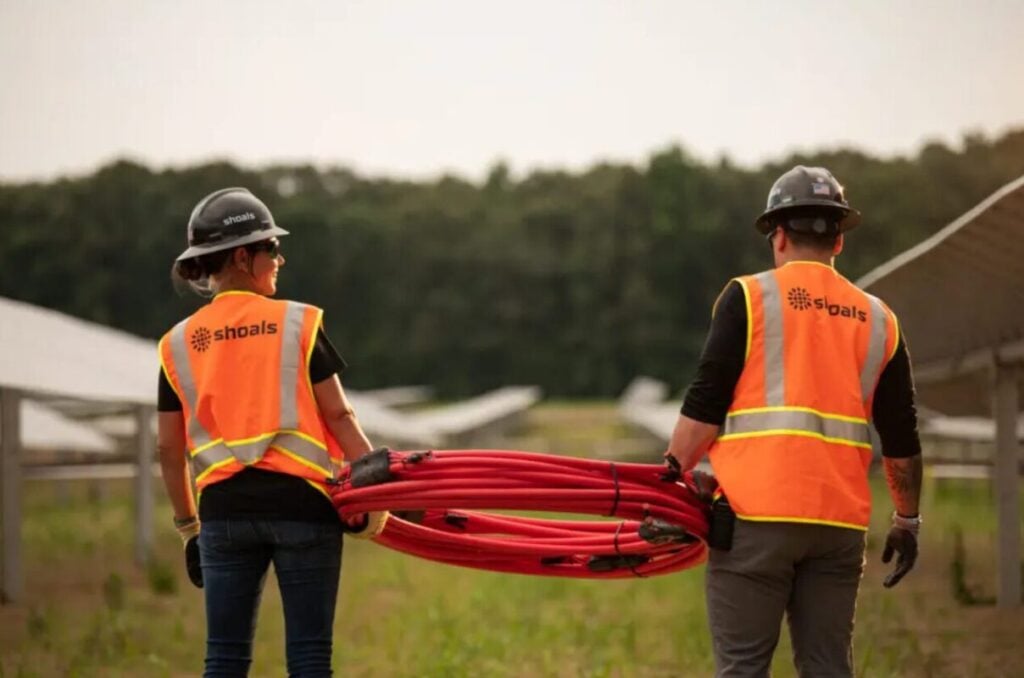
The patents pertain to Shoals’ ‘big lead assembly’ (BLA) solution, an aluminium trunk bus system that combines cable assemblies, combiner boxes and fusing, and that the company rolled out in 2017. Voltage’s product, meanwhile, is an aluminium trunk bus dubbed ‘LYNX’ that it has sought to import to the US.
On 9 February, Voltage responded to the initial ruling with its own release, leading with the heading: “Voltage wins again”, and saying that the company had “secured an important decision” in its favour from the ITC, a reading that, on the surface, directly contradicts Shoals’ conclusion.
In a publicly available document, the ITC ruled in favour of Shoals with regard to its two patents, saying there are four examples by which the 375 patent has “been shown to be infringed”, and three examples by which the 376 patent has “been shown to be infringed” by Voltage. The ITC ruling, issued by administrative law judge Doris Johnson Hines, also notes that these seven claims “have not been shown to be invalid”.
“The ITC initial determination was quite clear,” Lindsey Williams, VP of marketing and external communications at Shoals, told PV Tech Premium this week when asked about the ruling. “There is nothing in the initial ruling that would lend itself to any other conclusion other than a clear infringement violation of our patents.”
“I cannot speculate as to how Voltage came to a different conclusion.”
Voltage’s position
However, a source with knowledge of the Voltage side of the dispute told PV Tech Premium that the ruling will not prevent the company from importing its trunk bus products to the US, for two reasons.
Firstly, the ITC ruling is an “initial” determination, which is subject to internal review from the ITC and could be changed. The ITC has until June this year to provide a final determination, and while sources familiar with the Shoals side of the lawsuit expressed confidence that this initial determination would not be overturned, it is worth bearing in mind that this is not yet a final decision.
Secondly, Voltage has drawn attention a number of what it calls “alternative designs” (ADs) of its LYNX product that are different enough to both the initial LYNX design, and the Shoals BLA product, that they do not infringe on the 375 and 376 patents. According to ITC documents seen by PV Tech Premium, and shared with both Shoals and Voltage, these ADs “do not satisfy the disputed elements because their drop lines or drop line pathways are not parallel [to] the feeder cable of its pathway”.
While this is a small difference between these ADs and the initial products, the ITC document suggests that these differences are significant enough from a patent infringement perspective, concluding that “ADs do not infringe any asserted claim”. It is unclear, however, what form these ADs currently exist in, if any; Voltage makes reference to a new “LYNX PLUS” product in its 9 February announcement, but has not made other mentions to this product.
Ultimately, while the ITC has ruled that Voltage’s currently available product, the LYNX, is in violation of the Shoals patent, the ruling suggests that the potential remains for Voltage to import trunk bus products to the US, and certainly does not constitute a ban on Voltage imports.
“Shoals’ litigation has never been about protecting American jobs or innovation, but about stifling competition,” Voltage CEO Li Wang told PV Tech Premium this week. “We are pleased that the ITC has confirmed again that Shoals does not have a monopoly on trunk bus solutions.”
Following a 2024 lawsuit
The ITC’s initial ruling is the latest in a long line of lawsuits between the companies. Shoals and Voltage were involved in similar patent disputes in 2024, which yielded results largely in favour of Voltage: Shoals’ withdrew its complaint pertaining to one of its patents—number 10,992,254—and the ITC ruled that Shoals “had not satisfied the technical prong of the domestic industry requirement” for its patent number 10,553,739, which means that the patent could not be infringed upon.
This 2024 lawsuit is also significant because the initial determination made by the ITC was overturned, with the ITC first ruling that Shoals’ domestic industry products “satisfy the limitations” of its patents, but making the “reverse” ruling upon review.
This is precisely the kind of reversal that the Shoals sources said would be unlikely to happen in the 2026 case, and they told PV Tech Premium that this 2024 reversal was very surprising. Still, this reversal sets a precedent for such decisions in these kinds of patent disputes, and reinforces the importance of the final determination in June.
Looking ahead
Clearly, the next big milestone in this case will be the June final determination, when the ITC will rule as to the legal status of the LYNX products, and determine as to whether they can be imported to the US.
However, there is another key milestone next week, in the form of a court date in North Carolina, the state in which Voltage has announced plans to build a global headquarters. This lawsuit is being heard in two courts—the ITC and the North Carolina District Court—as these courts can issue different rulings: the ITC has the power to prevent the import of products to the US, while the North Carolina court can order a company to pay financial damages if it loses a case.
The hearing of a single case in two courts, to achieve different ends, is not unheard of, but typically the cases are heard one at a time; however, both cases are advancing simultaneously in this instance. Voltage plans to argue that Shoals’ conduct across the two simultaneous court cases constitutes “unclean hands”, a term used to refer to “inequitable” conduct on the part of one legal team, which can be broadly defined as acting in bad faith.
Voltage has not specified the nature of the inequitable conduct of which it is accusing Shoals, but it made a similar complaint against the company in the ITC court. The ITC’s ruling—which, again, is an initial determination that is subject to change—is that the 375 and 376 patents “have not been shown to be unenforceable for unclean hands”.
While there is no certainty that the North Carolina court will rule similarly, or that this ruling will be upheld in the final ITC decision in June, it is worth noting that one court has already dismissed Voltage’s claims of “unclean hands” in this case.
The North Carolina court date is set for next Thursday and Friday, 26-27 February, and the ruling on the “unclean hands” aspect of the case could set a precedent for the final June determination for the ITC.
Ultimately, with both the North Carolina court ruling and the final ITC determination still to come, the entire dispute is in something of a holding pattern: Shoals has secured a ruling in its favour in terms of the validity of its patent and Voltage’s infringement of that patent, but the initial nature of the ruling, and the presence of Voltage ADs that do not infringe on this patent, means that Voltage has not yet been prevented from importing its trunk bus products into the US.
This is, perhaps, why both companies felt able to declare victory: Shoals received a court ruling in its favour, and Voltage was not hit with a blanket ban on importing products to the US. However, with two big milestones looming, it is unlikely that both companies will be able to claim victory when this is all said and done.