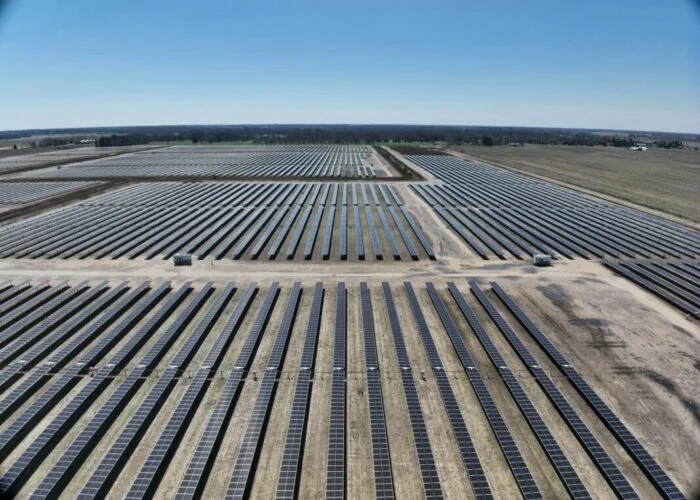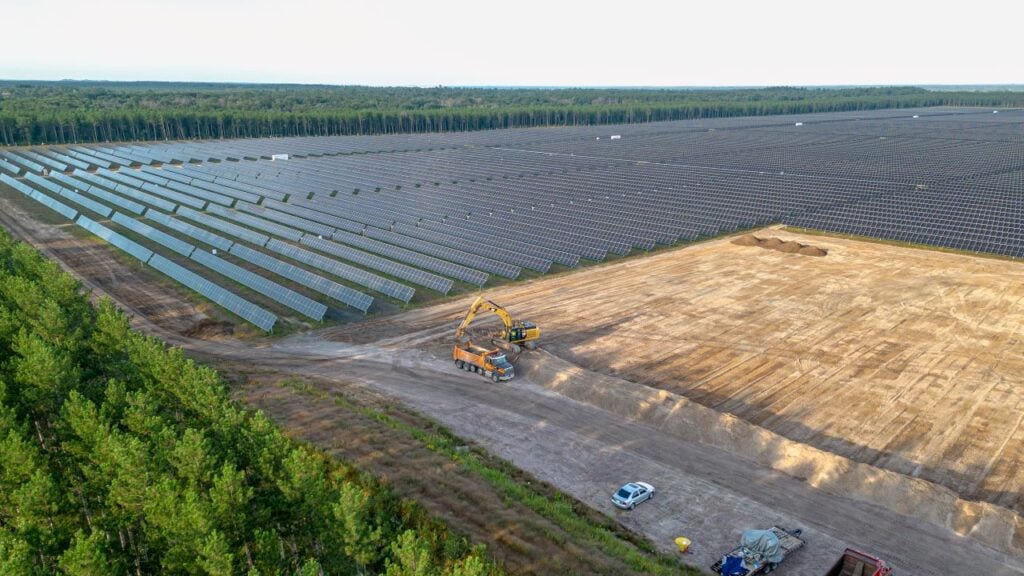
Two Wisconsin Republicans have introduced legislation to open access to community solar projects in the US state, the third time such a bill has been proposed.
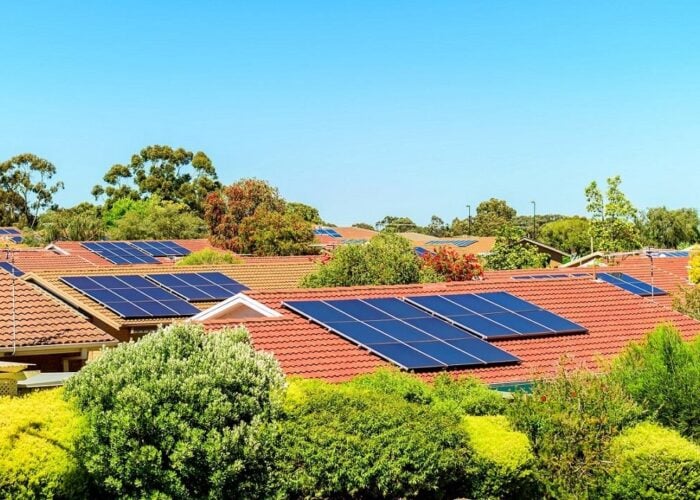
The bill, proposed by senator Pat Testin and representative Scott Krug, would allow farmers to lease “small, unproductive” parts of their land for community solar development, expanding the state’s solar sector and providing access to renewable energy for those unable to build residential solar projects on their own properties.
Try Premium for just $1
- Full premium access for the first month at only $1
- Converts to an annual rate after 30 days unless cancelled
- Cancel anytime during the trial period
Premium Benefits
- Expert industry analysis and interviews
- Digital access to PV Tech Power journal
- Exclusive event discounts
Or get the full Premium subscription right away
Or continue reading this article for free
Wisconsin’s solar sector has grown quickly over the last few years, with its 3.3GW of operational capacity enough for 18th among the 50 states, according to the Solar Energy Industries Association (SEIA). However, the vast majority of these additions have been in the utility-scale sector, with around 2GW of new utility-scale capacity coming online between the start of 2023 and the mid-point of 2025.
Currently, the state’s Public Service Commission (PSC) has the authority to approve energy projects, and the latest community solar bill would transfer some of this approval power to local groups, in an effort to accelerate the deployment of community solar projects.
According to the bill’s proponents, local residents would “have a direct say” in the approval process for community solar farms built on land covering 20-30 acres, granting local residents more control over the permitting and approval process. Under the proposed bill, a local governing body, rather than the state’s PSC would be able to grant zoning approval for a small-scale solar project with a two-thirds majority vote.
Testin and Krug argued that the “top-down approach”, where the PSC controls the approval process instead of local groups, means local people lack the power to control developments in their own communities.
“This legislation is designed to directly address those rising energy prices by expanding access to locally generated, affordable power,” said Testin. “Just as importantly, it ensures that communities themselves are in the driver’s seat, with a meaningful role in deciding where and how these projects are built.”
California also sees ‘suppression’ of small-scale solar
This uncertainty regarding responsibility for the approval process for small-scale solar projects is reflected elsewhere in the US. Earlier this month, the California Solar and Storage Association (CALSSA) called for US$10 million in fines to be levied on two state utilities for delaying the approval of residential solar and storage systems, and Kevin Luo, policy and market development manager for CALSSA, said that this amounts to the “suppression” of residential energy deployment in the state.
“Ultimately, the consequence of utilities’ violations of the interconnection timelines is the suppression of customer-side solar and storage,” Luo told PV Tech exclusively. “That is the ultimate consequence because what’s happening is that it’s adding extra time and extra costs to normal folks trying to add solar and storage on their rooves, on their business, on school [and] on farms.”
Indeed, variations of the Wisconsin community solar bill have been proposed and defeated several times over the past few years. The Wisconsin Conservative Energy Forum and Wisconsin Farm Bureau both supported this week’s bill, and earlier versions thereof, while utilities have often pushed back on these proposals.
Luo suggested that utilities and community solar projects are often at odds because their business models are incompatible with one another’s. He argued that each small-scale solar-plus-storage system built in a region takes customers away from a utility as they are no longer dependent on their, typically, large-scale projects to meet electricity demand.
However, some Wisconsin utilities have sought to invest in the community solar sector, however. Alliant Energy operates two community solar projects in the state – the most recent of which, the 2.3MW Janesville project, came online in May this year – and it remains to be seen if the utility will object to this version of the Wisconsin community solar bill.