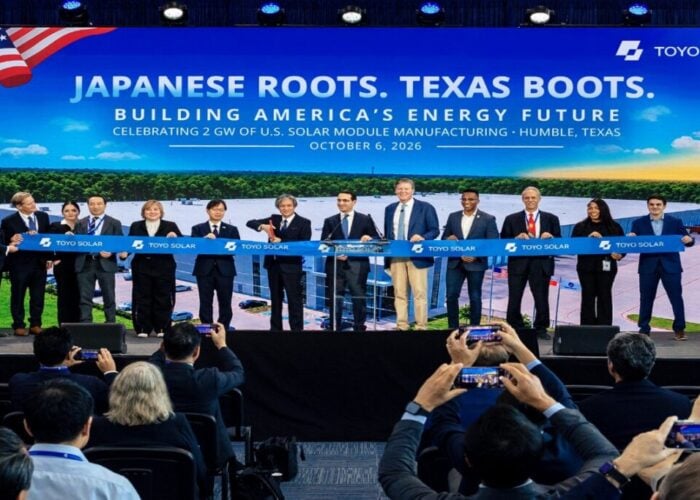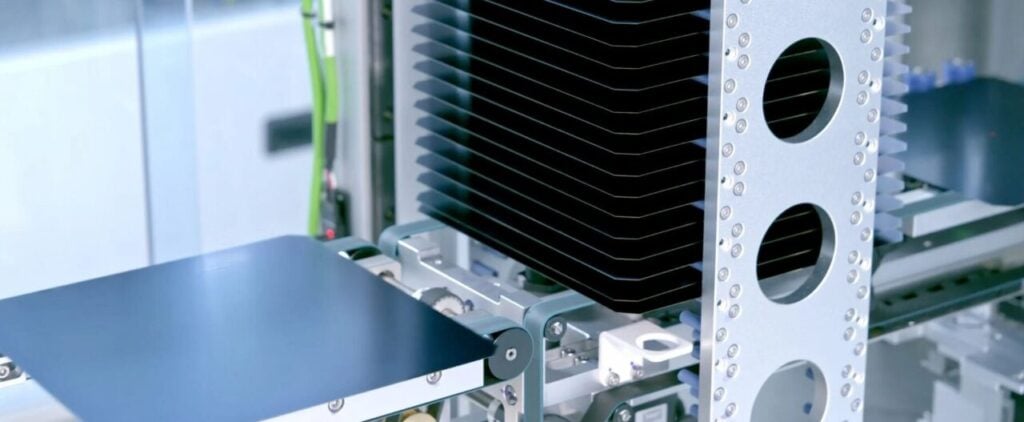
Japanese solar manufacturer Toyo has announced plans to add 1.5GW of heterojunction technology (HJT) solar cell production capacity at its Houston, Texas manufacturing facility.
The company said the expansion is expected to begin initial pilot production within “20 months” – around early 2028 – and will constitute around US$357 million in investment. Engineering, design and procurement for the project are already underway, and construction will happen in structured phases.
Try Premium for just $1
- Full premium access for the first month at only $1
- Converts to an annual rate after 30 days unless cancelled
- Cancel anytime during the trial period
Premium Benefits
- Expert industry analysis and interviews
- Digital access to PV Tech Power journal
- Exclusive event discounts
Or get the full Premium subscription right away
Or continue reading this article for free
In a statement, Toyo said the choice to produce HJT cells in the US was driven by the technology’s superior performance compared with “legacy solar architectures” and the opportunity to maximise its access to domestic content and Section 45X Advanced Manufacturing tax credits. The company said that at full capacity, the facility could potentially provide up to US$60 million in annual production tax credits.
“Expanding into domestic cell manufacturing is the natural next step in our commitment to creating an integrated onshore solar supply chain from polysilicon to panels,” said Takahiko Onozuka, chairman and chief executive officer of Toyo.
“The new cell plant reflects Toyo’s long-term strategy to build a fully FEOC-compliant domestic manufacturing platform focused on serving the needs of the US utility-scale solar market,” added Rhone Resch, Toyo’s chief strategy officer.
The Trump administration introduced expanded Foreign Entity of Concern (FEOC) restrictions in its 2025 budget reconciliation bill that impose strict limits on the use of Chinese-made or Chinese-owned products in solar projects or manufacturing sites looking to earn federal tax credits.
“By producing premium solar products in the United States, we will be well positioned to meet the market’s evolving domestic content requirements while strengthening supply chain security and reliability,” Resch continued. “Looking ahead, we believe HJT is the optimal technology platform for integrating next-generation perovskite solar cells, which we expect will drive the next major advancement in solar conversion efficiency and support Toyo’s long-term technology roadmap.”
TOPCon restrictions and AD/CVD
Despite framing this expansion as a technological choice, Toyo’s decision to produce US HJT cells comes amid stringent legal restrictions on tunnel oxide passivated contact (TOPCon) products in the US and an antidumping and countervailing duty (AD/CVD) investigation into Toyo’s existing cell production in Ethiopia.
TOPCon is the dominant cell technology for most of the global solar industry, but an intellectual property lawsuit brought by First Solar (which produces cadmium telluride thin-film modules in the US) earlier this year sought general exclusion and cease-and-desist orders for TOPCon products entering or produced in the US. This is an extension of the existing patent battles over TOPCon technology in the US, as manufacturers have fought for the rights to produce the tech.
Additionally, last month a group of US solar manufacturers operating as the Alliance for American Solar Manufacturing and Trade (AASMT) and including First Solar, filed an AD/CVD complaint with the US Department of Commerce against Toyo and fellow manufacturer Origin Solar for their cell production in Ethiopia.
The complaint alleged that the companies were “exploiting Ethiopia as the latest export platform to circumvent AD/CVD orders…by routing Chinese wafers and components through minimal Ethiopian solar manufacturing operations before shipping finished cells and modules to the United States”. This is the same type of allegation made against manufacturers in Southeast Asia back in 2022.
In comments to PV Tech, Resch refuted the allegations. He also told PV Tech Premium earlier this year that TOYO had existing plans for US cell manufacturing in Texas prior to the announcement of the AD/CVD case.
Moustafa Ramadan, head of market research at PV Tech Research, told us that Toyo’s HJT cell expansion is “the smart choice to avoid a legal action, not a technology choice”.
He added that the expansion of new AD/CVD cases from US-based manufacturers has shown that “the models of these companies [with module production in the US] will become harder and harder to maintain with manufacturing outside the US.
“It shows that if you want to be part of the US solar landscape, you need to have two things: 1: as much of your value and supply chain stateside as possible, and 2: to choose HJT, because TOPCon would mean either licensing from First Solar or a lawsuit.”
PV Tech Research is hosting its annual PV CellTech USA conference in the San Francisco Bay Area on 13-14 October 2026. The conference brings together the innovators, policymakers and supply-chain leaders driving the country’s next wave of wafer, cell and module capacity. You can find out more and get hold of tickets here. PV Tech readers can save 20% with code PVT20.