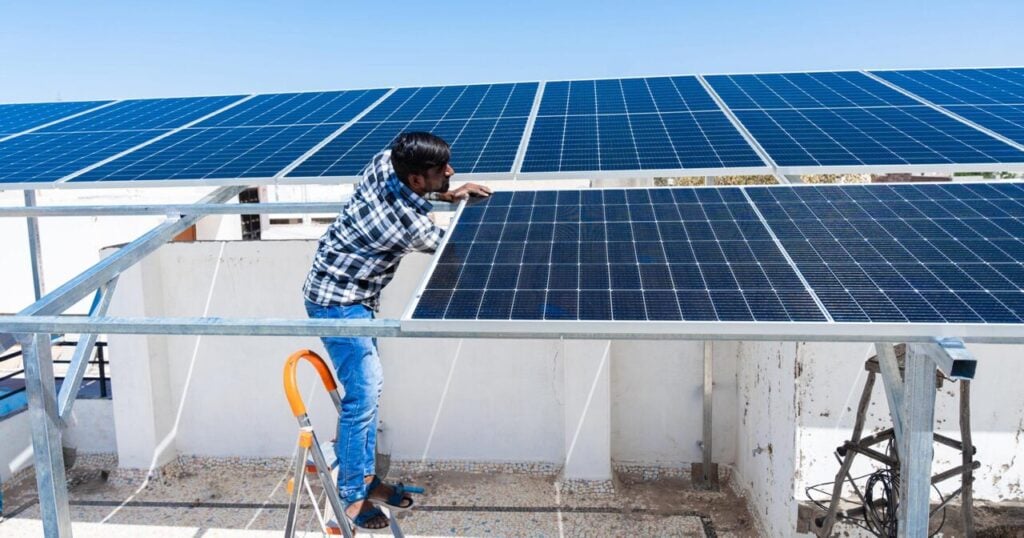
The World Bank’s board of executive directors has approved a US$890 million financing package to accelerate India’s national rooftop solar program, supporting the installation of solar systems for millions of households.
The financing will support the Government of India’s PM Surya Ghar: Muft Bijli Yojana (PMSMGBY) initiative, which aims to expand rooftop solar access to 10 million rural and urban households while reducing electricity costs for consumers and strengthening domestic solar manufacturing capacity.
Try Premium for just $1
- Full premium access for the first month at only $1
- Converts to an annual rate after 30 days unless cancelled
- Cancel anytime during the trial period
Premium Benefits
- Expert industry analysis and interviews
- Digital access to PV Tech Power journal
- Exclusive event discounts
Or get the full Premium subscription right away
Or continue reading this article for free
The package comprises an US$820 million loan from the International Bank for Reconstruction and Development (IBRD), a US$60 million concessional loan from the Clean Technology Fund, and a US$10 million grant from the IBRD’s Livable Planet Fund.
Alongside public financing, the World Bank said it will mobilise an additional US$4.2 billion in private sector financing through commercial loans to enable financial institutions to support rooftop solar installations for households.
Additionally, the investment will create an estimated 1.7 million jobs across the renewable energy manufacturing, installation and services value chain.
“The World Bank has been supporting India’s solar rooftop sector for over a decade, mobilising more than US$2 billion to catalyse market growth from 500MW to over 27GW of installed capacity,” said Paul Proccee, World Bank acting country director for India. “This new financing will help India scale up residential solar, while creating job opportunities across the supply chain and installation ecosystem.”
India has set a target of achieving net zero emissions by 2070 and increasing the share of non-fossil-fuel-based energy resources to 60% of its electricity mix by 2035. While utility-scale solar deployment has expanded rapidly in recent years, residential rooftop solar adoption has remained comparatively limited.
PMSMGBY program addresses barriers to residential solar adoption by providing incentives for rooftop installations, supporting local solar equipment manufacturing and expanding access to distributed clean energy.
“The program will transform the residential solar market by removing financial barriers and building the capacity of distribution companies, banks, and vendors to deliver integrated service solutions,” said Moez Cherif, task team leader of the program. “Through collateral-free financing, households can install solar power and significantly reduce their monthly electricity bills.”
The funding supports India’s renewable expansion, with rooftop solar central to scaling distributed generation and reducing household energy costs. While PMSGBY has boosted demand through subsidies and simplified processes, uneven state execution has constrained the conversion of applications into installations (subscription required).
India has installed 9.56GW of rooftop solar capacity under the PMSGMBY by March 2026, according to government data earlier this year. More than 2.62 million systems have been deployed since the scheme’s launch in 2024, benefiting around 3.24 million households.