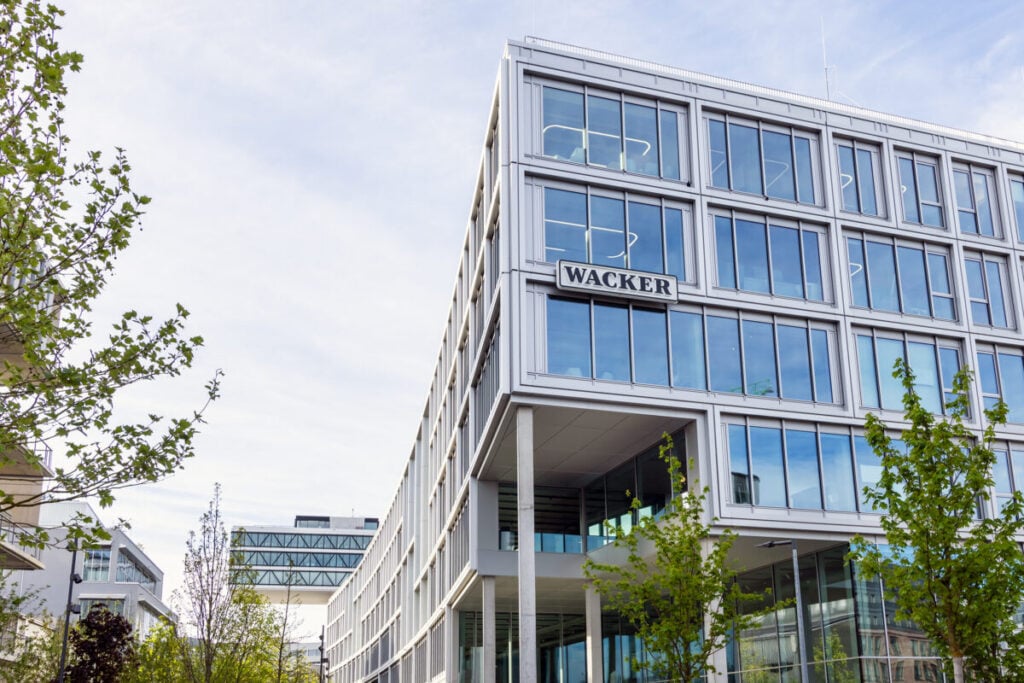
German chemical producer Wacker Chemie has recorded a significant decline in its earnings from polysilicon, due to the adverse market conditions in the solar sector.
The company recorded EBITDA of €11 million in Q2 2026 from its polysilicon division, down steeply from €34 million in the same period last year. This was driven by “lower demand and lower prices” in the solar-grade polysilicon sector.
Try Premium for just $1
- Full premium access for the first month at only $1
- Converts to an annual rate after 30 days unless cancelled
- Cancel anytime during the trial period
Premium Benefits
- Expert industry analysis and interviews
- Digital access to PV Tech Power journal
- Exclusive event discounts
Or get the full Premium subscription right away
Or continue reading this article for free
Wacker’s polysilicon EBITDA fell despite an increase in semiconductor-grade polysilicon sales. It said that overall polysilicon sales rise 3% to reach €226 million, “due to the positive development of the semiconductor-grade polysilicon business.”
The company as a whole saw its EBITDA rise by 85% year-on-year, from €114 million in Q2 2025 to €211 million in Q2 2026, primarily due to cost-cutting and efficiency measures the company implemented in October 2025. Wacker claims that the PACE efficiency programme has saved it around €300 million annually.
The company’s internal response is an attempt to counter what CEO Christian Hartel described as “persistently weak market conditions”.
“The rules of the game in the industry are currently undergoing a fundamental shift. At Wacker, we are addressing this change through our strategic priorities,” he said, citing “intensified” competition from Asia and “huge overcapacity in many markets”. He also mentioned the effects of the Middle East conflict, which has raised some commodity prices and pushed up energy prices.
All of these factors affect the polysilicon industry, which has been straining under massive overcapacity from Chinese producers in recent years. Earlier this month, the Silicon Industry Branch of the China Nonferrous Metals Industry Association issued data showing sustained weakness in the Chinese polysilicon market, with persistently low prices and little demand.

The industry has engaged in some sporadic efforts to alter the market conditions – notably Daqo New Energy resolved not to sell below the cost of production, meaning its Q1 2026 records showed an 88.3% decline in sales. But its production continued to rise at the same time, leading polysilicon market analyst Johannes Bernreuter to tell PV Tech that the market was “irrational” and “paradoxical”.
In the face of these dynamics, where Chinese producers seem content to lose money for the moment, potentially banking on future demand increases, and rising energy prices, Wacker’s polysilicon business is struggling to compete.
In its full-year outlook, Wacker said its forecast is marked with “a high degree of uncertainty…Due to the currently unpredictable future developments in the Middle East and the as yet unresolved American trade policies on imports of polysilicon and its derivatives”.
The Section 232 investigation into polysilicon imports to the US is currently ongoing, and could create a significant supply shock for US solar industry. As one of a handful of non-Chinese polysilicon producers, Wacker will be keeping tabs on the opportunities and risks that greater polysilicon supply constraints may bring. Yesterday, PV Tech reported that Korean producer OCI Holdings plans to double its poly production capacity to serve the US market, gambling on access to the US because of the price premium it offers. OCI already has a supply deal with Korean-owned US solar manufacturer Hanwha Qcells.