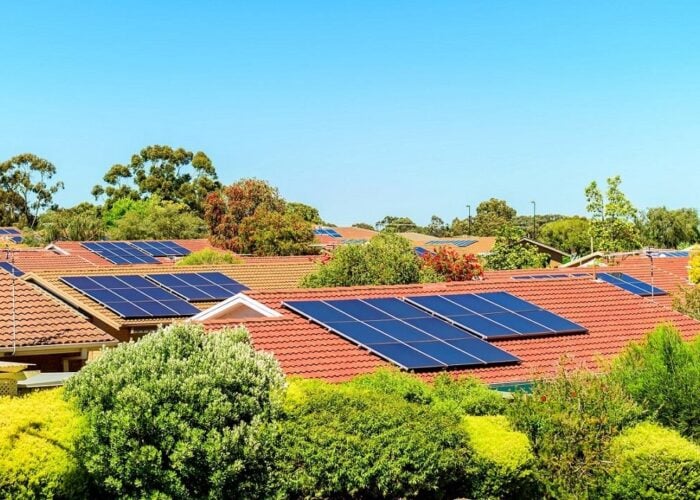
India’s rooftop solar sector is finally showing signs of catching up with the country’s utility-scale success story. Long constrained by high upfront costs, financing barriers and administrative hurdles, the residential segment has gained significant momentum since the launch of the government of India’s rooftop solar initiative PM Surya Ghar: Muft Bijli Yojana (PMSGY) in 2024.
In early 2026, India’s total solar capacity surpassed 150GW, but one of the fastest-growing segments is now found on household rooftops. Under the PMSGY more than 3.3 million rooftop solar systems have been installed, adding over 12GW of capacity.
Try Premium for just $1
- Full premium access for the first month at only $1
- Converts to an annual rate after 30 days unless cancelled
- Cancel anytime during the trial period
Premium Benefits
- Expert industry analysis and interviews
- Digital access to PV Tech Power journal
- Exclusive event discounts
Or get the full Premium subscription right away
Or continue reading this article for free
According to analyst firms Institute for Energy Economics and Financial Analysis (IEEFA) and JMK Research, India deployed nearly 4.9GW of residential rooftop solar capacity in H1 of 2025, equivalent to almost 45% of the nation’s total installed residential rooftop solar base, driven by the PMSGY.
According to the Ministry of New and Renewable Energy (MNRE), monthly rooftop installations have surged from a mere 7,000 before the scheme’s introduction to over 300,000, while the time taken to add a hundred thousand beneficiary households has fallen from 118 days to fewer than eight.
More than four million households have already benefited from the programme, with over 6.5 million applications currently in the pipeline and government projections targeting 7.5 million households by the end of 2026.
To understand what is driving this rapid shift— and whether the momentum can be sustained—PV Tech Premium speaks with Gaurav Upadhyay, energy finance specialist for India sustainable finance in South Asia at IEEFA, about the evolution of India’s rooftop solar market, the role of PMSGY, financing dynamics and the challenges that still lie ahead.
Scaling residential solar in India
Historically, India has prioritised utility-scale solar for its speed in delivering capacity via competitive auctions and attracting large-scale investment. Rooftop solar has lagged due to fragmentation and the complexity of reaching millions of consumers facing varied financial and administrative barriers.
Upadhyay highlights the accelerating pace of residential solar expansion, arguing that, “today, the economics and policy environment are much more favourable.”
“Government subsidies have reduced upfront costs, awareness has increased substantially, and installation procedures have become simpler. Rising electricity tariffs are also making self-generation increasingly attractive for households and businesses. As a result, rooftop solar is moving from an early-adopter technology to a mainstream consumer product.”
The government’s main target under PMSGY is to install rooftop solar systems on ten million households and achieve approximately 30GW of operational residential rooftop solar capacity by FY2027. The programme has an approved outlay of INR750.21 billion (US$7.8 billion), making it one of the largest residential solar programmes globally.
According to Upadhyay, rooftop solar plays a unique role in India’s clean energy transition because it complements utility-scale renewable energy.
“Unlike large solar parks, rooftop systems require no additional land acquisition and generate electricity close to where it is consumed. This helps reduce transmission losses, lowers peak demand, and improves grid resilience. As India pursues its target of 500GW of non-fossil fuel capacity by 2030, distributed solar can become a critical pillar of the energy transition,” he says.
PMSGY yields strong demand, uneven execution
PMSGY has emerged as a catalyst for India’s rooftop solar market. Earlier, adoption was largely confined to commercial and industrial (C&I) users, with households deterred by high upfront costs and complex approvals.
The scheme has since unlocked strong consumer demand, with 5.8 million applications received and 1.6 million installations completed by July 2025. Meanwhile subsidy disbursements exceeded INR 92.8 billion.
Rooftop solar economics have strengthened, with subsidies of up to INR78,000 under PMSGY reducing upfront costs. Payback periods are typically four to six years in higher-tariff states, but they can be longer elsewhere, while systems deliver 20–25 years of output. Savings are highest for high-consumption households, which offset more grid power and achieve faster returns.
“PMSGY has created confidence across the value chain. The national portal, direct benefit transfer (DBT) mechanism and simplified procedures have reduced many of the friction points that previously discouraged consumers,” says Upadhyay.
However, IEEFA’s research shows that strong demand under PMSGY has not consistently translated into installations. By July 2025, the scheme had received around 5.8 million applications, but only about 22.7% had been completed. Additionally, performance varies sharply by state, with Gujarat and Kerala seeing more than 65% of their project applications approved—a figure IEEFA calls ‘installation to application ratio’—, while Rajasthan and Uttar Pradesh posted ratios of 21.8% and 14.8%, respectively.
Upadhyay attributes this disparity to “stronger implementation frameworks, proactive power distribution company (DISCOM) engagement and higher consumer awareness, while several other states continue to lag.”
Looking ahead, IEEFA highlights the need for greater regulatory consistency across net metering rules, approval timelines and DISCOM practices, alongside stronger financing ecosystems, improved consumer awareness, expanded installer training and more efficient grievance redressal.
Rooftop solar and DISCOMs
Earlier, many DISCOMs had been cautious about rooftop solar as it displaces high-value electricity sales, particularly from commercial and industrial consumers. These segments typically pay tariffs above the cost of supply, cross-subsidising residential and agricultural users.
Upadhyay emphasises that with the increased adoption of rooftop solar, “DISCOMs risk losing some of their most profitable customers, which can further strain their financial position. This concern is particularly relevant given the fragile fiscal condition of many state-owned DISCOMs.”
However, the rooftop solar–DISCOM relationship is gradually evolving. “Distributed solar can reduce technical losses, ease peak demand, defer network upgrades and improve grid resilience by generating closer to load centres,” says Upadhyay “Under PMSGY, it can also moderate residential demand growth and limit the need for new capacity additions.”
Key challenges and the road ahead
While PMSGY has driven momentum, financing constraints, particularly for low- and middle-income households, continue to pose the biggest barrier, Upadhyay notes.
“While public sector banks offer lower rates but slower approvals, non-banking financial companies (NBFCs) provide faster credit at higher costs,” says the analyst. “Consumer awareness also remains uneven, especially in smaller cities and rural areas, where many households are still unfamiliar with financing options, system performance and installation processes.”
Another challenge is scaling the installer ecosystem to match rapid demand, including quality assurance and after-sales service. Persistent delays in net metering, inspections and commissioning, along with regulatory inconsistencies, continue to create uncertainty, while supply chain constraints and domestic manufacturing requirements can also impact timelines and equipment availability.
He argues that, looking ahead, “grid integration and regulatory innovation will be key to scaling distributed solar. This will require smarter distribution networks, digital monitoring and storage, alongside expanded models such as virtual and group net metering, community solar and RESCO frameworks to reach apartments, tenants and households without suitable rooftops. Addressing these gaps will be critical to converting strong demand into sustained deployment.”
The next phase of growth will require policy innovation beyond conventional rooftop models. Virtual and group net metering can help apartment residents, tenants, and small businesses access solar from off-site generation, expanding the addressable market and already showing promise in states such as Maharashtra.
By 2030, rooftop solar is set to play a key role in India’s distributed energy mix alongside utility-scale projects. It offers distinct advantages, including lower bills, reduced transmission losses, improved energy security, and greater consumer empowerment.
“The success of the next phase will depend less on subsidies and more on execution,” concludes Upadhyay. “Faster approvals, stronger financing ecosystems, improved installer quality, supportive state policies, and deeper integration with battery storage and smart-grid technologies will determine whether rooftop solar achieves its full potential. If these elements come together, rooftop solar could become one of the most visible and inclusive aspects of India’s clean energy transition.”