Australia’s Clean Energy Council (CEC) has called for a national ‘Renewable Resources Payment’ scheme, directing that a legislated payment be made from every megawatt-hour of renewable energy generation to the local councils hosting that infrastructure for the life of each project.
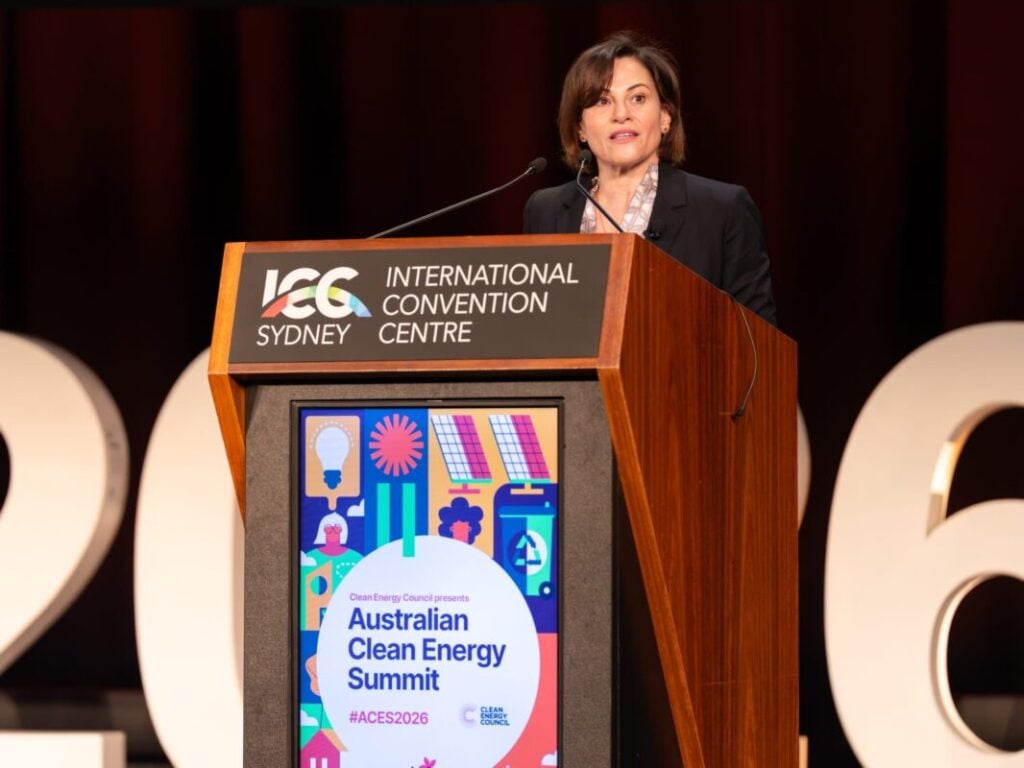
The proposal was put to the Australian Clean Energy Summit 2026 in Sydney this week (28 July) by CEC chief executive Jackie Trad, who was appointed to the role in August 2025 following the departure of Kane Thornton after a decade in the position.
Try Premium for just $1
- Full premium access for the first month at only $1
- Converts to an annual rate after 30 days unless cancelled
- Cancel anytime during the trial period
Premium Benefits
- Expert industry analysis and interviews
- Digital access to PV Tech Power journal
- Exclusive event discounts
Or get the full Premium subscription right away
Or continue reading this article for free
Trad, a former Deputy Premier and Treasurer of Queensland, framed the call as a direct response to a trust deficit between the renewable energy industry and regional Australia that she said was now the industry’s defining challenge.
“The fundamental problem this industry has is trust. We do not have enough of it in the places where we build: regional and rural Australia,” she told the audience.
“Our intentions are sincere. Our product is clean. But go looking for the research that says regional communities trust the renewable energy industry, and you will not find it. It does not exist. And in this business, what communities believe determines what gets built.”
Under the proposal, the payment rate would be set by legislation and applied uniformly across all renewable energy generation, replacing what Trad described as the current patchwork of access fees, community benefit funds, grants and negotiated arrangements that vary project by project.
Payments would go directly to local councils, which the CEC argues are best placed to determine how they are spent. “Scrap the patchwork. Replace it with something simple, permanent and public – the same way coal and gas pay royalties,” Trad said.
The proposal draws an explicit parallel with the royalty arrangements that apply to Australia’s coal and gas industries, where payments based on extraction flow to governments and communities in resource-hosting regions.
The CEC is positioning the Renewable Resources Payment as an equivalent mechanism for the clean energy sector, providing communities with a predictable, transparent income stream tied directly to the output of projects in their area rather than to the discretion of individual developers.
Trad said the scheme was not intended to add cost to the industry but to redirect existing community investment through a more transparent and effective channel.
“I want to be clear, this is not intended to be an additional cost; it is intended to be a better way of spending the money we already spend and a clearer way of communicating our investment and the benefit,” she said.
The details of the rate, thresholds and implementation mechanism would be developed through consultation with industry and regional communities.
Trust as a delivery constraint
Trad’s speech made a direct link between community trust and the speed of project delivery, arguing that the absence of a systematic community benefit framework was already adding cost and time to the development pipeline.
“Every project that spends three extra years in contested approvals. Every project that dies in a hostile council chamber. Every town hall that fills against us because nobody in that hall can point to a single thing our industry has built for their town. Distrust is the most expensive line item in this industry, and we pay it every single day.”
She distinguished community support and community trust, noting that broad public polling in favour of renewable energy had not translated into social licence at the project level.
“Support is soft. Support is what people tell a pollster. Trust is what they give you when the project is over the back fence – and support evaporates fast when trust is absent.”
The proposal was partly inspired by experience in Central Queensland, where Trad said renewable energy companies had moved to direct payments to Isaac Regional Council for the council’s own priorities, producing what she described as a reversal in a previously difficult relationship.
The choice of local councils as the payment recipient reflects their position as the most locally accountable level of government.
“A mayor knows whether the town needs a pool, a childcare centre, doctor’s rooms or a decent road. And if the money is spent badly, there is a reckoning every four years at the ballot box,” she said.
The CEC’s call comes as Australia’s renewable energy buildout places growing demands on regional communities that sit within renewable energy zones and along planned transmission corridors.
The Summit also heard from former Chief of the Defence Force Admiral Chris Barrie AC (Retd), who called on the industry to move beyond infrastructure deployment and become a public advocate for policy consistency across the entire energy system.
Admiral Barrie warned that Australia’s continued expansion of fossil fuel exports was cancelling out progress made by the clean energy sector and amounted to a “Jekyll and Hyde climate policy.”
Trad framed the energy transition in terms of national sovereignty, pointing to the disruption to global fertiliser supply caused by conflict in the Middle East as an example of the vulnerability created by dependence on globally traded commodities.
“Here is the thing about wind and sun. You cannot embargo them. You cannot blockade them. You cannot close a strait and choke them off,” she said, adding that an estimated AU$155 billion (US$107 billion) pipeline of proposed data centres in Australia was adding further urgency to domestic clean energy supply.
The CEC said the design of the scheme, including the rate per megawatt-hour and implementation timeline, would be developed in consultation with industry and regional stakeholders.