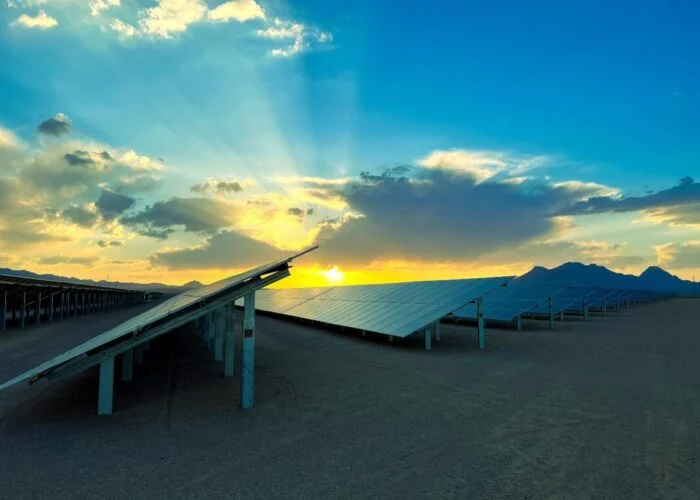
The Zambian government has signed contracts with five contractor groups to build 312MW of solar capacity across all 156 parliamentary constituencies under the Presidential Constituency Energy Initiative (PCEI).
The ZMW4.3 billion (US$234,979) programme will see the construction of 2MW solar plants in each constituency, with all projects expected to connect to the national grid operated by Zambian national power utility ZESCO.
Try Premium for just $1
- Full premium access for the first month at only $1
- Converts to an annual rate after 30 days unless cancelled
- Cancel anytime during the trial period
Premium Benefits
- Expert industry analysis and interviews
- Digital access to PV Tech Power journal
- Exclusive event discounts
Or get the full Premium subscription right away
Or continue reading this article for free
The contracts were awarded to five consortiums comprising Sunshare Construction and the China Railway Construction Engineering Group, the China Civil Engineering Construction Corporation, Golden Baobab Investments and Huawei Technologies Zambia, Chetam Metals Fabrication and the ZamChin Construction Company, and the China Jiangxi International Corporation and Qingdao Haier Photovoltaic New Energy Company.
According to the Ministry of Local Government and Rural Development, the projects are scheduled for completion within 12 months and are expected to create around 15,600 jobs during construction.
The programme was approved by Cabinet in November 2025 and will add 312MW of generation capacity to Zambia’s electricity system, which has faced supply shortages in recent years.
Speaking at the contract signing ceremony, permanent secretary for technical services Nicholas Phiri said electricity generated by the plants would be injected directly into the ZESCO grid to help reduce the country’s power deficit.
“The PCEI is directly aligned with Zambia’s broader macro-economic and developmental goals. By integrating these solar assets into the national grid, the initiative supports the long-term target of expanding Zambia’s power generation capacity,” Phiri stated.
“Local authorities will also share equity in the plants, generating a sustainable revenue stream to support community development. The achieved energy target of ten million megawatts will enable an all year-round crop cultivation through irrigated agriculture, and in turn directly support the National target of ten million metric tonnes of maize.”
The initiative will be managed through a special purpose vehicle involving the ministries of finance, local government and energy, while ZESCO will oversee project management, technical standards and grid integration.
China Civil Engineering Construction Corporation Southern Africa managing director Jacques Lioa, speaking on behalf of the contractors, said the projects would be delivered within the agreed 12-month construction period.