US solar has a massive data quality and transportability problem that is holding back the deployment of solar PV throughout the country, says Kiran Bhatraju, founder and CEO of renewable technology company Arcadia, which is aiming to build the ‘internet of energy’.
Utility data in the US is incomplete, difficult to access and lacking consistency in the way it is organised and shared, he said, adding that this is holding back the energy transition by preventing the move towards an effective digital network that can accelerate deployment.
Try Premium for just $1
- Full premium access for the first month at only $1
- Converts to an annual rate after 30 days unless cancelled
- Cancel anytime during the trial period
Premium Benefits
- Expert industry analysis and interviews
- Digital access to PV Tech Power journal
- Exclusive event discounts
Or get the full Premium subscription right away
Or continue reading this article for free
Speaking to PV Tech on the heels of the launch of Arc, the company’s flagship platform that aggregates data from more than 80% of US electric utility accounts and 125 utilities nationwide, Bhatraju says every major industry has digitised data in order to drive innovation, apart from the energy sector.
Energy innovation, he says, “has been blocked by fossil fuel utility monopolies for more than 130 years”. Arcadia aims to address this by building the digital infrastructure its customers need to help drive the energy transition through greater access, control and understanding over energy data.
Arcadia aims to give users real-time control and solutions
Arc essentially creates a ‘digital layer’ of energy data, analytics, billing and optimisation capabilities that will enable real-time visibility and control over energy usage and costs, says Bhatraju. This makes it easier for users to understand their precise energy needs relative to their decarbonisation plans and in the context of the local utility landscape, he said.
“This access to data will enable energy innovators to build thoughtful and climate-conscious solutions for their end-users, from charging their EV when the grid is cleanest and cheapest to automatically finding cheaper electricity rates based on their home’s energy footprint,” he said.
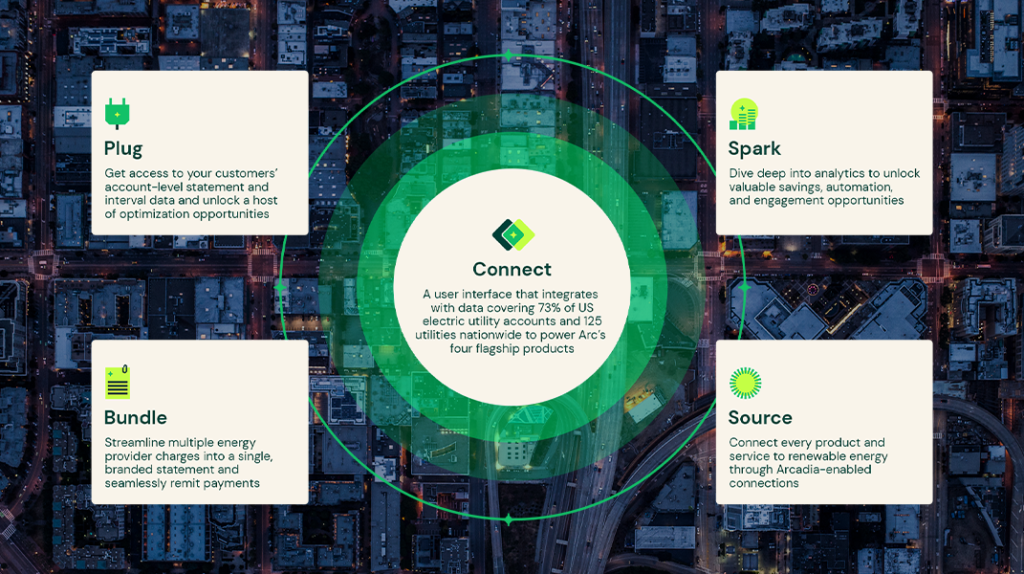
Through its user interface Connect, Arc accesses data from a customer’s utility account and then uses technology “similar to Google to collect data that exists within that utility account and make it easily digestible and available,” Bhatraju explained. This data is then standardised to enable comparisons in measurement and reporting across different US utilities and to inform Arcadia’s suite of services.
Arc, which has been seven years in development, provides users with the analytics tools to “turn that data into smart, actionable solutions”. Its four internal products tackle a range of home energy issues, from analytical software that can create savings through optimisation to grouping multiple bills into a single line to identifying access to community solar programmes. This has resulted in Arcadia becoming the biggest manager – not owner or operator – of community solar in the US, said Bhatraju.
While Arcadia rarely works with utilities directly, preferring the customer channel to access data, Bhatraju said utility companies welcome the role that Arcadia plays in many cases. “We’ve heard feedback from a lot of utilities that they very much appreciate that a third party can provide this service because customers do want access to new products.”
He said that utilities are focused on provision, resilience and transmission, with little time spent on better understanding the specific individual needs of customers. And these needs are changing. Now, consumers are more interested in technologies like electric vehicles (EVs), smart meters and the benefits of energy storage, said Bhatraju.
As part of the Arc launch, Arcadia also acquired a company called Genability, which had one of the most up-to-date utility rate engines, said Bhatraju. When combined with Arcadia’s databased, and mapped against utility and historical use data, these analytical tools can tell customers how much they could save with solar, energy storage systems or EVs, said Bhatraju.
Arcadia currently has over half a million end users and works with a broad range of customers, including residential solar, community solar, residential and commercial storage, electric vehicles, smart home providers and retail energy companies.
Since 2014, it has onboarded more than 700,000 utility accounts to its platform, processed more than US$470 million in residential utility bill payments, and connected more than 3.7 billion kilowatt-hours of clean energy. But Bhatraju sees this as just the beginning, with the launch of Arc set to propel the company even further.
“We’re enabling the ‘Internet of Energy’ – unlocking comprehensive energy data on a nationwide scale to support the development of a decentralised, decarbonised smart grid,” Bhatraju concluded.