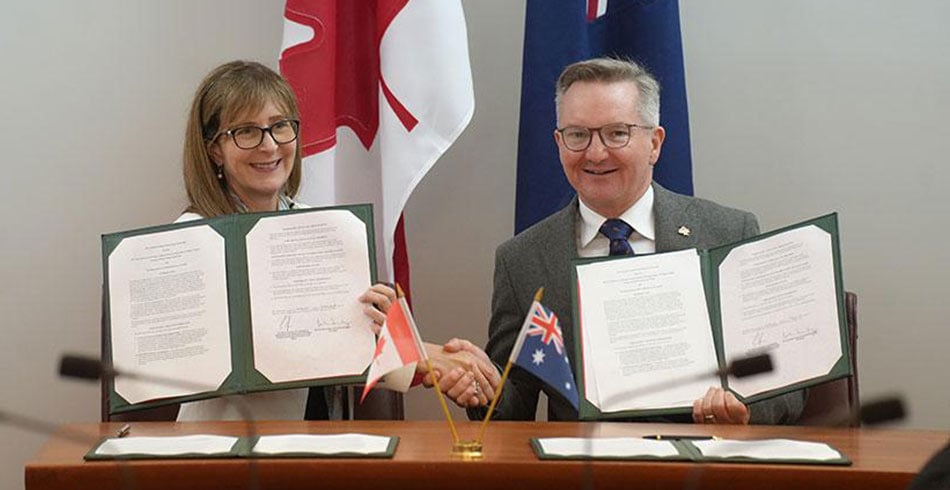
Australia and Canada have signed their first bilateral Clean Energy Partnership, establishing a framework for cooperation across five key areas, including grid modernisation, hydrogen standards development and Indigenous engagement in the clean energy transition.
The partnership signed last week (5 March) between Australia’s Department of Climate Change, Energy, the Environment and Water (DCCEEW) and Canada’s Department of Natural Resources aim to strengthen bilateral cooperation on decarbonisation while maximising economic opportunities from the clean energy transition.
Try Premium for just $1
- Full premium access for the first month at only $1
- Converts to an annual rate after 30 days unless cancelled
- Cancel anytime during the trial period
Premium Benefits
- Expert industry analysis and interviews
- Digital access to PV Tech Power journal
- Exclusive event discounts
Or get the full Premium subscription right away
Or continue reading this article for free
Minister for Climate Change and Energy Chris Bowen and Canada’s High Commissioner to Australia, H.E. Dr Julie Sunday, formalised the agreement during Canadian Prime Minister Mark Carney’s visit to Australia, marking the first bilateral visit by a Canadian Prime Minister to Australia in nearly two decades.
The partnership comes as Australia’s renewable energy sector continues its rapid expansion, with utility-scale solar and wind generation reaching significant milestones, while the National Electricity Market has achieved historic renewable energy penetration levels.
Five pillars of bilateral cooperation
The partnership establishes five distinct areas of collaboration, with trade, investment, standards and supply chains forming the first pillar.
This encompasses facilitating greater trade and investment in both countries’ clean energy industries, including business-to-business engagement and co-investment opportunities.
Significantly, the partnership includes provisions for developing international hydrogen standards and promoting environmental, social and governance practices in clean energy supply chains.
Grid modernisation and resilience represent the second pillar, focusing on standardised training and simulation-based learning for emergency response, grid management and variable renewable energy integration, such as solar PV.
The cooperation will include exchanges between scientific institutes and secondments to the grid operator to support knowledge exchange and address critical infrastructure needs as both countries scale their renewable energy deployment.
This collaboration becomes increasingly relevant as Australia’s grid operators navigate complex pricing volatility and generation management challenges.
The third pillar addresses energy and hard-to-abate sectors, with both countries cooperating to decarbonise energy systems and challenge industrial sectors on a path to net zero.
This includes the development and uptake of low-carbon liquid fuels, sustainable aviation fuels, and carbon dioxide removal technologies.
Indigenous engagement forms the fourth pillar, reflecting both countries’ commitment to including Indigenous peoples in the clean energy transition.
The cooperation will support outcomes from Australia’s First Nations Clean Energy Strategy and Canada’s engagement with Indigenous stakeholders in clean energy projects through business roundtables on local employment agreements and broader engagement processes.
Climate change adaptation completes the five-pillar framework, focusing on strategies to prepare energy systems for increasing intensity and frequency of climate-related risks, including extreme heat, floods, and wildfires affecting both nations.
Implementation framework and governance
The partnership establishes a structured implementation approach through regular ministerial meetings, business-to-business engagement, and working-level coordination between portfolio agencies.
Participants will hold senior officials’ meetings within six to eight months of the partnership’s commencement to identify priority areas for cooperation, with regular meetings thereafter to set ongoing priorities.
The agreement encourages enterprises to strengthen business-to-business cooperation and to create projects that support commercial objectives, while facilitating information exchange, expertise sharing, and technical knowledge transfer through visits and virtual platforms.
Joint partnerships between industries from both countries will be explored as opportunities arise.
The partnership operates as a non-legally binding framework that does not create rights or obligations under domestic or international law, with each participant bearing their own implementation costs unless otherwise agreed.
Any differences regarding interpretation or application will be resolved through diplomatic channels rather than through formal dispute-resolution mechanisms.
The clean energy partnership forms part of a comprehensive bilateral relationship expansion, with Canada welcoming Australia into the Critical Minerals Production Alliance during Prime Minister Carney’s visit. This initiative, launched under Canada’s G7 Presidency in 2025, aims to expand critical minerals production and processing capacity while diversifying supply chains from mine to market.
Both countries hold substantial reserves of critical minerals essential for defence, manufacturing, and technologies, including batteries, EVs, and artificial intelligence (AI) systems.
The partnership positions both nations to capitalise on growing global demand for clean energy infrastructure and technologies, particularly as Australia’s distributed solar capacity is projected to reach substantial scale in the coming years.
The agreement also encompasses broader cooperation on AI safety through a separate memorandum of understanding, enabling collaboration between the AI safety institutes of both countries.
The Energy Storage Summit Australia 2026 will be returning to Sydney on 18-19 March. It features keynote speeches and panel discussions on topics such as the Capacity Investment Scheme, long-duration energy storage, and BESS revenue streams. ESN Premium subscribers receive an exclusive discount on ticket prices.
To secure your tickets and learn more about the event, please visit the official website.