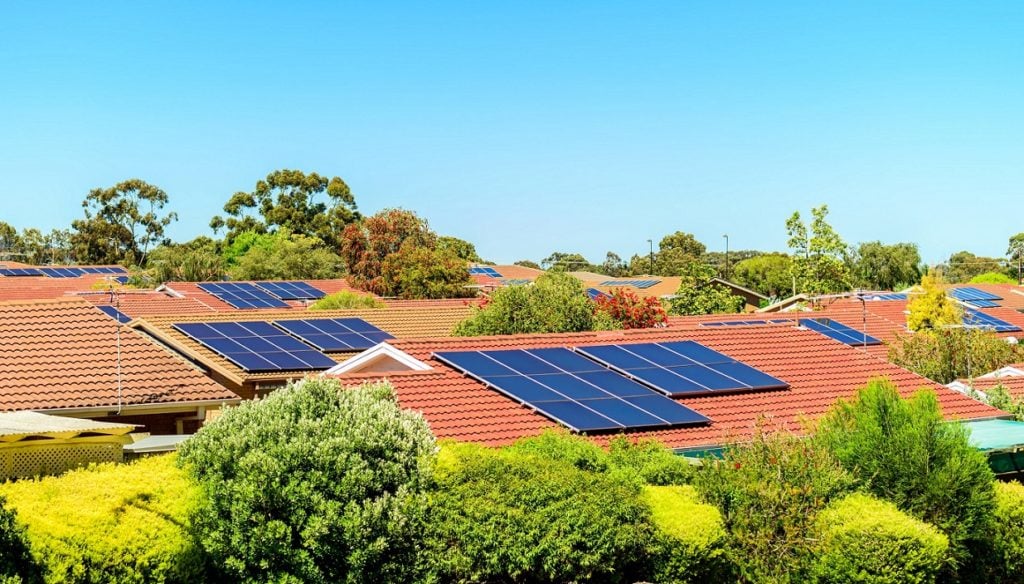
The Australian government has announced a new regulated electricity offer requiring energy retailers to provide free solar electricity to households during peak daytime generation periods, regardless of whether customers have rooftop solar installations.
The Solar Sharer programme, unveiled by Australia’s climate change and energy minister, Chris Bowen, will initially launch in New South Wales, south-east Queensland and South Australia from July 2026 through the Default Market Offer framework.
Try Premium for just $1
- Full premium access for the first month at only $1
- Converts to an annual rate after 30 days unless cancelled
- Cancel anytime during the trial period
Premium Benefits
- Expert industry analysis and interviews
- Digital access to PV Tech Power journal
- Exclusive event discounts
Or get the full Premium subscription right away
Or continue reading this article for free
Under the terms of the offering, energy retailers will be required to grant customers free solar-derived electricity for “at least three hours in the middle of the day”.
Bowen described the Solar Sharer offer as ensuring “every last ray of sunshine was powering our homes” while enabling more Australians to participate in the country’s solar energy transition.
The programme targets households with smart meters who can shift their electricity consumption to coincide with the designated free power periods during midday hours, when solar generation reaches its peak output.
The policy responds to Australia’s unique position as a global leader in distributed solar deployment, with the country hosting over four million rooftop installations, according to government figures. This extensive residential solar infrastructure has created significant midday generation surpluses that often exceed local demand, particularly during optimal weather conditions.
Australia’s National Electricity Market (NEM) has achieved record-breaking renewable energy performance in recent months, with rooftop solar capacity reaching 26.8GW in the first half of 2025. The substantial distributed generation capacity has contributed to minimum demand records as rooftop solar output reached 15GW during peak generation periods.
The Solar Sharer programme aims to address the economic challenges created by this generation abundance. Excess solar production during midday periods has reduced wholesale electricity prices and diminished feed-in tariff rates for rooftop solar owners, creating economic pressure on the distributed solar sector.
Indeed, the new programme seeks to increase daytime electricity consumption by incentivising households to operate appliances during peak solar generation windows.
Customers participating in the Solar Sharer offer will need smart meter installations to access the free electricity periods. The initiative covers all household electricity usage during the designated three-hour windows, including air conditioning, washing machines, dryers and other high-consumption appliances.
The Australian Energy Regulator (AER) will oversee the Solar Sharer programme to ensure customers receive fair pricing outside the free power periods. The regulatory framework aims to prevent retailers from inflating standard electricity rates to offset the cost of providing free daytime power, maintaining consumer protection across all usage periods.
The programme’s initial rollout covers Default Market Offer regions (New South Wales, South Australia and south-east Queensland) where the Australian Energy Regulator sets benchmark electricity pricing.
The government plans to consult with Victoria and Western Australia about extending the Solar Sharer offer to their jurisdictions by 2027, potentially expanding the program’s coverage to additional households across the NEM.
The Solar Sharer initiative reflects broader trends in Australia’s electricity system transformation, where record-breaking surges in renewables and energy storage assets have fundamentally altered generation patterns and wholesale market dynamics. The programme represents a policy response to manage the integration challenges created by high renewable energy penetration.
Energy retailers will be required to offer Solar Sharer plans, but customers must actively opt into the program rather than being automatically enrolled.
This approach aims to ensure consumer choice while providing access to the benefits of Australia’s abundant rooftop solar generation for households across different housing types and ownership arrangements.
You can explore September’s solar generation performance in our latest NEM data spotlight, with all entries available to PV Tech Premium subscribers.