Ark Energy, a Queensland-headquartered renewable energy developer and subsidiary of Korean metals company Korea Zinc, has secured a financial investment decision (FID) for its AU$1.3 billion (US$855 million) Richmond Valley solar-plus-storage project in Australia.
The FID was approved at an Extraordinary Board Meeting of Korea Zinc in Seoul on 21 July 2026. The financing package comprises AU$586 million in equity and AU$716 million in debt.
Try Premium for just $1
- Full premium access for the first month at only $1
- Converts to an annual rate after 30 days unless cancelled
- Cancel anytime during the trial period
Premium Benefits
- Expert industry analysis and interviews
- Digital access to PV Tech Power journal
- Exclusive event discounts
Or get the full Premium subscription right away
Or continue reading this article for free
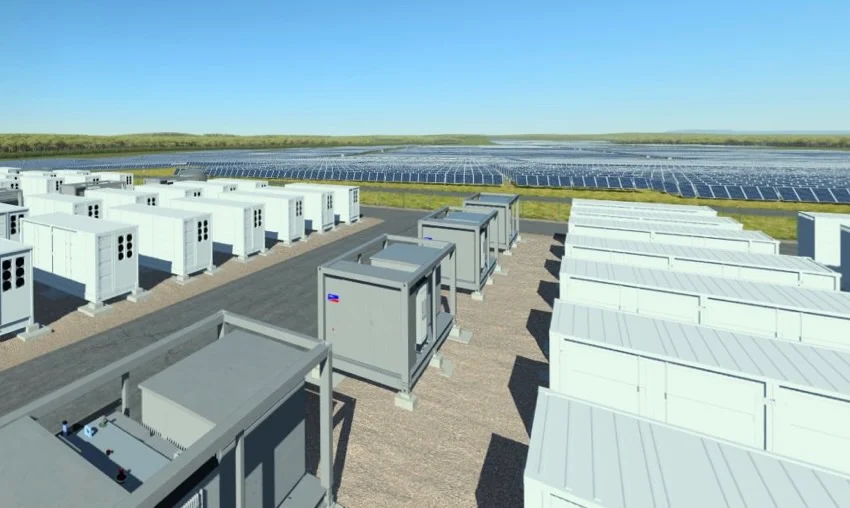
It covers the project’s priority stage: a 200MWac solar PV power plant co-located with a 275MW/2,200MWh lithium iron phosphate (LFP) battery energy storage system (BESS), located approximately 25km south of Casino in New South Wales’ northern rivers region.
Financial close is targeted for September 2026, with construction expected to begin in October 2026 and operations targeted for January 2029. The project is the first build-to-own development in Ark Energy’s portfolio to reach FID.
The milestone follows a development timeline that Ark Energy completed in four years.
New South Wales planning approval was granted in October 2025, federal environmental clearance under the EPBC Act followed in December 2025, and grid connection approval from AEMO and transmission network provider Transgrid was secured in June 2026.
Richmond Valley was also highlighted at the time as among the first hybrid solar-plus-storage projects in the National Electricity Market (NEM) to operate through a single point of connection using grid-forming inverter technology.
The full approved configuration extends to 435MW of solar and a 475MW/3,148MWh BESS.
The project holds a Long-Term Energy Service Agreement (LTESA) under the NSW Electricity Infrastructure Roadmap and is listed on the Australian government’s National Renewable Energy Priority List.
South Korean energy company Hanwha Energy is supplying the BESS, with Elecnor Australia engaged as early contractor for engineering and design.
Ark Energy CEO Michael Choi said the decision reflected strong backing from Korea Zinc.
“This approval represents a strong endorsement from Korea Zinc and confirms its continued commitment to supporting the Richmond Valley project and Ark Energy’s growth ambitions,” he said.
The project is expected to support more than 850 direct and indirect jobs during peak construction and generate approximately AU$180 million in local expenditure.
Quinbrook submits 150MW Lansdown Solar West project to Australia’s EPBC Act
Australian infrastructure investor Quinbrook Infrastructure Partners (QIP) has submitted a 150MW solar PV power plant in Queensland for assessment under Australia’s Environment Protection and Biodiversity Conservation (EPBC) Act.
The referral, to be developed by Brisbane-based renewable energy developer Private Energy Partners, covers the Lansdown Solar West project, which is approximately 4-6km south-west of Woodstock and 40km south of Townsville.
Construction is targeted to begin in January 2028, with operations planned through to 2060.
The project includes a solar array of up to 150MWac, a co-located BESS with a power output of 250MWp and an 8-hour storage duration, a 33/275kV substation, and a 30-metre wide transmission line connecting to Powerlink Queensland’s existing double circuit 275kV Strathmore to Ross line, which runs adjacent to the site.
The total area spans approximately 534 hectares, with the physical disturbance footprint covering 155 hectares. The land has historically been used for cattle grazing and is characterised by cleared and modified vegetation, with patches of remnant woodland and riparian corridors along Lansdowne Creek.
The project’s stated purpose is to supply renewable energy to the Northern Quartz Campus within the Lansdown Eco-Industrial Precinct (LEIP), a development also being advanced by Private Energy Partners that aims to convert Queensland-mined quartz into high-purity silicon for solar modules and semiconductors.
The solar farm would supplement available network capacity and provide baseload and firming electricity to the campus. It is located between the Lansdown Solar North development, which proposes up to 400MW of generation, and the Northern Quartz Campus itself.
A busy EPBC pipeline
The Lansdown Solar West referral adds to a growing queue of Queensland solar and storage projects working through federal environmental assessment at a time when the EPBC Act framework itself is in transition.
The Environment Protection Reform Act 2025, passed by the Commonwealth Parliament in November 2025, introduced a new streamlined 30-business-day assessment pathway for non-fossil-fuel projects and replaced the previous “no net loss” offsets standard with a “net gain” requirement.
The Clean Energy Investor Group has since called on the federal government to prioritise consistent and timely implementation of the reformed framework, warning that several critical regulatory instruments, including National Environmental Standards and the definition of “net gain,” remain under development ahead of a December 2026 full commencement deadline.
The pace at which projects are being processed under the current framework varies. Tonic Group obtained federal environmental clearance for a 75MW solar-plus-storage project in Western Australia within four weeks of submission in early 2026, with the department determining the Binningup Solar Facility would not be a controlled action due to the predominantly cleared and degraded condition of the site.
At the larger end of the scale, Wooderson Solar Development Co secured EPBC Act clearance for a 450MW solar project with 3,600MWh of co-located battery storage in Queensland in February 2026, also classified as not a controlled action, clearing a key regulatory hurdle for that project’s development.