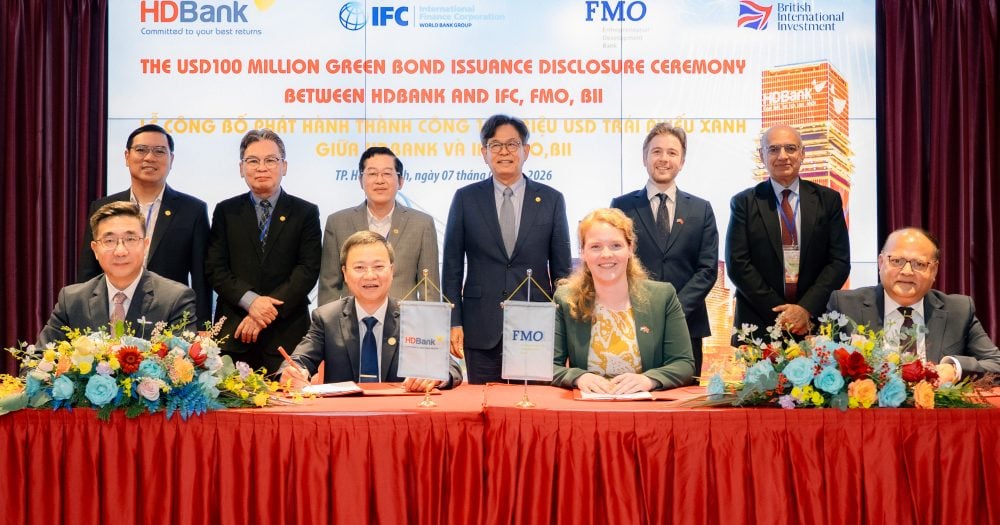
The UK’s development finance institution, British International Investment (BII), has committed US$20 million to Vietnamese lender HDBank’s inaugural green bond programme.
This will aid in providing financing specifically earmarked for solar energy projects as Vietnam positions itself as a key player in Southeast Asia’s renewable energy transition.
Try Premium for just $1
- Full premium access for the first month at only $1
- Converts to an annual rate after 30 days unless cancelled
- Cancel anytime during the trial period
Premium Benefits
- Expert industry analysis and interviews
- Digital access to PV Tech Power journal
- Exclusive event discounts
Or get the full Premium subscription right away
Or continue reading this article for free
The investment forms part of HDBank’s US$100 million international green bond issuance, with proceeds designated for solar PV installations, electric vehicle (EV) infrastructure, green buildings and energy efficiency solutions across Vietnam.
The bond programme attracted additional backing from the International Finance Corporation and Dutch development bank FMO.
BII’s participation signals growing international confidence in Vietnam’s solar sector despite ongoing trade tensions affecting the country’s manufacturing industry.
The financing comes as Vietnamese solar companies navigate US tariff pressures that have disrupted Southeast Asian supply chains and forced manufacturers to reassess export strategies.
The HDBank green bond financing addresses a critical funding gap for Vietnamese solar developers, particularly as the country transitions away from feed-in tariff mechanisms toward competitive auction systems.
Projects financed through the bond proceeds must meet environmental and social risk management requirements outlined in HDBank’s Sustainable Finance Framework.
International investors are increasingly viewing Vietnam as a strategic manufacturing hub for solar components destined for global markets despite the US trade tariffs.
Indeed, Korean chemical giant OCI Holdings recently acquired a 65% stake in a 2.7GW Vietnamese solar wafer facility.
The wafer plant investment by OCI Holdings demonstrates how Vietnamese solar manufacturing is adapting to meet US Foreign Entity of Concern requirements, positioning the country as an alternative to Chinese-dominated supply chains.
The facility is expected to begin commercial production in early 2026, supplying wafers to US solar cell manufacturers.
Vietnam’s solar sector has also attracted interest in project development from other international firms. Indian manufacturer Waaree recently signed a memorandum of understanding with Viet Khanh for a 100MW solar project in the country, while Vietnamese companies are expanding regionally with investment deals for a 1.9GW solar plant in Kyrgyzstan.
The green bond financing is expected to support projects that will reduce approximately 102,000 tonnes of carbon dioxide emissions over a 10-year period, contributing to Vietnam’s net zero 2050 commitment. This aligns with the country’s revised Power Development Plan 8, which targets a solar generation capacity of between 46GW and 73GW by 2030.
Srini Nagarajan, managing director and head of Asia at BII, emphasised Vietnam’s strategic importance for Southeast Asia’s green energy transition.
“Vietnam continues to be a priority market for BII as we invest in South-East Asia’s green energy transition. Our participation in HDBank’s inaugural green bond programme, together with IFC and FMO, sends a strong signal about the readiness and potential of Vietnam’s sustainable finance ecosystem.
“This will help attract more capital into climate-responsible projects, overall, supporting the country’s net zero 2050 ambitions.”
The financing structure provides HDBank with diversified funding sources to support Vietnam’s expanding solar sector while meeting international environmental standards. Projects eligible for financing must undergo rigorous screening processes to ensure compliance with sustainability criteria.