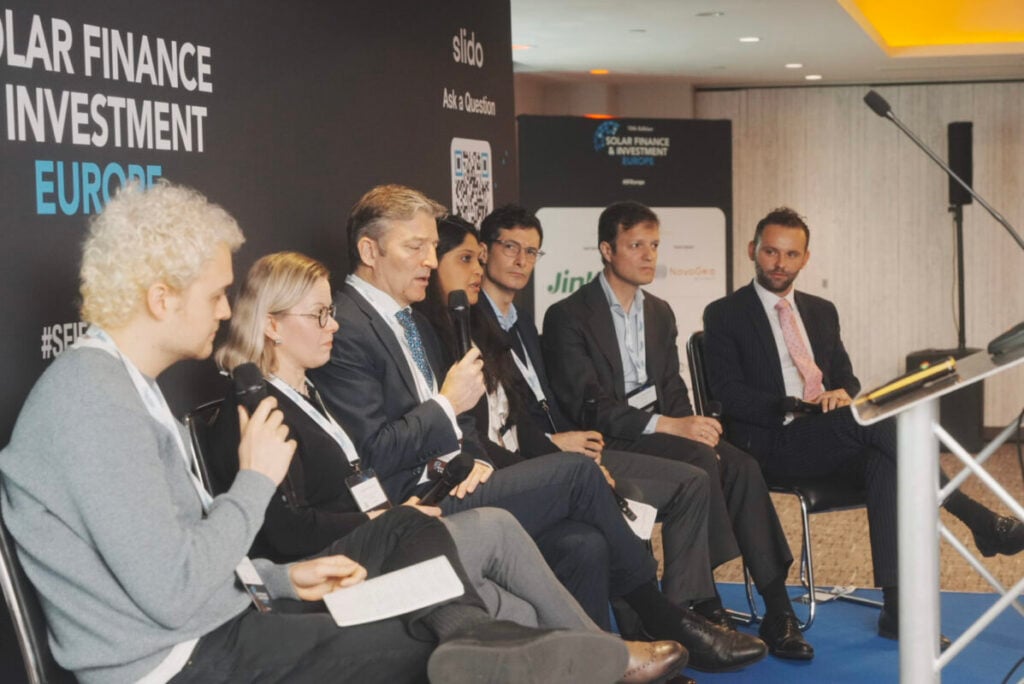
“The market is evolving,” said Daniel Machuca, global head of project finance at Sonnedix, on the topic of traditional financing models and their suitability for use in modern renewable energy projects.
“Traditional models are not failing, they are adapting, sometimes at the same pace as the markets, sometimes too late,” he continued, speaking on a panel this morning on the second day of Solar Media’s Solar Finance & Investment Europe event, held in London.
Try Premium for just $1
- Full premium access for the first month at only $1
- Converts to an annual rate after 30 days unless cancelled
- Cancel anytime during the trial period
Premium Benefits
- Expert industry analysis and interviews
- Digital access to PV Tech Power journal
- Exclusive event discounts
Or get the full Premium subscription right away
Or continue reading this article for free
The panellists discussed the role of financial mechanisms—including power purchase agreements (PPAs), feed-in tariffs (FiTs) and contracts for difference (CfDs)—and their viability in the current European power market, which is shaped by higher price volatility and curtailment and negative price risk.
“If you go back 20-25 years, looking at project finance assumptions these [projects] were single energy projects that had contracted revenue streams,” added Scott Douglas, senior director and head of debt advisory at Centrus. “The modern portfolio—and it is important to think about this in terms of portfolios—is dynamic and it will evolve over time; PPAs are getting shorter [and] FiTs are becoming less available, so revenue uncertainty has increased and volatility has increased.”
“I think it’s super important to note that, on the commercial side, merchant risks are more and more prevalent,” agreed Severin Hiller, partner and co-head of credit at Qualitas Energy.
“It’s important to be ahead of the market, not behind the market,” Hillier continued. “It’s important to have your own expertise to understand where the market is heading and [where] one can have a view on where the market is heading begore it arrives.”
Despite this shifting risk profile, the panellists agreed that many of the market fundamentals behind renewable power projects are the same as they have been in the past.
“Some fundamentals remain,” said Machuca. “Long-term stability, mitigation of the construction risk and mitigation of the counterparty risk for PPAs are key. Lenders and institutional investors will look to invest in proven technologies, [and] do analysis based on the due diligence that is there.”
Financing whole portfolios
Douglas’ comments on considering the financing of whole portfolios, rather than individual projects, were discussed by a number of other panellists. Considering that many investors—some of which were represented on the panel—now invest in projects across a range of markets, and a range of technologies, having this holistic view of a portfolio and its finances has become important for relevant investors, and is another manner in which the financing landscape has changed.
“Platform financing [is] a derivation of portfolio, where we start with little or no assets but he goal is to build a much larger portfolio,” said Gauri Kasbekar-Shah, senior director of project and structured finance at Siemens Bank.
“You have requirements that allow you to bring those assets in a relatively automatic way—lenders want to have a due diligence package!—but for solar, and to an extent batteries as well, we’re in a place where we understand the technology at the beginning a lot better, so we’re able to move into more of those high-risk categories,” she added.
Douglas noted that considering financing decisions over a longer period of time is a key difference compared to financing decisions for a single project; the panel also discussed the differences that can come from the addition of a battery energy storage system (BESS) to one of these portoflios, adding greater technological diversity to the portfolio.
“A lot of the comments cover the adding of BESS to the projects,” said Francisco González Palomo, global head of project finance at Zelestra. “In general, with BESS, we see financing that is technology agnostic and apply the same principles to the asset features, where we have instead of the resource risk, we’re exchanging that with volatility risk and revenue stacks.
“In the sense of PPAs we don’t see the tenders we saw in the solar space; we see shorter tenders, and every single BESS PPA we’re seeing is different to the others, so it’s difficult to streamline that process for the lenders.”
PV Tech publisher Solar Media is hosting the 13th edition of the Solar Finance & Investment Europe event in London this week, on 3 – 4 February 2026. This event annually attracts infrastructure funds, institutional investors, asset managers, banks and development platforms at the forefront of European renewables. For more details, visit the website.