China’s ‘Top Runner’ solar program becomes dominated by P-type mono PERC modules

Facebook
Twitter
LinkedIn
Reddit
Email
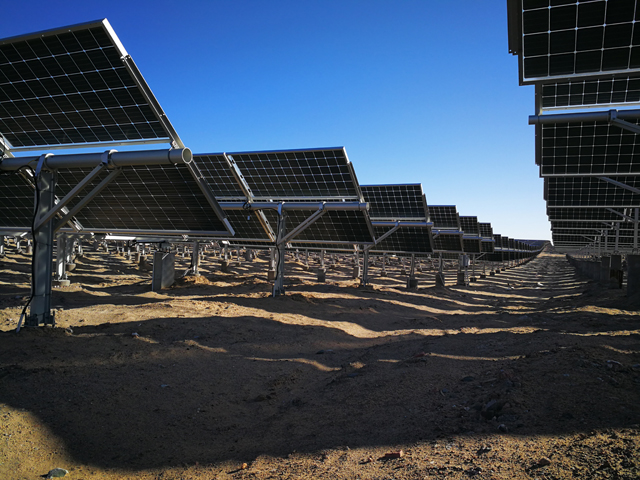
Although bifacial modules seem to be a key performance upgrade, EnergyTrend said that there are more uncertainties for bifacial modules in respect to evaluating the performance gains. Image: LONGi Solar

According to analysis by Taiwan-based market research firm, EnergyTrend, around 67% of Top Runner program bids in 2017 were won with P-type mono PERC modules and it expects an increasing percentage of project bids in 2018 will be secured by using P-type mono PERC bifacial modules.

This article requires Premium SubscriptionBasic (FREE) Subscription

Try Premium for just $1

  • Full premium access for the first month at only $1
  • Converts to an annual rate after 30 days unless cancelled
  • Cancel anytime during the trial period

Premium Benefits

  • Expert industry analysis and interviews
  • Digital access to PV Tech Power journal
  • Exclusive event discounts

Or get the full Premium subscription right away

Or continue reading this article for free
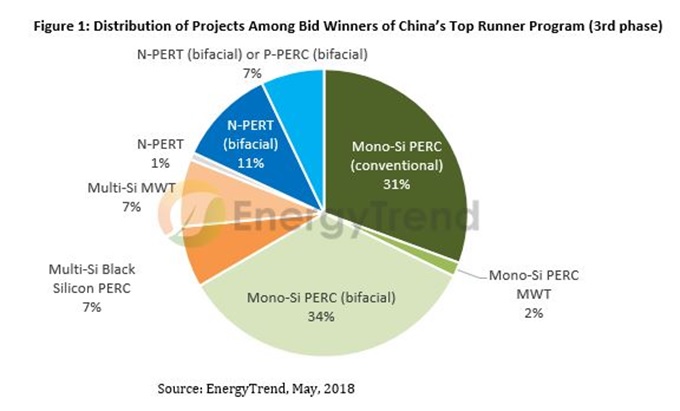
According to analysis by Taiwan-based market research firm, EnergyTrend, around 67% of Top Runner program bids in 2017 were won with P-type mono PERC modules. Image: EnergyTrend

“Mono-Si PERC accounted for the majority (67%) of all the bid-winning projects,” says Lions Shih, EnergyTrend’s analyst, “including conventional mono-Si PERC, bifacial mono-Si PERC, and mono-Si PERC MWT”. Other projects mostly use multi-Si P-PERC and bifacial N-PERT. For P-type products, black silicon and PERC technologies are applied to improve the performances.”

However, although bifacial modules seem to be a key performance upgrade, EnergyTrend said that there are more uncertainties for bifacial modules in respect to evaluating the performance gains claimed. Therefore P-type mono PERC modules are expected to remain the dominant choice of module for project developers in the Top Runner bidding in 2018. 
Read Next

Premium
September 3, 2026
Heterojunction is emerging as the n-type technology of choice as US PV manufacturers seek to minimise IP-related risks.
September 2, 2026
In the third part of this week’s series exploring the US solar supply chain, we track how quickly announced manufacturing capacity is translating into real production.
September 1, 2026
US module production is at a near saturation point, but significant capacity gaps persist further up the supply chain, writes head of PV Tech Research, Moustafa Ramadan.
August 28, 2026
Importing solar modules to the US will “no longer make any economic sense” under new Section 232 tariffs for polysilicon-based products, according to Intertek CEA.
Premium
August 27, 2026
Domestically produced solar glass is a key gap in the US PV manufacturing ecosystem. Tom Kenning reports on efforts to kick-start local production of this vital material
August 26, 2026
JinkoSolar shipped 15.9GW of modules in the second quarter of this year, which represents a 34.4% year-on-year decline.

Upcoming Events

Solar Media Events
October 13, 2026
San Francisco Bay Area, USA
Solar Media Events
November 3, 2026
Málaga, Spain
Solar Media Events
November 24, 2026
Warsaw, Poland
Solar Media Events
February 2, 2027
London, UK