Against the backdrop of a severe supply-demand imbalance, most Chinese PV enterprises have reported consecutive quarterly losses.
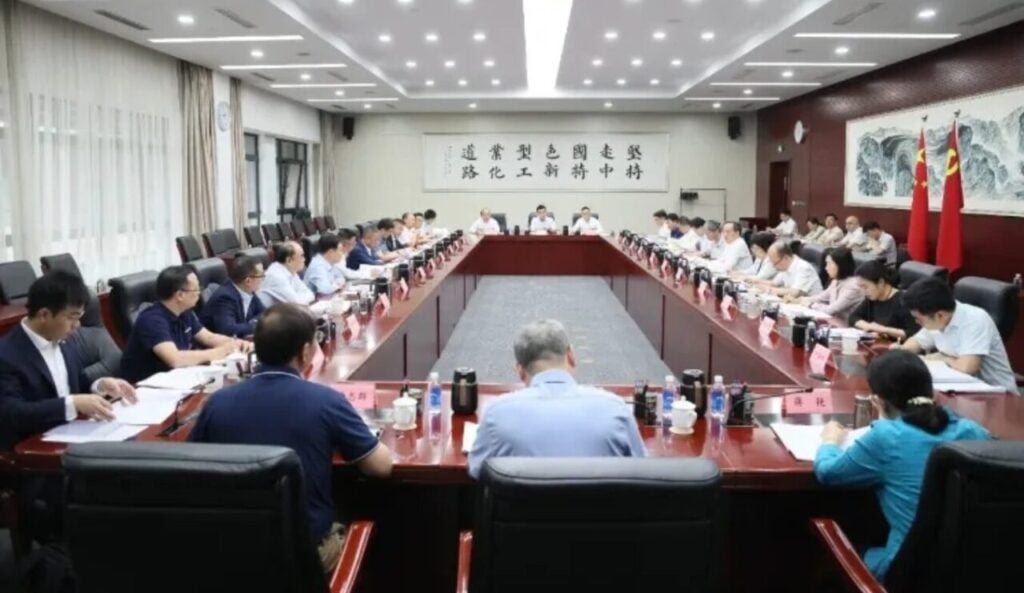
On 3 July, China’s Ministry of Industry and Information Technology (MIIT) convened a symposium with PV manufacturers, signalling heightened government efforts to curb the excessive competition in China’s PV manufacturing sector.
Try Premium for just $1
- Full premium access for the first month at only $1
- Converts to an annual rate after 30 days unless cancelled
- Cancel anytime during the trial period
Premium Benefits
- Expert industry analysis and interviews
- Digital access to PV Tech Power journal
- Exclusive event discounts
Or get the full Premium subscription right away
Or continue reading this article for free
At the MIIT symposium, executives from 14 leading Chinese PV companies and representatives from the PV industry association exchanged views on corporate operation, technological innovation, market competition and the development of the industry ecosystem. Participants presented their company profiles, discussed challenges and difficulties, and put forward policy recommendations.
Entrepreneurs participating in the symposium included:
-Gao Jifan, chairman of Trina Solar
-Li Xiande, chairman of JinkoSolar
-Zhong Baoshen, chairman of LONGi Green
-Zhu Gongshan, chairman of GCL-Si
-Li Dongsheng, chairman of TCL Zhonghuan
-Cao Renxian, chairman of Sungrow
-Liu Hanyuan, chairman of Tongwei
-Yang Aiqing, executive president of JA Solar
The meeting was chaired by Li Lecheng, Minister of the Ministry of Industry and Information Technology (MIIT). He stated that efforts should focus on addressing key challenges to comprehensively regulate disorderly low-price competition in the PV industry in accordance with laws and regulations. The goal is to guide enterprises in improving product quality, facilitate the orderly phase-out of outdated capacity and promote healthy, sustainable development. Industry players must set the right direction, commit to technological innovation, uphold quality and safety standards, strengthen international cooperation, and further expand the depth and breadth of PV applications, striving to become global technological leaders in the PV industry and key participants in the world’s low-carbon energy transition.
After the meeting, Trina’s Gao Jifan said that the symposium had boosted confidence in China’s PV industry. Gao had proposed earlier that to break the cycle of malicious competition and navigate industry fluctuations, the PV industry should first promote consolidation across supply chain segments, including silicon materials, wafer slicing and cell/module production. Additionally, regardless of the technology involved, unnecessary capacity expansions should be prohibited, and relevant national authorities must strictly penalise violations. He also emphasised the need to enhance intellectual property protection.
64 listed Chinese PV companies report annual losses exceeding RMB29.7 billion
According to statistics by the China Photovoltaic Industry Association, 64 listed Chinese PV companies recorded total revenues of RMB931.096 billion (US$129.7 billion) in 2024, a year-on-year decrease of 22.4%, with none achieving revenue over RMB100 billion (compared to four in 2023). Meanwhile, the total net profits of these listed companies shifted from a profit of RMB104.955 billion in 2023 to a loss of RMB29.757 billion in 2024.
Against this backdrop, a consensus is emerging within the PV industry to combat malicious competition. Zhu Gongshan previously stated that the period from the second half of this year to the first quarter of next year will be a critical period for supply-side reform in the PV sector, which will require joint industry efforts to drive the industry toward high-quality development. “Rather than anticipating a cyclical recovery in the PV industry, we should confront the reality of disruptive restructuring,” he noted.
He proposed government-enterprise collaboration to facilitate capacity clearance through “market-driven mergers and acquisitions + technology-based elimination mechanisms + policy-enforced constraints” to phase out outdated capacity, while adopting “supply-side self-discipline + demand-side stimulus” to reduce inventory. PV capacity indicators should be incorporated into the national regulatory framework, with comprehensive supervision over project approvals, capacity monitoring and the elimination of non-compliant operations. No new capacity expansions should be permitted unless driven by game-changing innovations.
According to an assessment by the Silicon Branch of the China Nonferrous Metals Industry Association, if domestic polysilicon manufacturers neither resume production nor expand capacity, the annual polysilicon output is estimated at around 1.2 million tons, with some 100,000 tons of inventory expected to be absorbed in the second half of the year. If the potential production resumption and expansion are taken into account, the annual output is projected to exceed initial expectations by 8%, which would further intensify supply-demand pressure for silicon materials in the second half of the year.
Therefore, the Silicon Industry Branch maintains that amid the current extreme predicament confronting the entire industry chain, the top priority is to strictly control capacity expansion. Secondly, to accelerate the exit of outdated capacity, it is essential to leverage enterprises’ advantages in energy efficiency and product quality, along with national standards for energy consumption and quality. Only through these measures can the underlying supply-demand imbalance be addressed and rational price levels be restored across all segments of the c-Si PV industry chain.