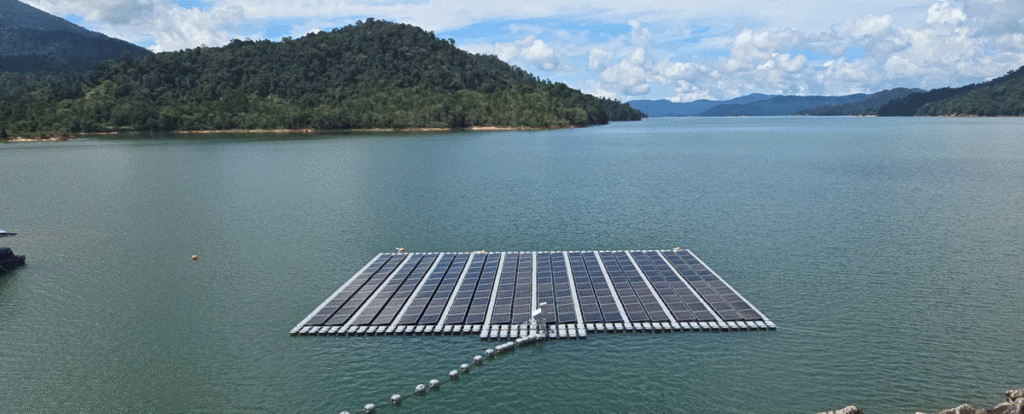
Malaysian utility company Tenaga Nasional Berhad has officially launched a floating solar pilot project, which could help unlock 2.2GW of generation capacity.
The Hybrid Hydro Floating Solar (HHFS) pilot project is located at Tasik Kenyir Dam, deep in the Pantai Timur Range. This dam, constructed in 1985, created Kenyir Lake, the largest man-made lake in mainland Southeast Asia.
Try Premium for just $1
- Full premium access for the first month at only $1
- Converts to an annual rate after 30 days unless cancelled
- Cancel anytime during the trial period
Premium Benefits
- Expert industry analysis and interviews
- Digital access to PV Tech Power journal
- Exclusive event discounts
Or get the full Premium subscription right away
Or continue reading this article for free
The floating solar pilot has a capacity of 100kW and spans an area of 1,085m² with 220 solar PV modules. It aims to demonstrate how Malaysia’s largest lake, covering 36,900 hectares, could be utilised for a larger floating solar project.
Tenaga Nasional Berhad estimates that floating solar could be deployed on up to 10% of the lake’s surface to generate approximately 2,200MW of renewable energy without disrupting the lake’s ecology.
Floating solar’s role in Malaysia’s renewable energy goals
Kenyir Lake will also supply renewable energy to Kertih, powering a green hydrogen hub developed in collaboration with Malaysian state oil firm Petronas.
This floating solar initiative is the result of a partnership between Tenaga Nasional Berhad’s subsidiary, TNB Genco Sdn Bhd, and state-owned investor Terengganu Inc.
Datuk Megat Jalaluddin, president and CEO of Tenaga Nasional Berhad, highlighted the importance of the floating solar pilot in advancing Malaysia’s renewable energy ambitions.
“The Kenyir HHFS project, part of our broader 2.5GW hybrid solar-hydro initiative, exemplifies how Tenaga Nasional Berhad is leveraging its existing assets to maximise renewable energy output,” Jalaluddin said.
“The hydro plant serves as a flexible energy storage system—conserving water during peak hours and discharging it during off-peak—to stabilise the grid and respond rapidly to fluctuations in demand.”
In February 2024, Tenaga Nasional Berhad announced plans to develop 2.5GW of hybrid hydro-floating solar projects.
This initiative combines solar and hydroelectric power to optimise resource utilisation and contribute to Malaysia’s renewable energy targets.
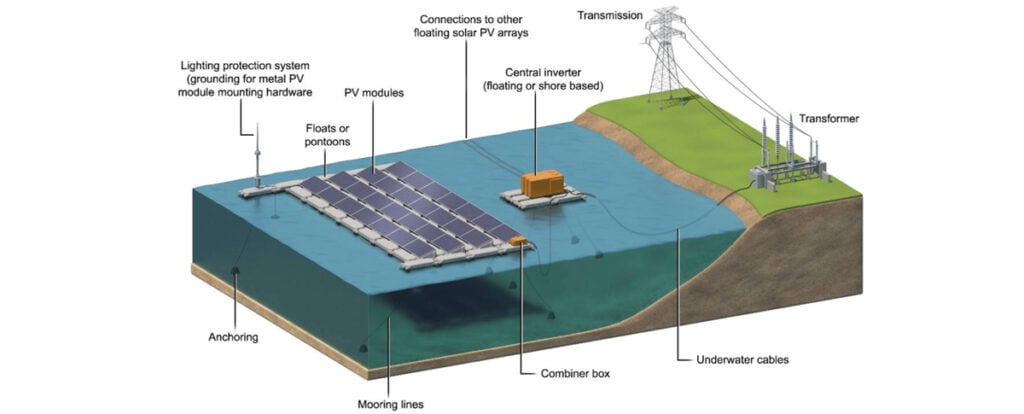
The HHFS system involves installing solar modules on floating platforms over hydro reservoirs. This system generates electricity during the day, while hydroelectric plants provide continuous energy during periods of low sunlight.
Government support for floating solar in Malaysia
The Malaysian government has shown strong interest in floating solar as part of the country’s energy transition. At the beginning of the year, it launched a tender seeking 2GW of large-scale and floating solar PV projects.
The tender was divided into two packages: the first offered 1,500MW for large-scale solar PV power plants between 30MW and 500MW, while the second allocated 500MW for water-based or floating solar PV projects with capacities ranging from 10MW to 500MW.
In August 2024, Malaysian energy company Cypark Resources Berhad commissioned a 100MW hybrid project featuring 35MW of floating solar PV in Merchang, a coastal town in the northeastern state of Terengganu, approximately 62km east of Tasik Kenyir Dam.
PV Tech Premium has previously discussed the role of floating solar PV in inland reservoirs in the most recent issue of our downstream journal, PV Tech Power. Specifically, the article examines how the energy yield performance of different system configurations could enable floating PV to fulfil its potential.