In the wake of Russia’s invasion of Ukraine, European energy has gone from an overreliance on Russia to an overreliance on China.
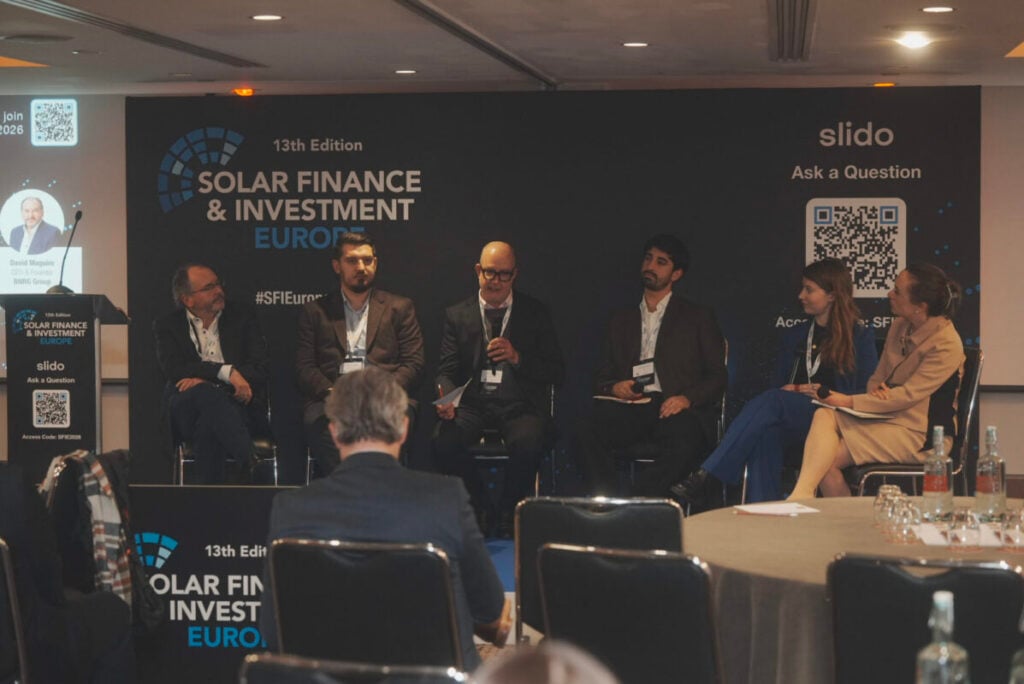
With one of the main risks facing renewables deployment in Europe being geopolitics, a panel at Solar Media’s Solar Finance and Investment summit Europe, ‘How to secure European renewables amid geopolitical risk’, noted the fact that renewables themselves have been a provider of some resilience themselves.
Try Premium for just $1
- Full premium access for the first month at only $1
- Converts to an annual rate after 30 days unless cancelled
- Cancel anytime during the trial period
Premium Benefits
- Expert industry analysis and interviews
- Digital access to PV Tech Power journal
- Exclusive event discounts
Or get the full Premium subscription right away
Or continue reading this article for free
Sean Rai-Roche, a policy advisor at consultancy E3G, pointed out that Europe’s deployment of renewables since Russia invaded Ukraine has saved €60 billion (US$70.85 billion) in fossil fuel imports.
In terms of the risks that renewables themselves face, geopolitically but also in terms of ESG, cybersecurity and supply chain, as well as in policy and market design, Rai-Roche highlighted the importance of public finance instruments.
“They are there to help some of the initial risks, help get projects off the ground and kind of capitalise the private sector.”
That can only go so far. CEO and founder of Ireland-headquartered solar plant developer-operator BNRG Group, David Maguire, said that in the push for energy security, solar PV is the cheapest form of generation available, but that this brings an “overreliance” on China.
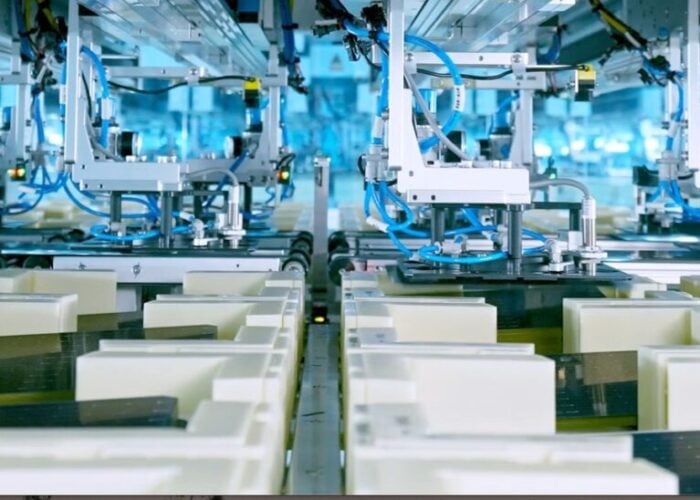
While he said there are “lots of investments on the assembly and the downstream, upstream, over 90% is produced in China”. Maguire said Europe and North America are both very exposed as a result.
Catching up would require an investment of billions, which really requires further state intervention to give investors confidence to mobilise, and in Europe that will require collaboration, he added.
De-risking the supply chain
According to Sarah Montgomery, co-founder and CEO of Infyos, a supply chain risk management platform, the complexity of solar and energy storage supply chains means that derisking requires focus not just on shifting end module manufacturing.
“For example, when you talk about battery energy storage, it’s the end integrators having to shift the battery cell manufacturing, having to shift the processing, component manufacturing, all the way back to the mining.”
The reality is that most developers are looking at how they can deploy as cost efficiently as possible, and then managing the risk associated with that, Montgomery said. This means that “nine times out of 10, Chinese manufacturers make the most sense”.
Through that lens, she said, the question becomes how we can still purchase from Chinese manufacturers while identifying where the risks sit and what can be done to mitigate them.
Velizar Cholakov, international business development expert at EPC firm HEC Solar, agreed, echoing what the company’s CEO said on a previous panel: that fewer than 20% of the businesses HEC works with request European-made equipment for their projects.
Cholakov said that this proves how price-driven the market is, adding that there will be no economically viable way of securing cells outside of China “in the near future” and that it will take a long time to “shift the entire supply chain”.
Domestic political risk
Andrew Pendleton, senior strategist at the Sunrise Project, a global network of independent organisations with the mission statement of driving the transition from fossil fuels to renewables through social change, said energy storage and solar can do something for energy security that “no other technology can”.
That is because of the speed at which it can deploy and the scale it can achieve, “but also in terms of decentralisation”.
“Having many modes of energy production and storage is where we should be anyway, without security concerns. However, we need to invest in it further: [at the moment] the second there’s an issue in the supply chain, everything stalls.”
Besides the economic implications of that stall for the renewables market, Pendleton noted the importance of speed and scale in the face of political risks in the European and UK markets – “that’s what keeps me up at night”.
With major elections scheduled for 2029 and 2030 in Europe and the UK, there is a risk that newly elected governments would take an anti-renewables stance, as opposition parties are increasingly using renewables as a political bargaining chip (in the UK, for example, Reform UK, which is running on a platform that is pro-exploration for new oil drilling sites is leading polls).
“I’m sure that’s already chilling the market to a certain extent,” said Pendleton. “Getting a lot of contracts signed in the meantime is absolutely critical to get us to that tipping point that will demonstrate to people, to populations and to businesses that renewables are entirely viable, and they’re going to improve peoples’ lives.”