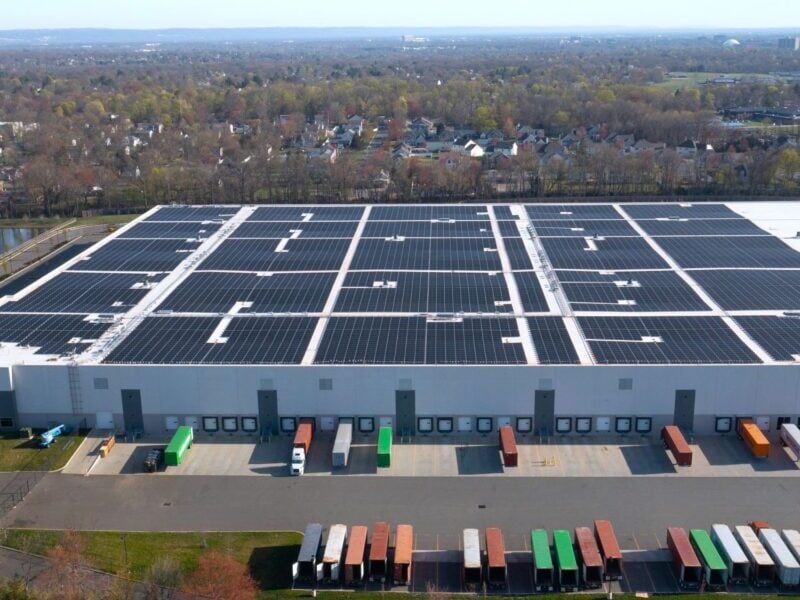
US community solar developer Dimension Energy has secured US$360 million in financing to develop a 112MW portfolio of community solar projects across six US states.
The construction and term financing arrangement will be used to support the development of 28 projects across Delaware, Illinois, Maine, New Jersey, Pennsylvania and Virginia, and will expand Dimension’s operating portfolio that currently boasts more than 700MW of capacity. Financing came from several organisations, including First Citizens Bank, ING, MUFG, and the National Bank of Canada, and is Dimension’s largest financial agreement to date.
Try Premium for just $1
- Full premium access for the first month at only $1
- Converts to an annual rate after 30 days unless cancelled
- Cancel anytime during the trial period
Premium Benefits
- Expert industry analysis and interviews
- Digital access to PV Tech Power journal
- Exclusive event discounts
Or get the full Premium subscription right away
Or continue reading this article for free
“This investment will strengthen local energy grids, create good-paying jobs, and expand access to lower-cost power in communities across the country,” said Tom Bitting, managing director at Advantage Capital, which provided US$170 million in tax equity.
Community solar has become increasingly popular in the US, as a way to deliver power without relying on local grids that have been increasingly overwhelmed with renewable capacity additions; figures from the US Energy Information Administration (EIA) note that solar and wind curtailments increased by 29% between 2023 and 2024 in the crucial state of California, where renewables play a key role in the energy mix.
In 2024, for instance, the US added a record 1.7GW of new community solar capacity, a 35% year-on-year increase, with the states of Illinois, New York and Maine responsible for more than two-thirds of new community solar capacity additions. Dimension has been a key part of this trend, upsizing a corporate credit facility to develop a 3.5GW community solar pipeline earlier this year.
Montana governor vetoes community solar bill
In less positive news for the community solar sector, Montana governor Greg Gianforte has vetoed the passage of a bill that would have established rules for the connection of community solar projects to the local grid.
The bill – Montana Senate Bill 188, ‘Revising Solar energy policy laws’ – was put forward by Democrat senator Christopher Pope and would have formalised the process for community solar projects connecting to the grid, namely by obligating public utilities to connect qualifying projects to the grid, with the projects’ owners to pay the administrative costs of the connection and the utility to grant an “on-bill credit” to the customers to cover further installation costs.
The bill drew widespread support – the state’s Republican-majority Senate passed the bill following amendments made by the Montana House of Representatives by a vote of 46 to four – but Gianforte said that, in his opinion, there remains uncertainty as to how the bill would be implemented.
“In several states, including Minnesota, New York and Oregon, shared solar facilities receive arbitrarily favourable credit rates based on non-economic considerations, such as purported benefits to the environment,” wrote the governor. “There is a wide range of methodologies to calculate a credit rate with no generally accepted practice.
“In short, it is impossible to predict how the Public Service Commission will proceed with implementing Senate Bill 188.”
The veto has been met with surprise and disappointment by the US solar industry, with the Coalition for Community Solar Access (CCSA) and Montana Renewable Energy Association (MREA) describing themselves as “confounded” by the decision to veto the bill, and confused as to his reasoning for doing so.
“SB 188 represented a meaningful step toward a more affordable, resilient and diversified energy future for Montana,” said the organisations. “It would have expanded energy options for families, small businesses, and farmers across the state—especially in rural communities—and encourage private investment in homegrown power.”
“In a formal letter to the PSC, the developer community voluntarily outlined clear guardrails for the program—including support for cost containment and a pledge to advocate for solely economic considerations in future rulemakings. These proactive steps were designed specifically to address concerns about PSC authority and potential cost impacts.”
Montana has one of the smallest solar sectors in the US based on installed capacity, with just 329MW in operation as of the first quarter of this year. However, the Solar Energy Industries Association (SEIA) expects the state to add 1.7GW of new capacity over the next five years.