As spring progresses in the Northern Hemisphere, the annual migration of solar professionals to conferences and trade shows begins, with many wondering just how many they can fit into June alone. Two of the industry’s biggest exhibitions – SNEC Shanghai and Intersolar Munich – are both now just around the corner, so what are some of the hot topics and key questions that everyone should be thinking about this year?
Will there be any realistic end to oversupply in sight?
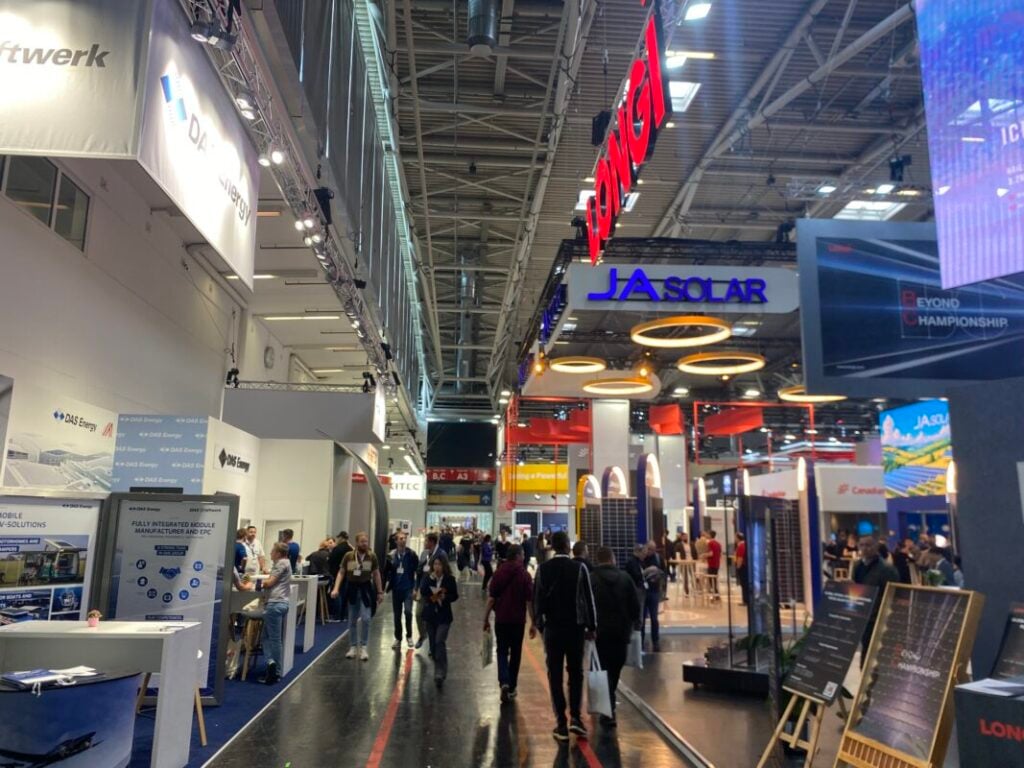
Following severe overproduction during the past few years, it was no surprise that the 2025 editions of these shows featured a somewhat downbeat atmosphere at times, and sense of resignation about the state of manufacturers’ near-term financial prospects. SNEC was visibly smaller than the year before, with more empty space around the edges of many of the halls. And while manufacturers often toed the party line that market consolidation and bankruptcies – always of their rivals but not them, of course – were just around the corner, this seemed to be more of a hope than an expectation based on concrete plans or intel. As we wrote shortly after the event, “too many manufacturers are still refusing to acknowledge the continued outlook for oversupply […] with surprisingly little strategy being evident”.
Try Premium for just $1
- Full premium access for the first month at only $1
- Converts to an annual rate after 30 days unless cancelled
- Cancel anytime during the trial period
Premium Benefits
- Expert industry analysis and interviews
- Digital access to PV Tech Power journal
- Exclusive event discounts
Or get the full Premium subscription right away
Or continue reading this article for free
One year later the financial struggles continue for many producers throughout the supply chain. For all the anti-involution focus in 2025 H2, little action or real consequence has yet materialised, and the industry faces many of the same fundamental challenges that it did 12 and even 24 months ago. Compounding this, the industry is facing a drop in annual global installations – we currently expect 2026 volumes to come in at slightly under 600GW, down around 10% year-on-year – a situation that manufacturers are not used to dealing with.
While a few smaller players have exited the market – and larger M&A deals are now slowly proceeding – there is no clear sign of supply and demand organically coming back into balance in the near future. Given this, the most realistic prospect for a near-term turnaround remains some kind of meaningful intervention by Chinese authorities. In recent weeks there has been renewed talk of minimum price benchmarks to avoid below-cost pricing, and of stricter enforcement around this. Expect this to be an important topic of conversation, although given recent history it’s perhaps best to treat optimism around a major intervention with a little caution until something meaningful has been made official.
Technology progress will continue, but are most manufacturers still biding their time for a move to BC?
At last year’s events half-cut TOPCon remained very much the mainstream product. While many booths featured a back contact (BC) module or two on display, most of these were not commercially available and – aside from Aiko Solar and LONGi – few manufacturers were making real moves into producing BC cells at large volumes. Since then, manufacturers have continued to lay the groundwork for a broader shift to BC, with R&D, pilot lines and work on cost reductions.
Expect to see plenty of BC modules on display from a wide range of manufacturers, but CRU believes many of these are not actually commercially available just yet. Looking upstream, expect BC cell production to remain dominated by those main two key producers for now. However, new pilot lines and small-scale mass production is coming onstream elsewhere, and as seen in previous technology transitions, the solar market can move quickly. Will we be surprised by some big new BC capacity announcements? Perhaps, though from our internal cost modelling we still forecast that a more widespread technology shift away from TOPCon will most likely have to wait until 2028.
At the module level, last year’s shows saw just a handful of companies exhibiting third-cut or quarter-cut cells. This year we expect to see more of this, with a good volume of TOPCon modules on display featuring the combination of multi-cut cells, overlapped cells and rear-side poly fingers. These new modules – typically claiming maximum module efficiencies above 24.5% – are gradually filtering through into our module tracking reports, and are likely to be featured heavily across both events.
When it comes to module sizes, the 66-cell G12R format (2382*1134 mm) has now become somewhat of a standard, narrowing the sprawling array of options that had been around in previous years. This year, we expect only small tweaks to wafer size, as overlapped cells allow module manufacturers to pack slightly more active area into these same module dimensions.
Will commodities volatility drive more substitution? And will there be any rebound in quality?
Among materials providers and testing labs last year there was agreement that reductions to module materials usage had reached – and probably already gone beyond – sensible limits. With cost reductions based on materials intensity reductions so hard to achieve, last year’s shows also saw more companies stepping in with alternative solutions based on material substitutions – for example by shifting to steel or composite frames. Since then, we have only seen prices for key materials such as aluminium and encapsulant feedstocks continue to rise, in part due to the conflict in the Middle East. Last year, it was mostly the materials suppliers pushing these solutions, and it will be interesting to see whether module manufacturers themselves have become more interested in promoting these options in 2026.
Whatever is on display from manufacturers, we expect testing labs, inspection providers and project developers to be increasingly speaking about recent quality challenges both in testing and in the field. And while we do not expect to see much evidence of manufacturers beefing up BOM items like frames and encapsulant to counter this, we hope that at least some of the industry might start to take these issues more seriously and push for more focus on reliability.
At the cell level, with silver prices having hit the headlines repeatedly over the past six months, watch out for how much attention there is on no-silver and low-silver approaches, and whether this remains confined to the booths of paste and equipment suppliers or is also on display from many module manufacturers.
Capacity outside China
There are plenty of rumours circulating around Tesla and SpaceX and while we expect to hear more of those at SNEC, official announcements may not yet materialise. We also expect to hear more talk of new locations for cell factories targeting the US market – the Philippines, several locations in Africa, and (particularly if the conflict in Iran is resolved) countries in the Middle East are all likely to be on the agenda.
Alex Barrows is Head of PV at CRU Group. He focuses on when and how new technologies will influence the PV market and oversees PV market analysis for the company.
Molly Morgan is a Senior Research Analyst at CRU. Her areas of focus include evolution in solar module efficiency and architecture. She also undertakes analysis of solar market data which contributes to CRU’s coverage of the solar market.