Hybridising existing hydropower assets across seven major EU markets could integrate 18% of planned renewable additions by 2030 while easing mounting grid constraints, according to Ember.
Existing hydropower plants across seven major European Union markets could accommodate 25GW of new wind and solar capacity without requiring additional grid infrastructure, according to a new report from energy think tank Ember.
Try Premium for just $1
- Full premium access for the first month at only $1
- Converts to an annual rate after 30 days unless cancelled
- Cancel anytime during the trial period
Premium Benefits
- Expert industry analysis and interviews
- Digital access to PV Tech Power journal
- Exclusive event discounts
Or get the full Premium subscription right away
Or continue reading this article for free
The report finds that hydropower facilities in Austria, Bulgaria, France, Italy, Portugal, Romania and Spain—which together account for 93GW of the EU’s 131GW hydropower fleet—could host new renewable generation behind existing grid connection points through hybridisation.
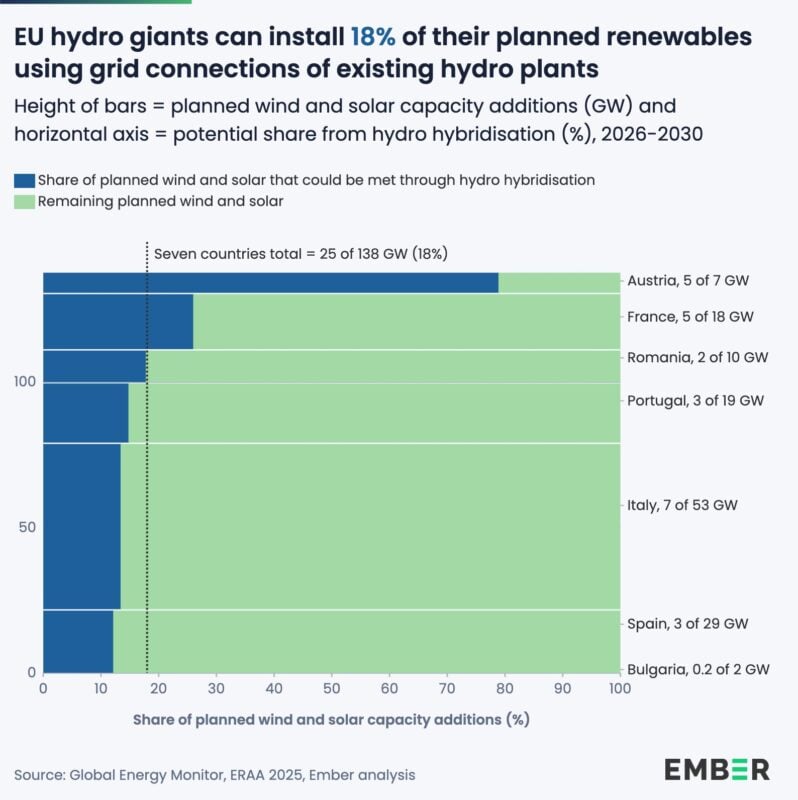
According to Ember, the additional 25GW represents 18% of the approximately 138GW of wind and solar capacity expected to be deployed across the seven countries between 2026 and 2030, allowing that capacity to be connected without requiring additional grid capacity or grid interventions.
PV Tech Premium spoke with the report’s lead author, Elisabeth Cremona, energy infrastructures lead at Ember, to discuss the report’s key findings and their implications for Europe’s renewable energy sector.
“With almost 700 GW of wind and solar blocked in the queue across 10 EU countries alone, solutions that allow renewables to bypass grid connection queues are crucial,” Cremona says.
“Not only could hybrid projects ‘jump the queue’ – if regulations are developed well – but they could also come online faster because they don’t need to wait for the delivery of necessary grid reinforcements. Hybridisation could speed up multiple parts of the connection process – both the application and the grid connection itself. This is especially important as several countries have zero availability on their grid to connect new capacity – particularly Austria, Bulgaria, Portugal and Romania.”
Grid bottlenecks drive need for hybridisation
The report comes as Europe faces increasing pressure on electricity networks amid accelerating renewable deployment and electrification.
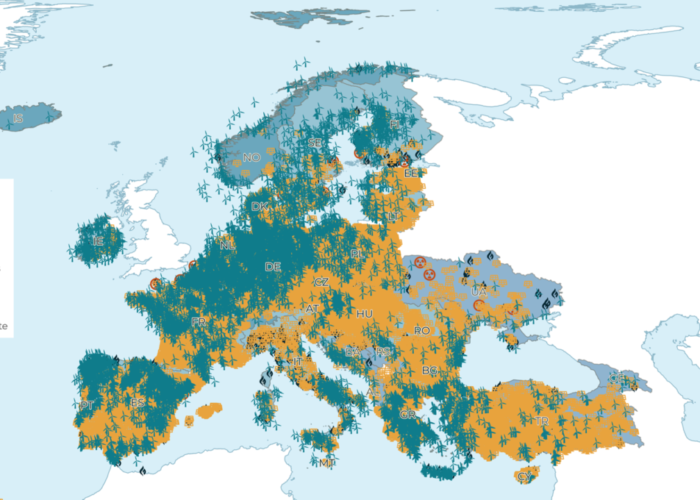
Ember estimates that a grid capacity gap of more than 120GW exists between available network capacity and anticipated renewable growth by 2030, with grid constraints already delaying new renewable connections and affecting investment decisions.
“The long-term objective is to build a grid that supports Europe’s strategic goals in the most cost-efficient way possible. This necessitates making the most out of the infrastructure that exists, as well as what will be built in the future. Hybridisation is one way to deliver on that. For this reason, it will remain part of the portfolio of solutions that will be employed well into the future, particularly as Europe seeks to keep network costs down,” the Ember analyst adds.
The report argues that while expanding transmission infrastructure remains essential, maximising the use of existing grid assets offers an immediate solution for continuing renewable deployment in grid-constrained markets.
Hybrid projects combine multiple generation technologies behind a single grid connection point, allowing existing infrastructure to be used more efficiently while remaining within grid injection limits.
Existing grid connections could nearly double utilisation
According to the analysis, hydropower facilities are particularly suited to hybridisation because they typically operate well below their maximum grid connection capacity.
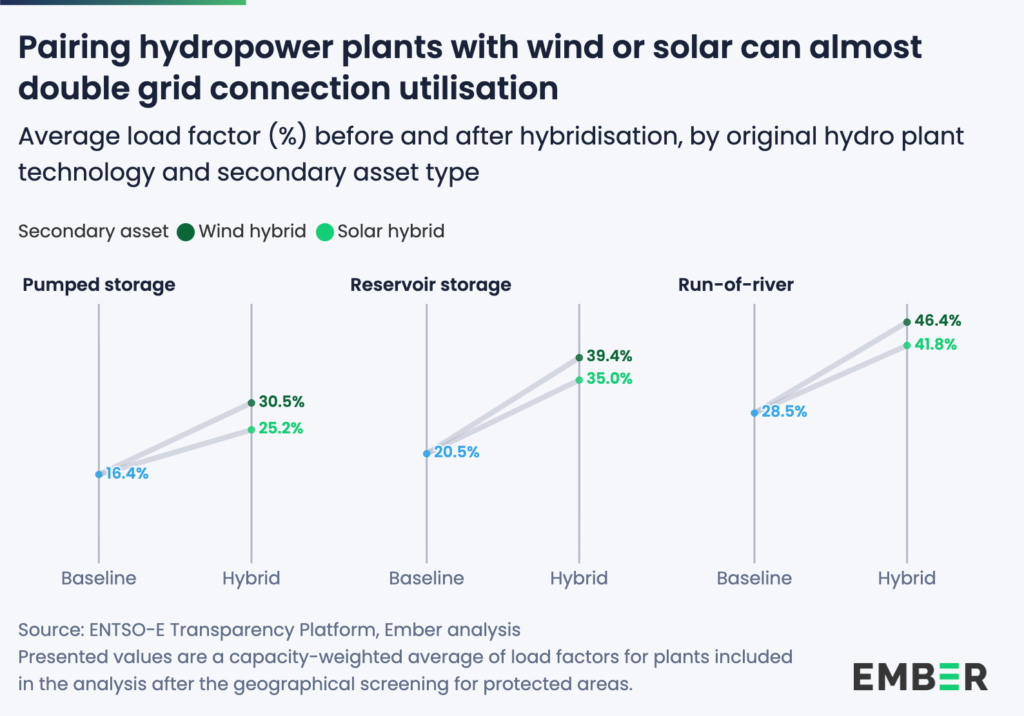
Reservoir storage and pumped storage plants eligible for hybridisation currently operate at an average capacity factor of 19%, leaving significant unused grid capacity. Adding solar would increase average utilisation to 36%, while adding wind would raise it to 31%. In some locations, wind and solar additions could more than triple utilisation of existing grid infrastructure.
Run-of-river hydropower plants, which have a higher average capacity factor of 29%, could also increase utilisation to 47% with solar and 42% with wind, according to the report.
“Looking solely at hybridising hydropower plants illustrates the large potential for renewable deployment behind existing grid connections. It could cover 18% of the 2026-2030 renewables pipeline across seven countries,” Cremona emphasises.
The report notes that hydropower generation is typically concentrated during morning and evening peak demand periods, creating a complementary generation profile with solar, which produces electricity during the middle of the day.
Hybridisation potential varies across countries
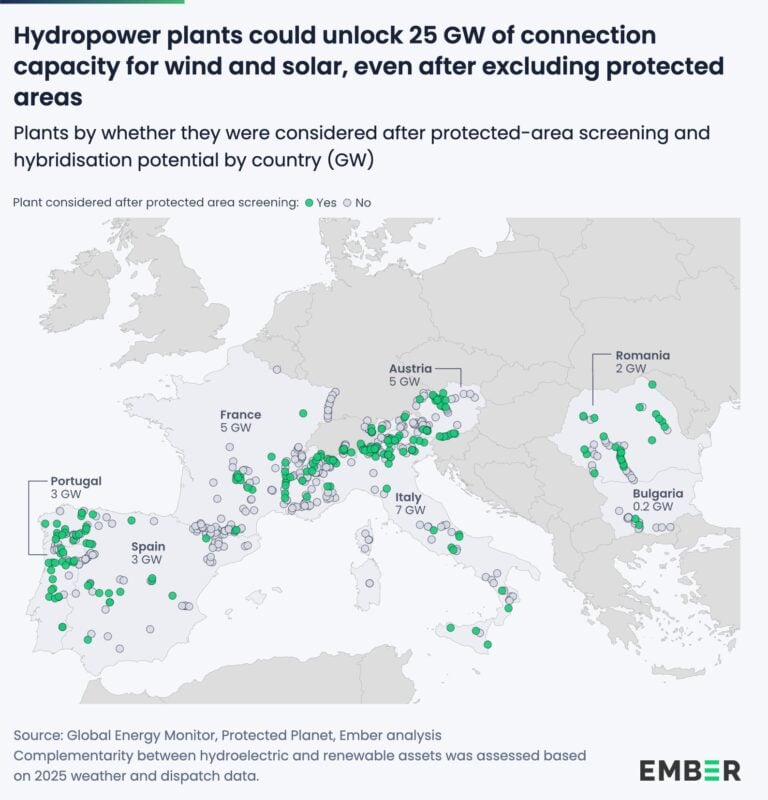
Ember found that the proportion of planned renewable deployment that could be integrated through hydropower hybridisation differs considerably across the seven countries.
The share ranges from 77% in Austria to 7% in Bulgaria, reflecting differences in the availability of hydropower sites suitable for additional renewable generation.
The report excludes hydropower plants located within environmentally protected areas from its assessment. Applying this criterion, around 28% of large hydropower capacity across the seven countries is considered eligible for hybridisation, ranging from 6% in Bulgaria to 41% in Austria and Italy.
“I would expect the biggest near-term solar deployment through hybridisation to be in Portugal and Spain – two countries where the enabling regulatory framework is already in place. Hybrid projects can proceed even where regulation is absent, but the process is likely to be more complicated and lengthier,” she highlights.
Regulatory support remains limited
Despite the technical potential, Ember says regulatory frameworks remain underdeveloped across most of the EU.
Among the seven countries assessed, only Portugal and Spain have dedicated regulatory frameworks designed to support hybrid projects. Both countries introduced specific regulations in 2020 and 2022, respectively, and have since streamlined permitting, reduced administrative barriers and introduced measures to accelerate hybridisation.
Spain allows hybrid projects to bypass the “first-come, first-served” grid connection process and reduces financial guarantees for hybrid connection requests by 50%. Both Spain and Portugal also waive environmental screening for hybridisation projects that remain within the footprint of existing generation facilities.
“Where specific regulation on hybrid projects is absent, project developers have to grapple with grid connection rights, capacity allocation and permitting rules that were designed for single-technology projects. Establishing national legislation that enables hybridisation is a quick and no-regrets way to get more renewables online faster while reducing grid investment needs. Portugal and Spain provide the foundation for such policies,” she notes.
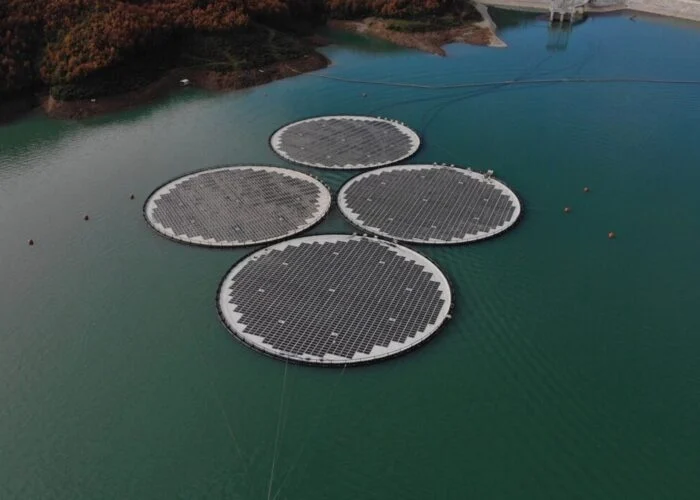
Elsewhere, hybrid projects are progressing despite the absence of dedicated legislation. The report highlights operational projects in France and notes that Bulgaria’s state-owned utility NEK is converting hydropower assets into battery-coupled hybrid facilities while considering floating solar projects at existing dams.
“Hydro is not a special case – just an illustration of the potential for hybridisation particularly given the relatively low capacity factor of these plants in Europe,” Cremona adds.
“The same logic works anywhere there’s spare capacity behind a connection point. Hybridisation can happen at the start of a new project – intentionally building a site with one or two generators and storage – or as an add-on to an existing facility. Regarding the latter, repowering offers an important opportunity for project developers to consider hybridisation, particularly in the coming years during which large gigawatts of Europe’s wind fleet is likely to start undergoing repowering.”
The report recommends that national governments establish dedicated legislation for hybrid projects and streamline permitting and grid connection procedures to accelerate deployment.
It also calls for EU-level guidance on hybrid projects, arguing that harmonised rules would provide greater regulatory certainty and support investment across multiple Member States.