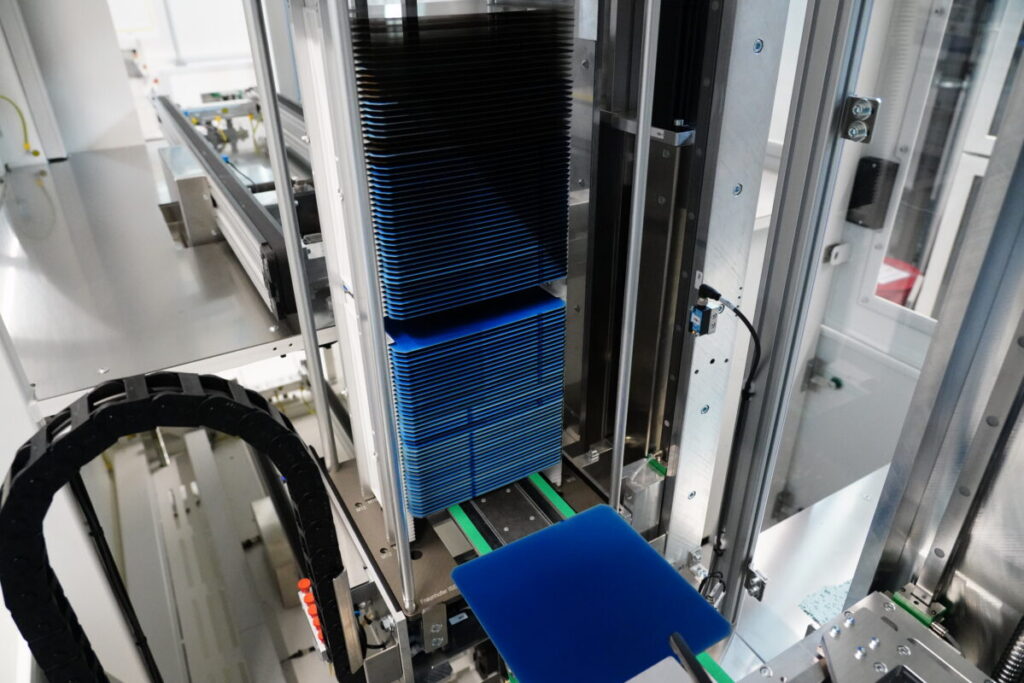
German research organisation Fraunhofer ISE has developed a tunnel oxide passivated contact (TOPCon) solar cell with a power conversion efficiency of 24%, which is comprised of large-area M10 silicon wafers.
M10 wafers are those with an edge length of 182mm, and larger products such as these have seen increased attention in recent years, as they tend to have lower manufacturing costs, and higher efficiency output, than smaller wafers.
Try Premium for just $1
- Full premium access for the first month at only $1
- Converts to an annual rate after 30 days unless cancelled
- Cancel anytime during the trial period
Premium Benefits
- Expert industry analysis and interviews
- Digital access to PV Tech Power journal
- Exclusive event discounts
Or get the full Premium subscription right away
Or continue reading this article for free
Fraunhofer ISE researchers presented the cell to industry representatives at its 20th Photovoltaic Technology Advisory Board meeting in Freiburg, Germany. It is the first European research institute to switch to large-area M10 wafers with the latest TOPCon cell combining this larger wafer with cell architecture first presented in 2013.
“Achieving an efficiency of 24.0% with the first batch suggests that we will exceed 25% with the next optimisation steps,” said Dr Ralk Preu PD, director of the Photovoltaics Division at Fraunhofer ISE. “This recent success lays the foundation for our medium-term goal of large-area silicon-based tandem solar cells with an efficiency potential of well over 30%.”
The growth in popularity of M10 wafers is well-documented, with Chinese module manufacturer Couleenergy reporting that such wafers are expected to account for 62% of the wafer market by 2026. This is a significant increase from the 27% market share held by M10 wafers in 2021.

However, an oversupply of silicon has driven the polysilicon price down in recent months, and has had a knock-on effect on wafer prices. PV Tech Premium’s latest PV Price Watch notes that, in early May, the average price of a p-type M10 wafer fell by 3.68% week-on-week, while the average price of an n-type M10 wafer fell even further, by 9.68%.
The news follows efforts made to standardise wafer sizes by leading manufacturers. Earlier this week, Chinese giant LONGi launched its Hi-MO X6 Max series of modules, which use the M11 wafer size and that the company notes was developed in consultation with other industry leaders.