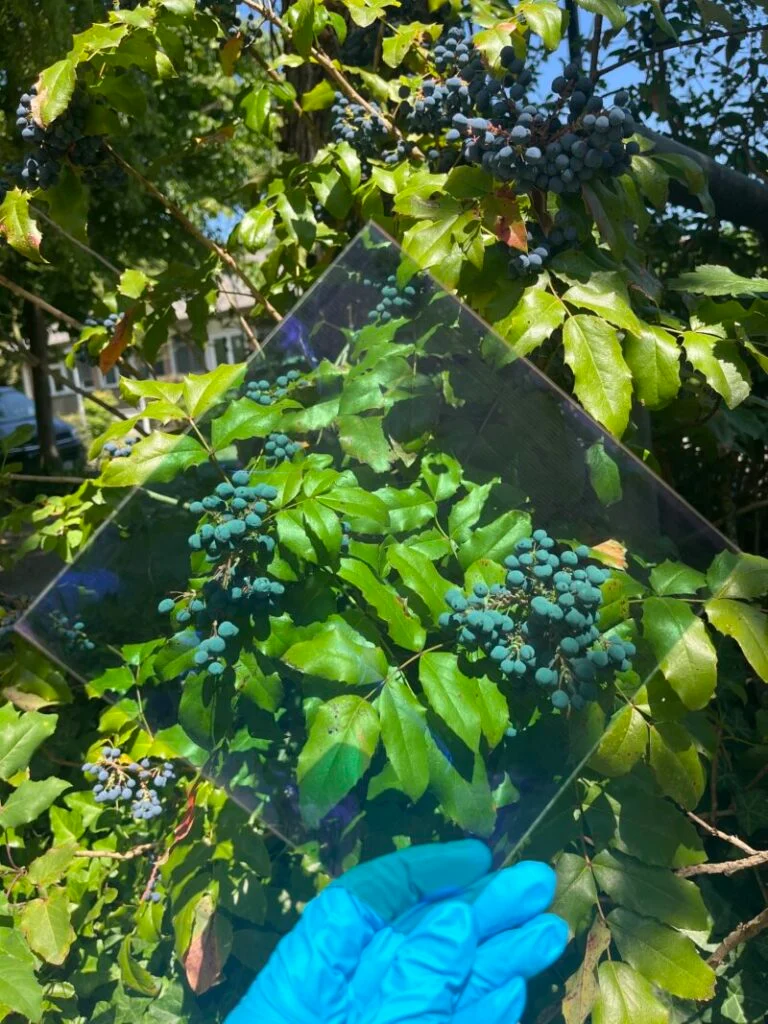
German research institute Fraunhofer ISE has developed what it described as “industry-ready” semi-transparent PV modules with a conversion efficiency of up to 9.26%.
Developed in tandem with researchers from the University of Freiburg, the institute developed modules measuring 14.5 centimetres by 14.5 centimetres with an average transparency of 43.2%.
Try Premium for just $1
- Full premium access for the first month at only $1
- Converts to an annual rate after 30 days unless cancelled
- Cancel anytime during the trial period
Premium Benefits
- Expert industry analysis and interviews
- Digital access to PV Tech Power journal
- Exclusive event discounts
Or get the full Premium subscription right away
Or continue reading this article for free
These use organic solar cells, which use carbon-based materials such as polymers instead of crystalline silicon to convert light into electricity, and this follows considerable innovation in the organic cell sector. Last year, researchers at the Solar Energy Research Institute of Singapore (SERIS) claimed a record 26.4% conversion efficiency in a perovskite-organic tandem solar cell.
More than 100 of these cells make up each module, and consist of three components: a back electrode that reflects near-infrared light, an absorber layer made of organic semiconductors and a top electrode made of the polymer PEDOT:PSS, a blend of two polymers, PEDOT and PSS.
Fraunhofer ISE noted that modules with a transparency of over 50% could be used “in place of window glad in building facades or greenhouses,” and Dr Uli Würfel, head of the Organic and Perovskite Photovoltaics Department at Fraunhofer ISE, expressed optimism about the future of the modules.
“Scaling up to larger areas is one of the major challenges in organic photovoltaics,” said Würfel. “The fact that we have now, for the first time, successfully and with virtually no loss applied all the layers of the solar cells using the slot-die process is a major breakthrough for us.”

The research organisation also noted that the manufacturing process uses sputtering and slot-die coating methods, which it says are “industrially proven and highly scalable to large module areas”, which could address the scaling challenge identified by Würfel. Sputtering is a thin film creation process that is used to deposit the back electrode onto a glass substrate in the organic solar cell; meanwhile, slot-die coating is a technique for thin film deposition that was used to apply the PEDOT:PSS polymer.
“As part of the project, we have already produced the first flexible, organic PV modules that retain 100% of their original efficiency after 1,274 bending cycles over a rod with a diameter of 15 millimetres,” added Dr Mathias List, research associate for organic and perovskite photovoltaics at Fraunhofer ISE.
The news follows Fraunhofer ISE’s research into coloured films for PV modules that can imitate roof tiles or building facades, which could allow for greater control over the aesthetic appearance of modules.