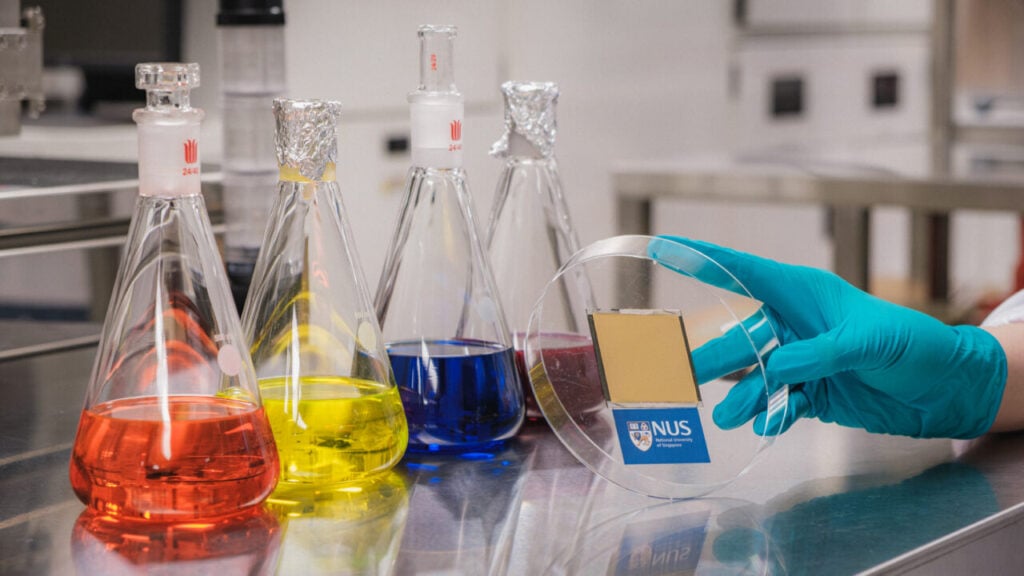
Researchers at the Solar Energy Research Institute of Singapore (SERIS) have claimed a record 26.4% conversion efficiency in a perovskite-organic tandem solar cell.
The demonstration device incorporates a newly designed narrow-bandgap organic absorber layer underneath a wide-bandgap perovskite top cell.
Try Premium for just $1
- Full premium access for the first month at only $1
- Converts to an annual rate after 30 days unless cancelled
- Cancel anytime during the trial period
Premium Benefits
- Expert industry analysis and interviews
- Digital access to PV Tech Power journal
- Exclusive event discounts
Or get the full Premium subscription right away
Or continue reading this article for free
The record was achieved under the leadership of assistant professor Hou Yi, who leads the Perovskite-based Multijunction Solar Cells Group at SERIS, part of the National University of Singapore.
The researchers said the design’s key innovation was in its near-infrared (NIR) photon harvesting capabilities, which have been a weakness in thin-film tandem cells.
With widely tunable bandgaps, perovskite and organic semiconductors in tandem offer theoretically high conversion efficiencies. “Thanks to their lightweight and flexible form factor, perovskite-organic tandem solar cells are ideally suited to power applications that are run directly on devices such as drones, wearable electronics, smart fabrics and other AI-enabled devices,” said Hou.
However, an absence hitherto of efficient NIR thin-film absorbers, which help capture sunlight more efficiently and thus boost the overall efficiency of the cell, has meant perovskite-organic concepts have lagged behind other tandem approaches.
To address this, the researchers developed a new absorber layer featuring an asymmetric organic acceptor with an extended conjugation structure, enabling absorption deep into the NIR region while maintaining a sufficient driving force for efficient charge separation and promoting ordered molecular packing. According to the SERIS team, analyses with ultrafast spectroscopy and device physics have confirmed that this design achieves high free charge carrier collection with minimal energy loss.
The researchers stacked the organic subcell underneath a high-efficiency perovskite top cell, interfacing the two layers with a transparent conducting oxide-based interconnector.
The tandem cell achieved a power conversion efficiency of 27.5% on 0.05cm2 samples and 26.7% on 1cm2 devices. SERIS said the 26.4% result over a 1cm2 active area had been independently certified, without naming the certification body, and marked the highest certified performance to date among perovskite-organic, perovskite-CIGS and single-junction perovskite cells at comparable size.
“With efficiencies poised to exceed 30%, these flexible films are ideal for roll-to-roll production and seamless integration onto curved or fabric substrates — think self-powered health patches that harvest sunlight to run onboard sensors, or smart textiles that monitor biometrics without the need for bulky batteries,” said Hou.
The scientists said the next phase of their research would focus on enhancing real-world operational stability and advancing towards pilot-line manufacturing. Stability has thus far been a key barrier to the widespread commercialisation of perovskite-based PV technologies.
The results of the trial have been published in the journal, Nature.