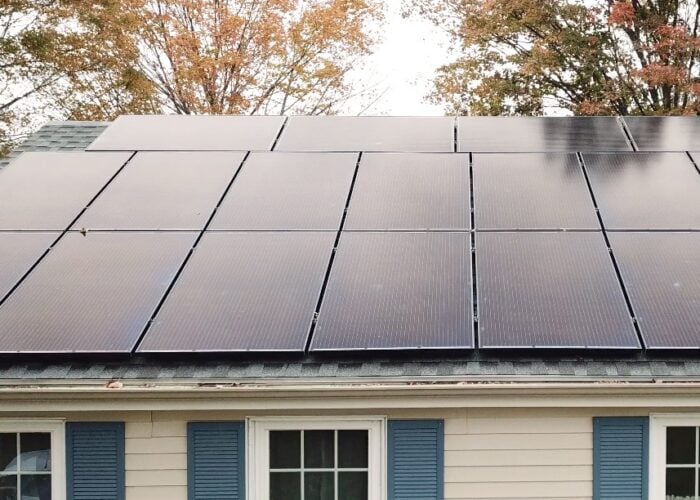
A waste law bringing PV modules that are made or sold in Germany under mandatory producer responsibility rules came into force on 24 October.
Under the new Waste Electronics and Electrical Equipment (WEEE) legislation, known as ElektroG, PV modules are classified as household equipment. Therefore, producers of PV modules must provide a legally binding financial guarantee on their annual sales of PV modules in the country.
Try Premium for just $1
- Full premium access for the first month at only $1
- Converts to an annual rate after 30 days unless cancelled
- Cancel anytime during the trial period
Premium Benefits
- Expert industry analysis and interviews
- Digital access to PV Tech Power journal
- Exclusive event discounts
Or get the full Premium subscription right away
Or continue reading this article for free
Meanwhile ElektroG also mandates producers to finance the collection of their end-of-life modules from municipal collection points. Collection can be performed by a municipal waste-collection network, a subcontracted industry scheme or the producer directly.
The law applies to Germany-based companies, which manufacture or import PV modules for the German market.
The official producer register Stiftung ElektroAltGeräte (EAR) coordinates communication between the municipal waste network and the producers. EAR is also responsible for issuing mandatory Producer Identification Numbers, which gives permission for firms to market PV modules in Germany. Firms must now have an EAR-accredited financial guarantee before being given a Producer Number.
There may be limitations to disposing of waste modules at municipal collection points. In such cases, the waste can be managed by an industry-led compliance and waste management scheme.
Ullrich Didszun, country manager for PV CYCLE Germany, which is a collective compliance and waste management scheme for WEEE and battery products, focusing on solar equipment, said: “A dedicated, industry-focused scheme has the relevant market and product knowledge to collect PV modules where they arise as waste, recycle them with the priorities of its members in mind and educate the right people along the value chain. This allows us to bring cost down, while maintaining our high environmental standards”.
PV Cycle’s take-back and recycling service has already treated more than 7,000 tonnes of end-of-life modules.
In a blog for PV Tech in September Pia Alina Lange, head of public affairs at PV CYCLE, said that measuring compliance with WEEE regulations is crucial for allowing a level playing field in the PV industry where compliant companies do not have to pay for their free-rider peers.
She added: “Free-riders bring a tremendous disadvantage to compliant companies, especially in countries where PV modules are classified as household products, such as France, the United Kingdom, the Netherlands or Germany under its imminent new law.”
At the time, Jan Clyncke managing director of PV CYCLE, said: “Those who are compliant pay double the bill. Companies pay for their WEEE-compliance and waste operations but they may also end up carrying the burden of poorly pre-financed waste at municipal collection points. If the pre-financing through compliant companies does not match the actual market volumes, non-compliance is a clear game-changer.”
The European Waste Electrical and Electronic Equipment Directive (WEEE) came into force on 14 February 2014, mandating PV companies to ensure the collection and recycling of their discarded end-of-life products and to guarantee the financial future of their PV waste management.
Meanwhile, in June PV Tech reported that Japan will soon begin implementing recycling rules for solar modules, having recognised that the vast growth in solar deployment under the feed-in tariff (FiT) could lead to an accumulation of PV waste in landfills.