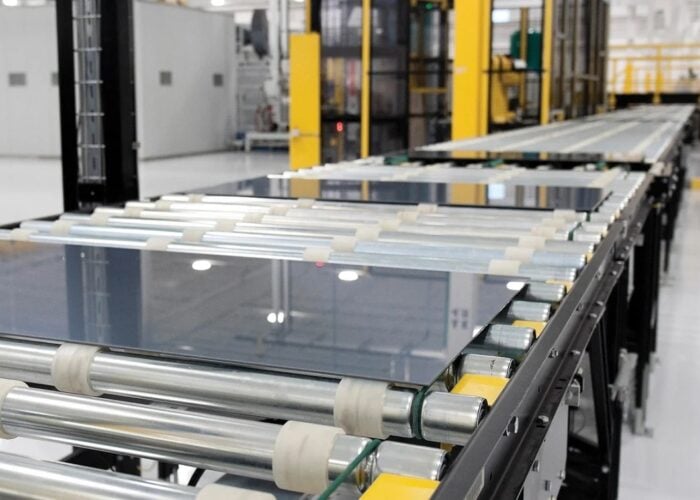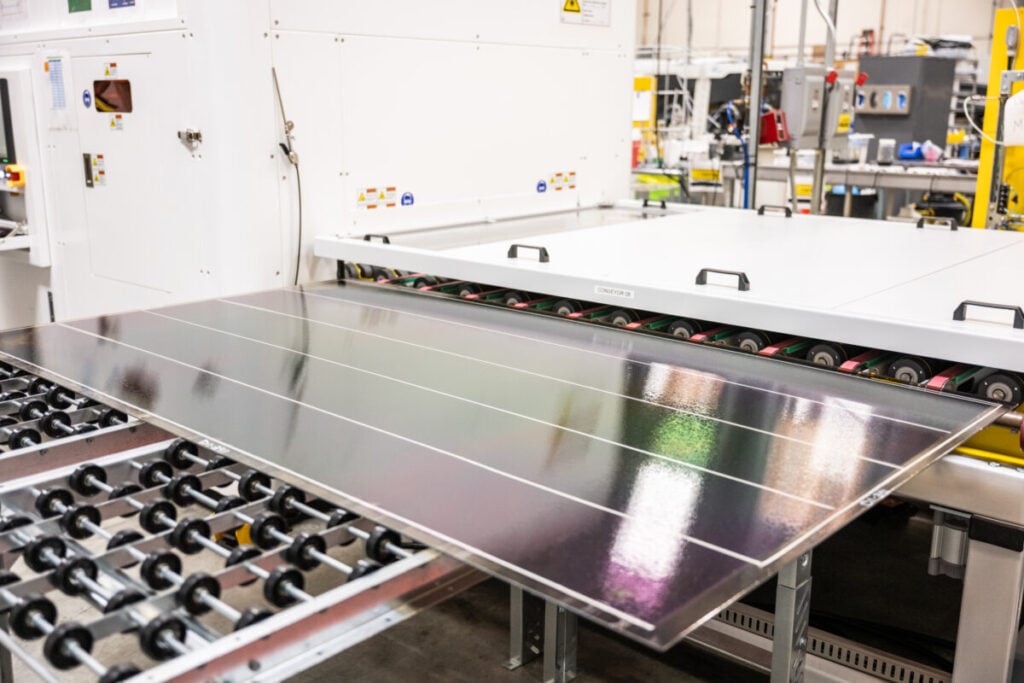
US perovskite glass manufacturer Caelux has completed the first order of its ‘Active Glass’ technology, which will be paired with a silicon solar module developed by a “reputable silicon solar manufacturer”.
Caelux’s Active Glass is built with perovskites, and then applied to conventional solar cells, as a means to integrate perovskites into solar projects without having to integrate them into the design of the cell from scratch. This combination of perovskite-enhanced glass and a silicon solar cell creates what Caelux calls a ‘Hybrid Tandem’ module, and the first commercial shipment of its technology is an important milestone for the company as it looks to transition to large-scale implementation of the concept.
Try Premium for just $1
- Full premium access for the first month at only $1
- Converts to an annual rate after 30 days unless cancelled
- Cancel anytime during the trial period
Premium Benefits
- Expert industry analysis and interviews
- Digital access to PV Tech Power journal
- Exclusive event discounts
Or get the full Premium subscription right away
Or continue reading this article for free
“Our technology offers a step-function advancement for solar, and this shipment is the beginning of many more improvements to come,” said Caelux CEO Scott Graybeal. “We’re energised to be moving the industry forward with our technology.”
While Caelux did not provide details on the recipient of its technology, it notes that the integration of perovskite glass into solar modules could improve a module’s power density by 30% and lower project costs by 20%. The use of perovskites on a module’s glass, rather than its cell, also sidesteps the limitation that has been historically associated with perovskite solar cells, that they have a shorter lifespan than their silicon counterparts.
Graybeal has already spoken to PV Tech Premium about the technology, and how it addresses other “pitfalls” in other forms of perovskite product design, such as the use of two terminals in a cell that “limit the absolute theoretical limit [of efficiency]”.
However, Radovan Kopecek, co-founder of ISC Konstanz, told PV Tech Premium that the confidence of “perovskite populists” who advocate for the deployment of the as-yet unproven technology to reach the world’s solar deployment goals is unwise, likening it to thin-film technology, which he said has a part to play in the global solar industry, but would not be its cornerstone.
“I am quite sure that perovskite will not drive our energy transition,” Kopecek said. “You know that [perovskites] will be out there, and they will be used for different applications, but they will still remain, as thin film always was, in a niche market.”
This uncertainty has not dissuaded interest in the perovskite space. Last month, researchers at the Solar Energy Research Institute of Singapore (SERIS) developed a perovskite-organic tandem solar cell with a record conversion efficiency of 26.4%, and several industry leaders told PV Tech Premium at this year’s SNEC conference in China that they are increasingly convinced of the potential of perovskites for the long-term future of the solar industry.