In case you’ve missed it – and jealousy abounds if you have – it’s political party conference season in the UK. Because if there’s one thing this country hasn’t had enough of over the past year, it’s politics.
For the uninitiated or readers outside of the UK, late September and early October usually sees parliament prorogued for political machinations the country’s political parties to gather and settle their agendas for the forthcoming year. The Conservatives, Labour and Liberal Democrats have all now taken to the stage, with clean energy playing a pivotal role.
Try Premium for just $1
- Full premium access for the first month at only $1
- Converts to an annual rate after 30 days unless cancelled
- Cancel anytime during the trial period
Premium Benefits
- Expert industry analysis and interviews
- Digital access to PV Tech Power journal
- Exclusive event discounts
Or get the full Premium subscription right away
Or continue reading this article for free
First up were the Liberal Democrats, whose conference was in Bournemouth this year. Climate has long been a strong consideration within Lib Dem policy making and this year is no different, even if the party is going for a distinctly vintage feel this year.
Having lost out to Jo Swinson for the leadership, Sir Ed Davey is the party’s shadow energy minister a little over four years after he last served as the country’s energy secretary as part of the Tory/Lib Dem coalition government. So it’s of little surprise then that the Lib Dems are inclined to reinstate a specific department for climate change. Perhaps Ed feels there’s some unfinished business there.
The Lib Dems, whose membership play a central, voting role in policy making, have also endorsed a more ambitious net zero policy than the status quo. The party passed a motion to bring the date forward to 2045 “at the latest”, with interim targets for a 75% reduction by 2030 and 93% by 2040.
But that target is, in effect, only the tip of an ever-decreasing iceberg. The party goes into real detail within its motion, which can be seen in full here. Its power proposals are specific and progressive, perhaps the most complete of all three major parties. It calls for 80% of electricity generation to derive from renewables sources by 2030, a commitment to develop smart grids, energy storage and interconnectors, a requirement for all new homes to be fitted with solar panels and a ban on the sale of ICE vehicles to come into effect in 2030.
The ambition and detail underpinning the Lib Dem climate strategy is unquestionably promising amidst the dearth elsewhere, but it shouldn’t be surprising. Under the Clegg/Cameron coalition, the Department of Energy and Climate Change was very much Lib Dem territory and decisions made with Davey at the helm paved the way for much of the renewables deployment seen today.
Labour, meanwhile, proposed to take things further. Huge investments in offshore wind and electric vehicle infrastructure aside, the most eye-catching development from Labour’s conference in Brighton was the approval of a net zero by 2030 target.
At some 20 years ahead of the status quo, it’s difficult to overstate the level of ambition here. The Committee on Climate Change’s advice to government has been that even the 2050 target it proposed is futile without significant policy overhaul. To bring that forward by 20 years would require comprehensive behavioural and societal change, the likes of which is almost entirely unprecedented. To not then substantiate that target with a clear and precise raft of policies – chucking in a load more offshore wind farms, investing in EV charging infrastructure and establishing some car sharing hubs does not a complete environmental policy suite make – is foolhardy at best, and disingenuous at worst.
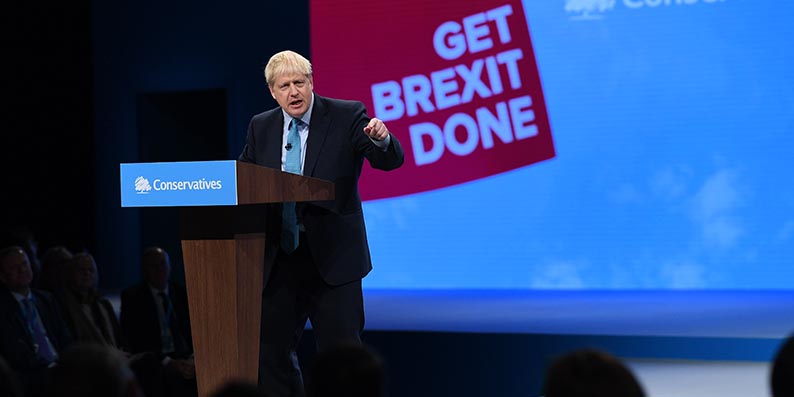
Speaking of foolhardy and disingenuous, Boris Johnson took to the stage just over a week later in typically bombastic fashion.
For their part, the Conservatives had spent much of the week saying how imperative it was they “Get Brexit Done”. What little attention the government did grant to climate issues was mired in catch phrases like “21st Century Conservativism” and was, simply, lacking in any meaningful detail.

£1 billion in R&D funding was pledged for the automotive sector to pursue “green growth”, aimed specifically at battery manufacturing and other parts for electric vehicles. That’s all well and good, but I think I’m correct in suggesting that the UK’s domestic automotive sector has more prescient business decisions to make at this moment in time, and £1 billion for R&D barely constitutes a gentle nudge compared to the almighty kick up the arse transport needs when it comes to decarbonisation. Ofgem yesterday revealed transport emissions have fallen just 2% between 2010 and 2018.
A Future Homes Standard is, again, to be welcomed. Reducing emissions from new-build homes by 31% by 2025, as the government’s preferred option suggests, is not to be sniffed at. But the policy itself barely scratches the sides when it comes to the kind of overhaul the built environment needs if the UK is to stand any chance of attaining net zero status by 2050. It’s almost as if, in desperate need of something that wasn’t Brexit, the Conservatives had a dig behind the sofa and found Labour’s Zero Carbon Homes policy from 2006, which George Osborne axed in 2015, but thought even that was too radical for its audience these days so watered it down.
Fear not, climate conscious, because here’s Boris Johnson, doubling down on the Conservatives’ commitment to climate issues during his leader’s speech on Wednesday afternoon. Just like we’re expected to believe in Britain to get Brexit done, we should trust the party’s record on environmental issues and believe that the net zero target is achievable. “We can beat the sceptics,” Johnson said. Penny for the thoughts of the PM’s illustrious Leader of the House of Commons at the moment, considering how Rees-Mogg has continually conveyed some pretty frank climate scepticism.
Then there’s Johnson’s pledge that a battery ‘gigafactory’ will be built on these shores. For those who thought that the Bridge to Ireland was the PM’s “jumping the shark” moment when it came to fanciful infrastructure should look away. The notion that a private company would invest billions into building a battery factory with gigawatts of capacity in a nation whose trading arrangements are anything but certain is, frankly, ludicrous.
But it wasn’t even the most fanciful energy-related pledge from the Conservatives this party conference season. That award goes to whoever considered that £200 million would be enough to stimulate the development of a fully-functional fusion plant in the UK by 2040. That, as others have suggested, is just pure fantasy.
And, after that, conference season was over. Politicians packed up and returned to Westminster after a brief and legally-curtailed respite. Back to Getting Brexit Done, and not much else, for the government.
If there’s anything to draw from party conference season this year, it’s that the full gravity of the situation – across so, so many points – has yet to dawn on the Prime Minister. The net zero target, amongst Theresa May’s last acts in office, now counts among the many albatrosses swinging from Boris’ brass neck. Policy direction needs to be much sharper, much more detailed and considerably more ambitious if it is to get anywhere near the level the CCC has previously asked for.
From the last two weeks, however, there’s little evidence that anything past 31 October 2019 is on the government’s calendar.
See here to read the story as originally published on sister title Current±