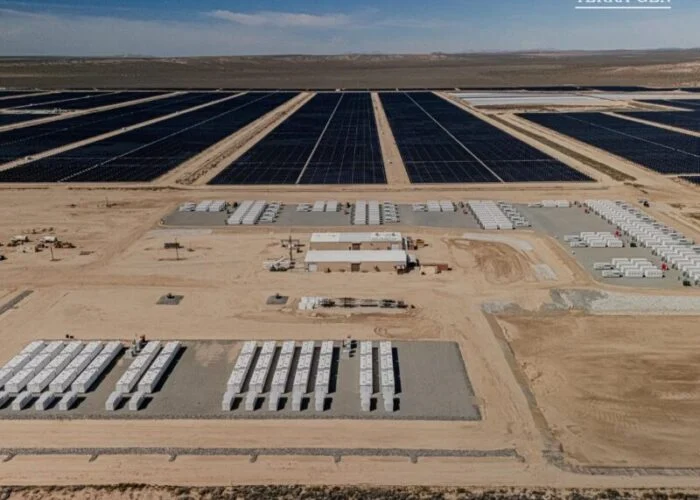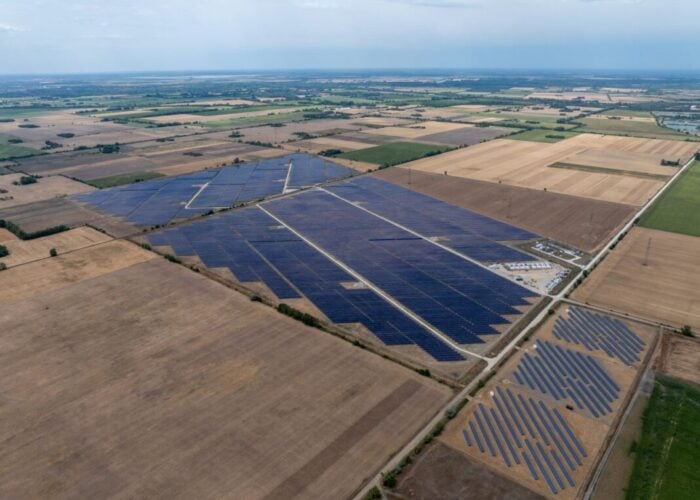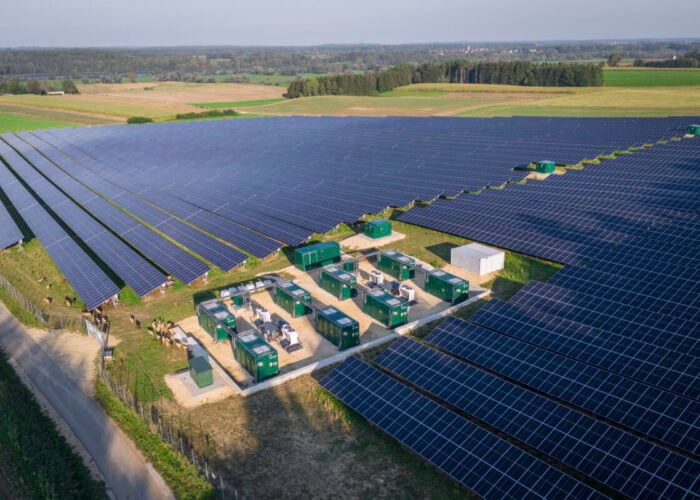
Growing hybridisation and co-location of renewable power projects and storage facilities are a key means to strengthen revenue in Europe’s power sector, according to speakers at Solar Media’s Solar Finance & Investment Europe event.
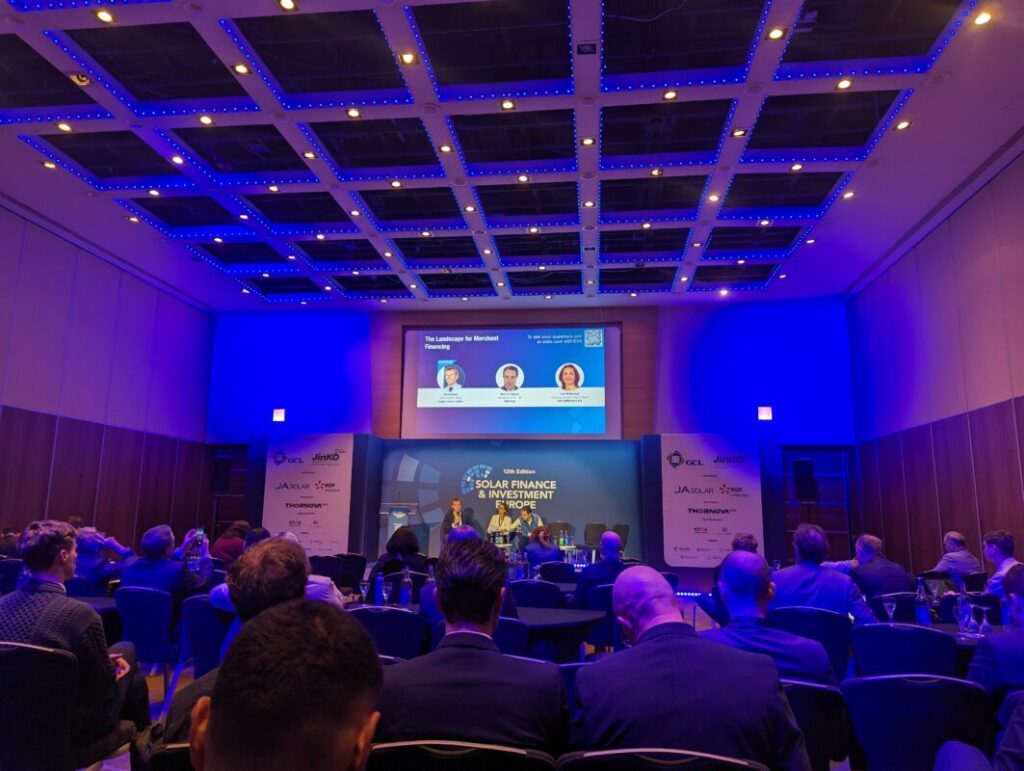
Speaking on a panel about merchant financing risks and opportunities in Europe in London this afternoon, Lisa McDermott, managing director of project finance at ABN AMRO Bank, said that the bank is financing an increasing volume of merchant risk but that hybrid portfolios and ones that incorporate storage are more attractive investment destinations.
Try Premium for just $1
- Full premium access for the first month at only $1
- Converts to an annual rate after 30 days unless cancelled
- Cancel anytime during the trial period
Premium Benefits
- Expert industry analysis and interviews
- Digital access to PV Tech Power journal
- Exclusive event discounts
Or get the full Premium subscription right away
Or continue reading this article for free
“If we’re doing merchant, we’ll do a more diverse portfolio,” said McDermott. “We’re seeing two things in the market. Some parties are putting the blinkers on and [using] the same tactics. But others are smarter; they’re working on their business case, they’re working on stabilising that revenue line and one method is hybridisation and co-location.”
Investing in more diverse projects can help minimise some of the merchant risk involved in these projects, according to panellist Ricardo Folgado, managing partner for the UK at TagEnergy.
“We can take some merchant risk, so it’s not something we’re afraid of, as it gives us a lot of flexibility,” said Folgado. “The reason we’re comfortable with merchant is because we take a lot of everything … we have the flexibility to take investment decisions with a high degree of merchant risk, but we want to be comfortable with short-term financing, long-term financing, price volatility and cannibalisation.”
“All of this leads to energy management sophistication,” Folgado continued. “This all leads to developing a project that is attractive … and not worrying about financing for 20 years. Increasingly, people need to be aware of power and risk … it’s becoming a very complex [and] sophisticated market.
Sharing risk
Another topic of discussion was the potential for sharing risk in merchant agreements. McDermott said that ABN AMRO had completed a “deep dive” on merchant investment and risk in the fourth quarter of 2024, and one of the conclusions from this research was the presence of significant potential in power price agreements (PPAs) where risk is shared.
“We’re really pushing sponsors to negotiate PPAs where negative price risk is being shared,” said McDermott. “The last two or three years, it was all being taken by projects, so in zero or negative price hours, the PPA would switch off for these, often, big tech PPAs.
“We have engaged with a provider who’s done a bit of analysis in Spain, and they think that 20% of the volumes of solar will see zero or negative prices. By any account, that’s a significant amount of cannibalisation on your PPA, and that’s an issue for merchant revenue.”
McDermott’s comments follow earlier discussions at the event, which highlighted the need for investors to recalibrate their risk appetite amid a more volatile financial framework for Europe as a whole.
“There’s a lot of volatility in the market, [but] volatility can be a good thing; we finance on volatility,” said McDermott. “We’ve seen significant moves [in solar] over the last year, so I’m going to say ‘approach with caution’; we look really carefully at the business case: how much storage is on the system, [renewable] penetration [and] how the PPA or subsidy performs.”
Solar Media is hosting its annual Solar Finance & Investment Europe event in London on 4 – 5 February 2025. This event annually attracts infrastructure funds, institutional investors, asset managers, banks and development platforms at the forefront of European renewables; the vast majority of which are responsible for billions in active and prospective investments in the Europe’s energy transition. For more details, visit the website.