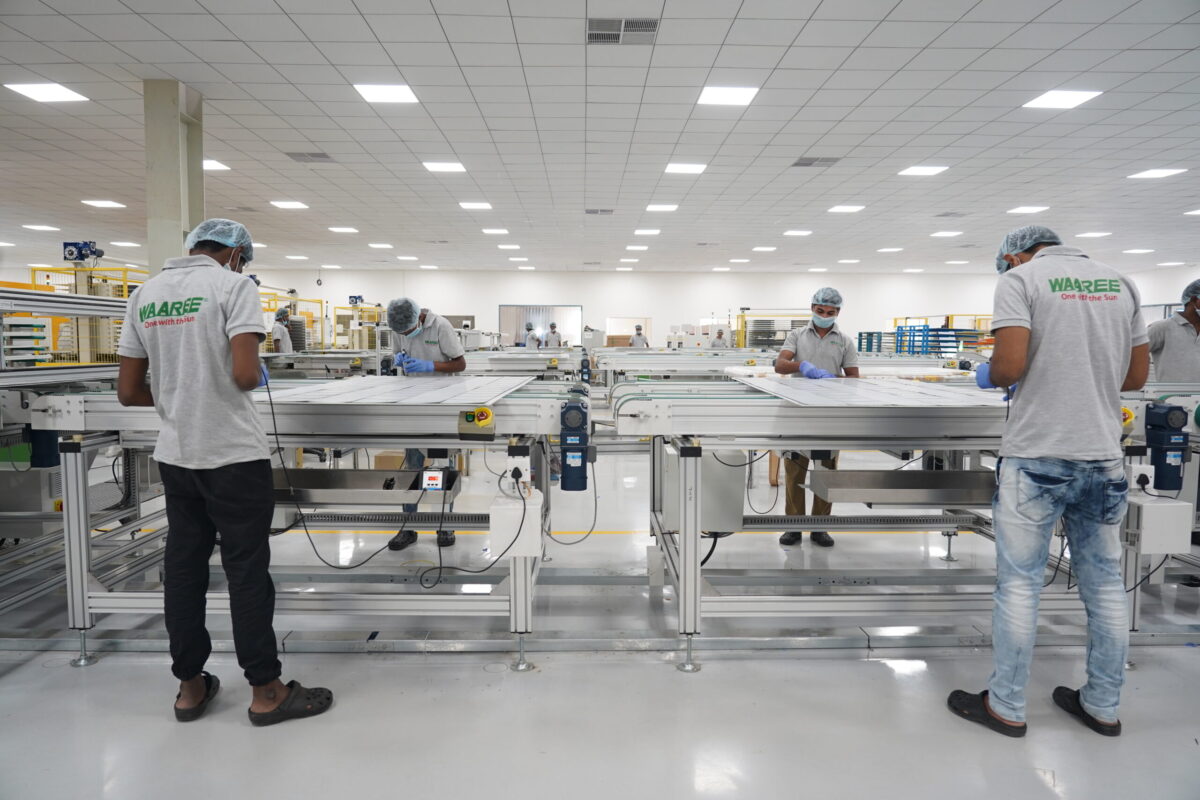
Indian PV producers have endorsed new measures in the country’s latest budget aimed at supporting domestic solar and clean energy manufacturing.
India’s Union Budget 2026-27, announced late last week, signalled continued government backing for renewables, energy storage and low-carbon technologies through customs duty exemptions, manufacturing incentives and infrastructure investment.
Try Premium for just $1
- Full premium access for the first month at only $1
- Converts to an annual rate after 30 days unless cancelled
- Cancel anytime during the trial period
Premium Benefits
- Expert industry analysis and interviews
- Digital access to PV Tech Power journal
- Exclusive event discounts
Or get the full Premium subscription right away
Or continue reading this article for free
Presenting her ninth budget in Parliament, Indian finance minister Nirmala Sitharaman set out several fiscal measures aimed at scaling renewable energy, energy storage, nuclear power and emerging technologies, aligning with the government’s ambition of advancing India under its “Viksit Bharat” ideology.
The Budget introduced a series of customs duty exemptions designed to boost domestic manufacturing across the clean-energy value chain. Duty exemptions on capital goods used for manufacturing lithium-ion cells have been extended to cover Battery Energy Storage Systems (BESS), a move expected to encourage large-scale grid storage manufacturing in India.
Further measures include an exemption from Basic Customs Duty (BCD) on sodium antimonate, a key raw material used in solar glass production, which is expected to lower input costs for domestic solar manufacturers. BCD exemptions have also been extended to capital goods used in the processing of critical minerals such as lithium, cobalt and rare earths, supporting domestic refining capacity for clean-energy technologies including EVs and wind turbines.
Another headline energy-sector announcement was the launch of a INR200 billion (US$2.3 billion) scheme for Carbon Capture, Utilisation and Storage (CCUS). The programme is intended to address emissions from hard-to-abate industrial sectors, enabling continued economic growth while supporting India’s climate commitments.
For firm low-carbon power generation, the Budget extended BCD exemptions on nuclear power project imports until 2035 and expanded the scope to cover all nuclear plants regardless of capacity. In addition, biogas has been fully excluded from central excise duty when blended with CNG, supporting waste-to-energy projects and lower transport emissions.
Industry stakeholders broadly welcomed the measures, particularly the emphasis on long-term policy visibility and domestic manufacturing. Prashant Mathur, CEO of solar manufacturer Saatvik Green Energy, said the Budget “sends a strong and well-balanced signal for India’s clean-energy manufacturing ecosystem. For manufacturers like us, this clarity is a green light to scale to multi-GW capacities, invest in deep backward integration, and position India as a credible China+1 alternative and a globally competitive, export-ready clean-energy manufacturing hub.”
“The extension of customs duty exemptions for lithium-ion cell manufacturing to battery energy storage systems directly strengthens both energy transition and energy security,” Mathur said, adding that exemptions on inputs such as sodium antimonate would improve cost competitiveness for domestic solar manufacturing.
Manufacturers also highlighted the importance of policy continuity. DV Manjunatha, founder, Emmvee Photovoltaic Power Limited, said the Budget reinforced “policy stability for renewable energy and manufacturing”, with the focus shifting “from incentives to execution, scale and quality”.
The Budget also included institutional reforms, with plans to restructure Power Finance Corporation (PFC) and Rural Electrification Corporation (REC) to improve financing capacity for large-scale power and renewable projects. Additional investments in logistics infrastructure, including Dedicated Freight Corridors and National Waterways, are expected to reduce costs for transporting energy equipment and materials.
Overall, the government said the Budget balances fiscal discipline with targeted capital deployment, supporting India’s ambition to sustain economic growth of around 7% while strengthening energy independence and environmental performance.