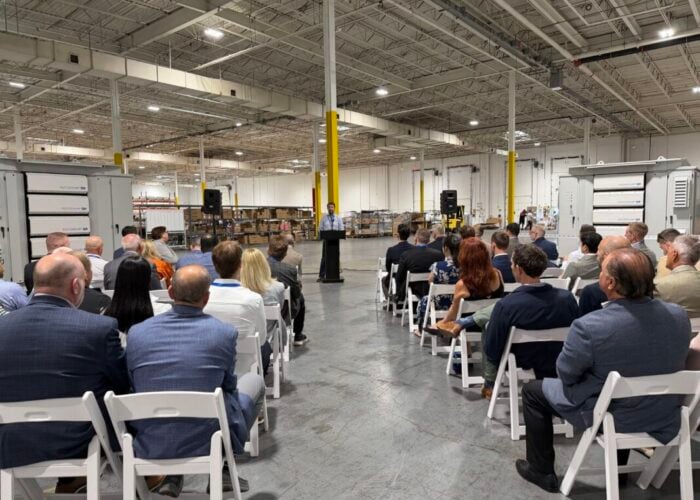
After a slow start, this year’s PV Industry Forum, the traditional opening conference of Intersolar Week in Munich, finally got going during the last session of the day with a resounding call to action from none other than Q-Cells’ boss, Anton Milner (pictured at left).
The conference opened with the usual slides and the usual suspects giving their views of the overall solar market. The obligatory emerging market was given lip service–this time it was India–while the rest of the presentations mostly failed to engage the audience in a meaningful way.
Try Premium for just $1
- Full premium access for the first month at only $1
- Converts to an annual rate after 30 days unless cancelled
- Cancel anytime during the trial period
Premium Benefits
- Expert industry analysis and interviews
- Digital access to PV Tech Power journal
- Exclusive event discounts
Or get the full Premium subscription right away
Or continue reading this article for free
Things changed during the afternoon, as Greentech Media analyst, Shyam Mehta, offered up a refreshingly realistic view for an as-yet-realised America where grid parity is no longer a pipe dream. Also on the same panel, looking at grid parity, was Milner (Q-Cells) and Eddy Blokken (PV Group), who both admirably tried to live up to the panel’s theme of grid parity.
It became clear however that each had his own agenda on the podium. First, Blokken discussed the economic and material benefits of standardisation, a subject near and dear to his heart, since he is leading the task force to implement manufacturing standards on behalf of the PV Group, a subset of SEMI. Despite the obvious agenda, his presentation was filled with practical ways for the PV industry to save “up to 15% of costs” through standardising certain manufacturing and installation practices.
But the highlight of the opening day was Anton’s speech, which looked at the EU reaching 12% of its total energy generation with solar power by 2020. He is perhaps uniquely appropriate to address this topic, since he runs the largest cell manufacturer in the world and is vice president of EPIA.
Highlights of Milner’s presentation included his prediction of €2-per-watt total system cost by 2013-14 in Germany. He also sees a significant parallel between the current US market and the German market in 2002. As a result, he believes that the nearly 50% cost portion of BOS components in the US will come down in the next few years to 25%, which is in line with German installations.
He also issued a resounding call to all politicians to effect “disruptive policy change” to drive solar to its 12% target in the EU by 2020. Interestingly, Anton does not see this shift in political direction arising from economic imperatives, which he says we have already achieved in many markets, but rather from climate change initiatives built into regulatory reform.
He also reiterated, brandishing an AT Kearney report, that Italy’s residential market has achieved grid parity, while Germany residential market should get there by 2012.
The session ended with an all-in discussion of a what-if scenario of the world having achieved grid parity. What happens to the supply chain? What happens to the solar companies? Where is the profit coming from?
None of the panelists were moved to contribute new information during this question time, leaving the session ending on a somewhat sombre note as the initial excitement of Anton’s powerful speech waned in the room.