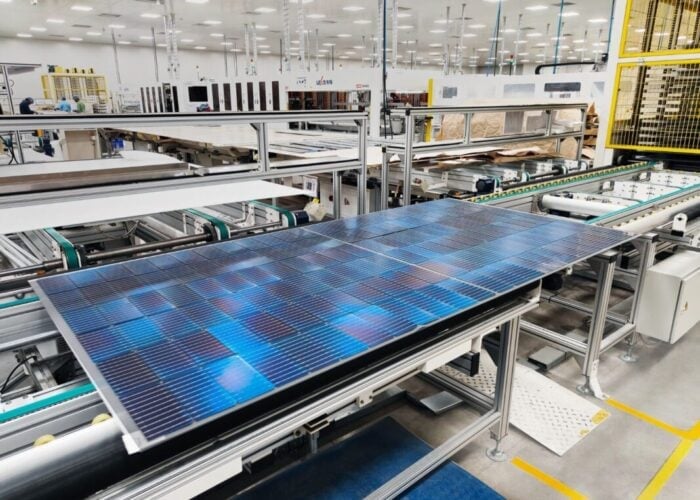
Vietnam is the cheapest country to produce fully domestic solar modules outside of China, according to a report from the International Renewable Energy Agency (IRENA).
Producing tunnel oxide passivated (TOPCon) solar PV modules in Vietnam using domestically produced polysilicon, ingots, wafers and cells is equivalent in price to a Chinese-made module, IRENA’s Solar PV Supply Chain Cost Tool shows. An all-domestic module in Vietnam costs US$0.18/Wp, which compares with US$0.191/Wp in India, US$0.256/Wp in Australia and US$0.284/Wp in Germany.
Try Premium for just $1
- Full premium access for the first month at only $1
- Converts to an annual rate after 30 days unless cancelled
- Cancel anytime during the trial period
Premium Benefits
- Expert industry analysis and interviews
- Digital access to PV Tech Power journal
- Exclusive event discounts
Or get the full Premium subscription right away
Or continue reading this article for free
The report said that the cost of raw materials in the US sits between Australia and Germany, though it did not provide a precise domestic module cost, potentially because the capability is currently lacking in the US.
IRENA said the main drivers of module manufacturing cost are electricity prices and labour. This is the primary reason that Vietnam and other Asian countries offer lower production costs. In contrast, Germany’s higher manufacturing cost is driven almost entirely by electricity expenses, the report said, which are particularly costly in energy-intensive polysilicon production
In all regions profiled, solar cells, wafers and polysilicon comprise the largest portion of module production cost. But the cost of manufacturing falls everywhere when imported Chinese products are introduced, IRENA’s report shows.
In Vietnam, module production costs fall by 7% when importing Chinese polysilicon, around 19% when importing Chinese wafers and up to 31% when importing Chinese cells. This in turn increases the portion of cost that comes from “other materials”, overheads and increases proportional profits.
“Our analysis of the total module costs reveals that the overall price is highly dependent on the stage at which components are imported versus domestically manufactured,” the report said.
It continued: “Domestic manufacturing in most cases demonstrates higher costs, particularly when compared with importing components from lower-cost markets. The biggest cost reduction is observed when importing solar cells for local PV assembly, highlighting the current price advantages of established manufacturing centres.”
A ‘problematic relationship’: demand vs. sustainability
These dynamics show the outsized influence of Chinese solar products on the global industry, IRENA’s report suggests.
“While low-cost imports from China enabled a rapid solar deployment by making PV systems more affordable for installers and end users, these prices are significantly lower than what is required to maintain sustainable production levels,” it said. “Financial data from major manufacturers confirm that current price levels are below production costs, leading to financial strain across the value chain.”
Even amid political and industry efforts to consolidate upstream production levels and control price competition, Chinese solar manufacturers are struggling to maintain their bottom lines (subscription required). Simultaneously, IRENA’s data shows the extent to which established Chinese producers can have profound impacts on the viability of manufacturing in other regions, with prices “highly dependent” on the level of imported Chinese products. In Vietnam, where prices are comparable with China, many manufacturers are Chinese owned or operated.
“Without some corrective action, there is a risk of deepening market distortions within the solar industry,” the report said.
It recommended that governments adopt “hybrid strategies” combining supportive measures for domestic production and strategic importing of upstream components. It gave examples of lowering electricity prices for energy-intensive upstream manufacturing with preferential tariffs or incentives for onsite renewables, manufacturing certifications and incentives like India’s Production-Linked Incentive (PLI) programme and long-term strategy to focus on future or emerging technologies and R&D efforts.
The report concluded: “Countries can adopt hybrid strategies that combine importing of key upstream components (such as wafers or cells) with a focus on domestic assembly and module manufacturing. This approach helps balance cost competitiveness, job creation and ensure some level of security, especially where full domestic production remains uncompetitive.”