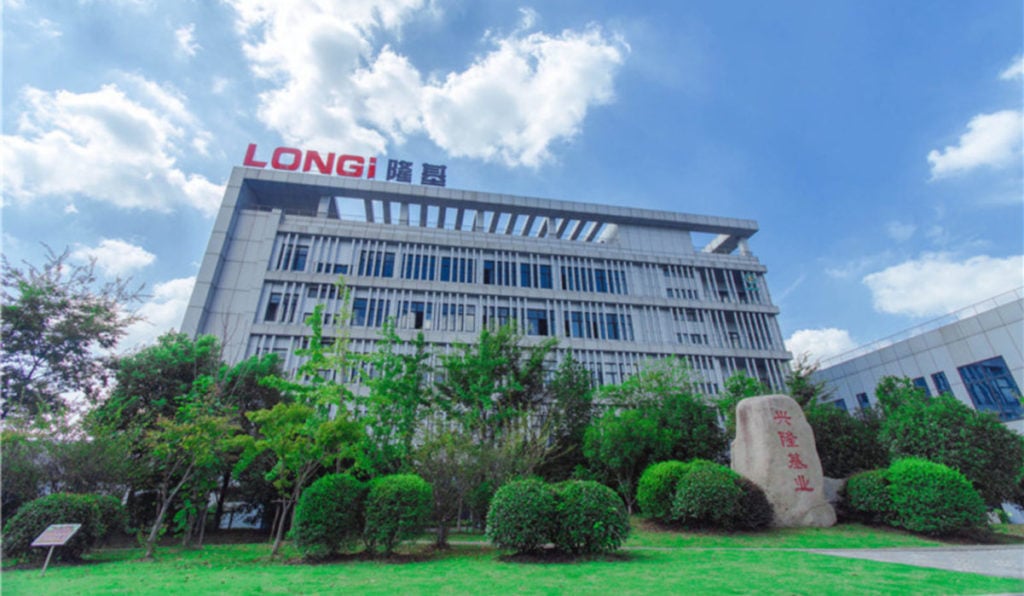
Major Chinese solar manufacturer LONGi has called on the Chinese government to introduce new bidding rules to crack down on low prices and ensure the sustainable development of the renewables industry in China.
In an interview with Shanghai Securities News, LONGi’s chairman, Zhong Baoshen, said prices were often the sole criteria in the bidding process for solar PV components. To win the bid, some solar PV manufacturers offered a price much lower than the cost of solar PV components.
Try Premium for just $1
- Full premium access for the first month at only $1
- Converts to an annual rate after 30 days unless cancelled
- Cancel anytime during the trial period
Premium Benefits
- Expert industry analysis and interviews
- Digital access to PV Tech Power journal
- Exclusive event discounts
Or get the full Premium subscription right away
Or continue reading this article for free
After winning the bid, these manufacturers lowered the costs of procuring materials and production to compensate for the losses, resulting in lowered product quality. Therefore, these manufacturers could not guarantee the safety, reliability, and efficient power generation performance of the solar PV components throughout their lifecycle, risking downstream solar PV power plants.
Zhong described the phenomenon of bidding prices lower than the costs of solar PV components as “unsustainable”.
“Unscrupulous solar manufacturers use low prices to get orders first. If they fail to deliver the products, they should be replaced by another company. However, in reality, these solar manufacturers will negotiate with buyers as it is very difficult for the buyers to admit that a wrong decision was made in the last tender,” Zhong said.
“As a result, responsible solar manufacturers cannot win the bids. Big companies are very distressed about this issue.”
Zhong suggested that the solar manufacturing industry in China should introduce a new bidding method. For example, buyers can use the average prices of the bids as criteria and eliminate the highest and lowest prices, which could encourage solar manufacturers not to submit bids with unreasonably low prices.

The Chinese government should also introduce regulations to ban submitting bids with prices lower than costs, while designated authoritative industry associations should also issue guidelines on a regular basis.
Moreover, Zhong further suggested that buyers of solar PV components should consider non-price factors in the bids, such as technological innovation, quality and reliability of solar PV products, as well as business competence.
Last year, PV Tech talked to Zhong about back-contact (BC) cells produced by LONGi based on n-type technology. In the interview, Zhong announced plans to invest RMB3.92 billion (US$536 million) in production.
Furthermore, in a recent blog post for PV Tech, Finlay Colville, head of research at Solar Media, wrote about the possible downturn the PV manufacturing industry will face in 2024, with module prices low due to an over-production and over-supply of modules to Europe and the US.